
Online vs Land-Based Gambling Law NZ
How New Zealand Separates Online and Land-Based Gambling
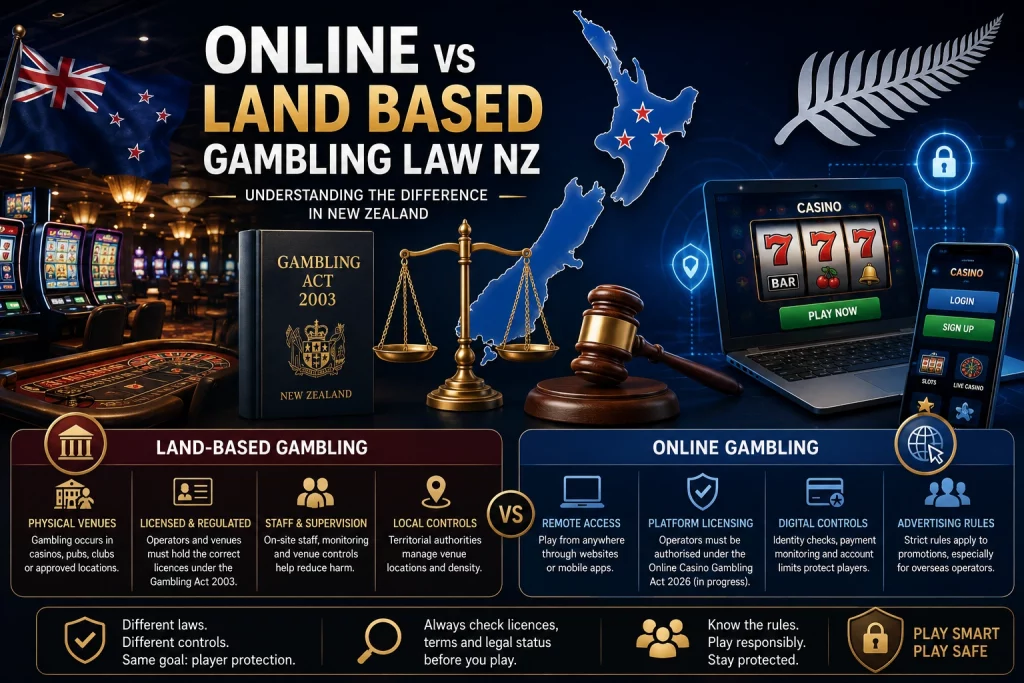
New Zealand gambling law does not treat online gambling and land-based gambling as the same legal category. Land-based gambling has long been controlled through the Gambling Act 2003, which divides gambling into classes and separates casino gambling from non-casino gambling. Online casino gambling now sits in a newer legal environment because the Department of Internal Affairs states that online casino gambling is regulated by the Online Casino Gambling Act 2026 and that implementation of the new law has started.
This distinction is the foundation of the topic. Land-based gambling usually involves physical venues, venue supervision, staff intervention, approved gaming areas, licence conditions, and direct regulatory inspection. Online gambling involves remote access, account-based participation, payment systems, identity checks, platform rules, data records, and digital harm-minimisation tools. The legal goals overlap, but the control methods are different.
For Casino Kingdom, the most useful way to explain the topic is to compare structure, not only terminology. A land-based casino, a Class 4 gaming-machine venue, a lottery, and an online casino product are not interchangeable. Each one is regulated by a different mix of law, licence type, venue control, operator responsibility, and harm-prevention duties.
The Gambling Act 2003 classifies gambling by money spent and risk of problem gambling. The Department of Internal Affairs explains that gambling classes range from Class 1, which represents low-stake and low-risk gambling, to Class 4, which represents high-risk and high-turnover gambling. Casino operations and lotteries run by the New Zealand Lotteries Commission are treated as separate classes under the Act.
This matters because land-based gambling law is not one single rule. Class 1 and Class 2 gambling can often operate without a licence when legal thresholds are respected. Class 3 gambling usually requires an operator licence. Class 4 gambling requires stronger controls because it involves gaming machines outside casinos. Casino gambling requires casino-specific operator and venue authority. Online casino gambling now requires attention to the 2026 online framework.
Why the Legal Difference Matters
The difference between online and land-based gambling law matters because the risks appear in different places. In a physical venue, the law can control the room, the machines, the staff, the signs, the entry points, and the player environment. In an online setting, the law must control the account, the platform, the payment path, the advertising channel, and the operator’s digital systems.
This difference affects how a reader should assess gambling information. A visible Login area or mobile App section does not prove that an online product fits New Zealand law. A physical venue with machines does not automatically prove lawful Class 4 operation either. Legal status depends on the correct authorisation, licence type, venue approval where relevant, and compliance with the rules attached to that category.
For land-based gambling, the reader should ask: what type of venue is involved, what licence applies, who operates the gambling, and whether the activity is connected with an approved location. For online gambling, the reader should ask: what jurisdiction applies, whether the operator is covered by the current New Zealand online framework, what advertising restrictions apply, and whether the platform has the required consumer-protection controls.
This is why the phrase “legal gambling in New Zealand” is incomplete without context. A low-value community raffle, a pub gaming-machine room, a licensed casino venue, a Lotto NZ product, and an online casino platform are all treated differently. The law does not only ask whether gambling happens. It asks how, where, by whom, under which authority, and with what safeguards.
Land-Based Gambling Under the Gambling Act 2003
Land-based gambling in New Zealand is primarily structured through the Gambling Act 2003. The Act defines different gambling classes and assigns different legal consequences to each. The lower classes cover lower-risk and lower-value gambling activity, while Class 4 covers gaming machines outside casinos. Casino gambling is treated separately from Class 1 to Class 4 gambling.
New Zealand Police summarises the basic lower-class structure by explaining that lotteries, prize competitions, games of chance, and instant games mostly fall into Classes 1–3, while gaming machines outside casinos fall into Class 4. Police also notes that Class 1 gambling has prizes and turnover not exceeding NZ$500 and does not need a licence, while Class 2 gambling has prizes exceeding NZ$500 but not exceeding NZ$5,000 and potential turnover exceeding NZ$500 but not exceeding NZ$25,000, with no licence needed.
This shows how land-based gambling regulation is built around scale and risk. Small local activity is not treated like high-turnover machine gambling. Larger prize activity is not treated like an informal low-value raffle. Gaming machines outside casinos are not treated like ordinary entertainment equipment. Casino gambling is not treated like pub gaming-machine gambling.
The Ministry of Health explains that the government restricts and controls gambling to prevent and minimise harm through the Gambling Act 2003. That purpose explains why land-based gambling law focuses strongly on controlled venues, approved operators, licence conditions, and harm-minimisation procedures.
Online Gambling and the 2026 Framework
Online gambling has a different legal history in New Zealand. DIA’s current gambling page states that it is legal for New Zealanders to gamble on offshore casino gambling websites, while online casinos based in New Zealand are illegal under the older position. The same page now states that online casino gambling is regulated by the Online Casino Gambling Act 2026 and that implementation of the new law has started.
This creates a major difference between online and land-based gambling law. Land-based casino gambling is connected with existing casino venue and operator licensing. Online casino gambling now needs to be understood through the newer online casino framework. A land-based casino licence does not automatically explain online casino permissions, and an offshore licence does not automatically equal New Zealand online authorisation.
For readers, this means online casino law should be treated as a separate subject. The fact that a site is accessible from New Zealand does not settle the legal question. The fact that an operator has a licence somewhere else also does not settle the New Zealand question. The correct issue is whether the operator and product are covered by the relevant law for New Zealand users and whether the activity is promoted lawfully.
The online framework also changes the compliance focus. Instead of relying on physical venue controls, online regulation must deal with account access, advertising, age and identity checks, transaction monitoring, game fairness, complaint processes, and digital responsible-gambling tools. That does not make online regulation lighter. It makes the control points different.
Main Comparison: Online vs Land-Based Gambling Law NZ
| Legal area | Land-based gambling | Online gambling | Reader takeaway |
| Core framework | Gambling Act 2003, gambling classes, casino licensing, venue controls | Online Casino Gambling Act 2026 for online casino regulation, alongside existing gambling rules | The legal framework changes depending on whether gambling happens physically or remotely |
| Control point | Venue, operator, staff, gaming area, machine location, licence conditions | Platform, account, operator, payment system, advertising, digital safeguards | Land-based law controls places; online law controls platforms and accounts |
| Licensing focus | Class 3, Class 4, casino operator licence, casino venue licence, Lotto NZ framework | Online casino licensing under the 2026 framework where applicable | A licence must match the gambling format being offered |
| Player access | Physical entry into a venue or participation in a local activity | Remote access through a website, mobile platform, or digital account | Online access creates different age, identity, and payment checks |
| Harm controls | Staff supervision, venue exclusion, signage, machine controls, physical intervention | Account limits, self-exclusion tools, monitoring, payment controls, digital messaging | Same policy goal, different enforcement tools |
| Advertising risk | Local venue promotion and gambling-class rules | Greater sensitivity around overseas gambling promotion and remote inducement | Online content must be especially careful with promotion language |
| Legal misunderstanding | Assuming any machine or casino-style event is legally approved | Assuming accessibility equals local authorisation | Visibility does not prove legality in either environment |
Casino Venues vs Online Casino Platforms
A land-based casino venue is a regulated physical environment. It has premises, approved areas, operating conditions, staff, security, direct supervision, and licence documents. DIA states that under the Gambling Act 2003 no new casino venue licences will be issued, although existing casino venue licences may be renewed. This shows how tightly controlled the land-based casino sector is.
An online casino platform works differently. It does not control a physical gambling floor. Instead, it controls a digital product environment. The relevant questions are about account creation, player verification, platform integrity, payment handling, product scope, advertising rules, and licensing under the current online framework.
This difference matters when a website discusses casino-style content. A section about Slots or Games may describe gambling products, but the legal status depends on whether those products are inside a land-based casino, a Class 4 venue, an offshore online platform, or a licensed online casino framework. The same word can point to different legal realities.
A reader should therefore avoid assuming that a land-based casino and an online casino are simply two versions of the same legal permission. They are not. Land-based casino law is venue-centred. Online casino law is platform-centred. Both require control, but they control different operating environments.
Class 4 Gaming Machines vs Online Casino Games
Class 4 gambling usually refers to gaming machines outside casinos, often located in pubs and clubs. The Office of the Auditor-General’s glossary describes Class 4 gambling as gambling that applies or distributes net proceeds for authorised purposes, does not involve commission for conducting the gambling, satisfies relevant game rules, and uses or involves a gaming machine.
This is different from online casino games. Class 4 gaming machines are tied to venues, corporate societies, authorised purposes, and machine-specific regulation. Online casino games are tied to digital platforms, account systems, product approval, remote gambling rules, and the 2026 online framework.
This distinction matters because people often use the same casual terms for both environments. A machine in a pub, a game inside a casino venue, and an online casino product may all look like gambling entertainment, but their legal basis differs. The platform or venue determines the compliance route.
For Casino Kingdom, this section should make the comparison clear: land-based machine gambling is not the same as online casino gambling. It may involve similar themes or outcomes, but the legal controls are built around completely different operating models.
Advertising and User Pathways
Advertising is one of the biggest legal differences between online and land-based gambling. Land-based gambling promotion is connected with venues, approved activities, and local gambling rules. Online gambling promotion raises additional issues because it can reach users remotely and may involve overseas operators.
That is why internal wording should be controlled. A page may include references such as Bonus, Sign up, or FAQ as site navigation terms, but legal pages should not use them as pressure points. They should appear only as contextual internal anchors or information paths, not as inducements.
For a New Zealand legal page, the better editorial approach is to focus on law, licence categories, regulatory checks, player protection, and advertising limits. This keeps the page aligned with the subject: the difference between online and land-based gambling law.
Land-Based Gambling Is Built Around Physical Control
Land-based gambling law in New Zealand is built around physical control. The law can identify where gambling happens, who manages the venue, what machines or games are present, how people enter the gambling area, whether staff are trained, how gambling proceeds are handled, and whether harm-minimisation procedures are followed.
This makes land-based gambling more visible to regulators than online gambling. A casino venue, pub gaming-machine room, club gaming area, lottery event, or prize draw has a physical or organisational structure that can be inspected, audited, licensed, and supervised. The law can attach duties to the venue and to the operator separately.
Online gambling works differently because the venue is replaced by the platform. There may be no physical gaming room for a New Zealand player to enter. The control points shift from doors, staff, machines, and venue managers to accounts, identity checks, payments, digital records, and remote monitoring. This is why online gambling law needs different tools even when the policy goal remains similar.
For readers, this difference is practical. Land-based gambling should be assessed by asking whether the venue and operator are approved. Online gambling should be assessed by asking whether the platform and operator are authorised under the relevant online framework.
Casino Operator and Casino Venue Licences
Land-based casino gambling in New Zealand is controlled through casino-specific licensing. A casino is not simply a place where gambling happens. It is a regulated venue operated under specific legal permissions, licence conditions, and official supervision.
A casino operator licence focuses on the entity that conducts the casino business. It addresses who controls the operation, whether the operator is suitable, whether influential persons meet legal expectations, and whether the business can operate within licence conditions. A casino venue licence focuses on the physical premises where casino gambling is allowed to occur.
This separation is important. A legal casino structure must account for both the business and the location. The operator must be suitable, and the premises must be approved. The licence conditions then define how the operation may function in practice.
Online gambling does not use this same physical venue model. The online framework must evaluate remote platform operation, digital access, advertising, consumer safeguards, and account-based gambling. That is why a casino venue licence should not be treated as automatic permission for online casino products.
Land-Based Casino Law vs Online Casino Law
The key legal difference is that land-based casino law controls a fixed place, while online casino law controls a remote service. A land-based casino can be inspected as a physical environment. Regulators can assess entrances, gaming floors, staff conduct, machine locations, security procedures, and venue-based harm controls.
An online casino platform cannot be supervised in the same way. Instead, the law must assess systems: account creation, age verification, self-exclusion, deposit controls, complaint handling, advertising pathways, platform security, game fairness, and transaction records. These controls are less visible to the player, but they are central to online regulation.
This is why readers should not compare online and land-based gambling only by the game types offered. The legal comparison is about control architecture. Land-based gambling relies heavily on place-based oversight. Online gambling relies heavily on platform-based oversight.
For Casino Kingdom, the subject should be framed around that difference. The same gambling theme can sit under different rules depending on whether the player is standing inside a venue or accessing a product remotely.
Class 4 Gambling and Venue Licensing
Class 4 gambling is one of the most important land-based gambling categories in New Zealand. It usually refers to gaming machines outside casinos, often in pubs and clubs. This category is separate from casino gambling. A gaming-machine venue is not the same as a casino, even if some players casually describe both as gambling venues.
Class 4 gambling requires a stronger control model because gaming machines can generate high turnover and may create significant harm risk. The operator must be licensed, and the venue must also be licensed. This two-layer structure exists because both the organisation and the location affect compliance.
The operator controls the gambling operation, financial structure, proceeds distribution, and legal accountability. The venue controls the physical environment, access, supervision, staff response, and machine area. If either layer is weak, the gambling activity becomes harder to regulate.
This is different from online gambling, where the account and platform replace the machine room. Online regulation must answer different questions: who operates the platform, where the operator is licensed, how the account is verified, how payments are handled, and how harm tools work remotely.
| Control area | Land-based gambling | Online gambling | Why it matters |
| Physical environment | Venue, gaming room, casino floor, machine area, staff presence | No physical gambling room for remote users | Land-based regulation can inspect and control the gambling location directly |
| Operator responsibility | Casino operator, Class 4 corporate society, venue-linked organiser | Online operator and remote platform provider | The responsible legal entity must match the gambling format |
| Venue approval | Important for casino venues and Class 4 gaming-machine venues | Not venue-based in the same way | Online gambling shifts control from premises to platform systems |
| Access control | Door checks, staff supervision, restricted areas, signage | Account registration, verification, login controls, digital monitoring | The access method changes the compliance tools |
| Harm minimisation | Staff intervention, venue exclusion, visible behaviour monitoring | Self-exclusion tools, account limits, activity monitoring, payment controls | Both settings require safeguards, but the delivery method differs |
| Financial control | Cash handling, machine proceeds, banking, grant distribution | Payment processors, deposits, withdrawals, transaction records | Money movement is regulated differently in each environment |
| Advertising exposure | Venue promotion, local event promotion, visible premises | Digital ads, search traffic, social media, affiliate content | Online advertising can reach users more directly and repeatedly |
Territorial Authority Policies and Local Venue Control
Land-based gambling is also shaped by local policies. Territorial authorities can influence where Class 4 venues may be located and how venue numbers are managed in their communities. This adds another layer of control beyond the national licensing framework.
This local role matters because gambling harm can concentrate geographically. A high number of gaming-machine venues in one area may affect vulnerable communities more strongly than the same number spread across a wider region. Local venue policies help councils manage that risk through location and consent rules.
Online gambling does not work through the same local venue model. A digital platform can reach users across regions without being physically located in their community. That means local concentration is harder to manage through ordinary venue rules. Online regulation must instead rely on platform licensing, advertising restrictions, and digital harm controls.
For readers, this is one of the clearest differences between land-based and online gambling law. Land-based gambling can be restricted by where venues are allowed to operate. Online gambling must be restricted by who may provide the service and how the platform may interact with users.
Class 4 Proceeds and Community Benefit
Class 4 gambling is also tied to community benefit. Non-casino gaming-machine proceeds are not treated as ordinary private revenue. The legal framework requires net proceeds to be applied or distributed for authorised purposes. This makes Class 4 gambling different from a standard commercial casino model and different from online casino gambling.
This creates special duties around money handling. Machine profits must be banked and accounted for properly. Grant decisions must be made through the required structure. The operator must demonstrate that gambling proceeds are handled according to law.
Online casino gambling is different because it does not follow the Class 4 authorised-purpose model. Online operators are regulated through licence conditions, consumer safeguards, advertising rules, taxes or fees where applicable, and compliance obligations. The money-flow model is not the same as Class 4 community grant distribution.
For Casino Kingdom readers, this distinction prevents a common misunderstanding. A gaming machine in a pub is not just a land-based version of an online casino slot. It sits in a separate legal and financial structure, with different obligations and a different public-interest purpose.
Online vs Land-Based Gambling Control Points
Land-Based Harm Controls
Land-based gambling harm controls depend strongly on visibility. Staff can observe behaviour, identify distress, respond to requests for exclusion, and enforce venue rules. Signs, restricted areas, machine placement, security, and venue procedures all play a role.
This does not mean land-based gambling is automatically safer. It means the law has different tools. A person gambling in a venue can be seen by staff, but the environment may still create risk if staff are poorly trained or venue procedures are weak. That is why licensing and compliance matter.
In Class 4 venues, harm minimisation is especially important because gaming machines are accessible in ordinary community settings such as pubs and clubs. In casino venues, harm controls are tied to a dedicated gambling environment with specific licence conditions.
Online gambling requires a different approach. There may be no staff member watching the player’s behaviour in real time. Instead, the platform must rely on digital signals, account data, spending patterns, self-exclusion tools, identity checks, and automated intervention systems.
Online Harm Controls
Online harm controls focus on account-based monitoring. A platform can track deposits, play frequency, session length, payment patterns, and changes in user behaviour. Those controls can be powerful when implemented properly, but they require strong regulation and technical compliance.
The risk is that online gambling can become private and continuous. A person can access gambling from home, late at night, or on a mobile device without the natural interruption created by travelling to a venue. This is why online regulation places pressure on account limits, identity verification, self-exclusion, advertising standards, and payment controls.
For readers, the point is not that online gambling is always unlawful or always worse. The point is that it needs different legal controls. Venue rules cannot fully solve online risk. Digital safeguards must carry more responsibility.
This is why the online framework should be assessed separately from land-based law. The regulatory question is not only “is gambling allowed?” It is “what controls exist for this specific environment?”
Online Gambling Requires a Separate Legal Reading
Online gambling in New Zealand needs to be read separately from land-based gambling because the legal and technical structure is different. A player does not enter a casino building, pass through a physical access point, speak to venue staff, or sit inside a regulated gaming area. Instead, the player interacts with a remote platform through an account, payment method, device, and internet connection.
This changes the compliance model. In land-based gambling, regulators can inspect premises, check machine placement, review venue procedures, assess staff training, and examine cash-handling systems. In online gambling, regulators must look at platform architecture, account controls, user verification, payment monitoring, advertising routes, game fairness, complaint handling, and data records.
The Department of Internal Affairs states that online casino gambling is now regulated by the Online Casino Gambling Act 2026 and that implementation has started. That means online casino law is no longer only a side note to the Gambling Act 2003. It is becoming its own legal pathway with its own licensing and compliance logic.
For Casino Kingdom readers, this is the key distinction: a land-based gambling licence should not be assumed to cover online casino products, and an overseas online gambling licence should not be assumed to equal New Zealand authorisation. The licence must match the format, jurisdiction, operator, and product.
Offshore Online Gambling and New Zealand Players
Offshore online gambling has historically been one of the most misunderstood areas in New Zealand law. DIA explains that New Zealanders may access offshore casino gambling websites, while online casinos based in New Zealand have been illegal under the older position. With the Online Casino Gambling Act 2026 now being implemented, the local framework is changing, but readers still need to distinguish access from approval.
Access means a player can reach a site. Approval means an operator is authorised under the relevant New Zealand framework. Those are not the same thing. A website may be visible from New Zealand, accept traffic from New Zealand, or display New Zealand-related content without necessarily being licensed under the domestic online casino regime.
This is why offshore wording must be read carefully. A site may claim it is licensed internationally, regulated abroad, or trusted by global players. Those claims may be relevant to the operator’s overseas status, but they do not automatically answer the New Zealand legal question. The reader still needs to know whether the operator is covered by the current New Zealand online framework and whether its promotion to New Zealand users complies with local rules.
For content planning, this distinction affects how pages should discuss online gambling. A legal page should avoid implying that accessibility equals local approval. It should explain the difference between offshore access, offshore licensing, domestic licensing, advertising restrictions, and player protection.
Advertising Restrictions and Online Gambling Content
Advertising is one of the sharpest differences between online and land-based gambling law. Land-based gambling promotion is tied to venues, local visibility, physical access, and approved gambling categories. Online gambling promotion can reach people through search engines, social media, emails, push notifications, affiliate content, banners, and comparison pages. That wider reach creates more regulatory sensitivity.
DIA identifies advertising overseas gambling as a prohibited area under the Gambling Act framework. This matters for any site writing about online gambling in a New Zealand context. A page that explains the law is different from a page that pushes readers toward offshore operators. The difference can depend on wording, layout, calls to action, and whether the content is reasonably likely to encourage gambling with an overseas operator.
A legal-information page can discuss online gambling, explain operator categories, compare remote and physical regulation, and outline licence checks. It should not turn the legal discussion into an inducement. For example, mentioning internal navigation terms such as Bonus or Sign up should be handled as site structure, not as pressure language.
This is also relevant to affiliate-style content. A comparison table that explains legal differences can be informative. A comparison table that ranks offshore sites and directs New Zealand readers to use them may create a different regulatory impression. The purpose and presentation of the page matter.
Digital Account Controls
Online gambling law depends heavily on account controls. In a venue, access can be controlled at the door or inside a gaming area. Online, access starts with account creation and identity checks. This makes the user account one of the most important compliance points in online gambling.
An online gambling account can control age verification, identity confirmation, access restrictions, payment limits, communication preferences, exclusion tools, and transaction history. If those systems are weak, the operator may fail to manage risks that a land-based venue would normally address through staff and physical supervision.
This is why online platforms must be assessed by more than their design. A clean layout, simple Login flow, or fast account page does not show whether the platform has strong verification and harm controls. The deeper issue is how the system handles eligibility, identity, payments, exclusions, records, and responsible operation.
For readers, the practical question is not only whether an online site looks professional. It is whether the platform has regulatory backing and whether its account controls support legal and consumer-protection duties.
Payment Monitoring and Transaction Records
Payment monitoring is another major difference between online and land-based gambling. In land-based venues, money may move through cash, machine credits, tickets, venue banking, and operator accounts. In online gambling, transactions move through digital payment systems, card payments, e-wallets, bank transfers, or other remote methods.
This creates both opportunities and risks. Digital payments can leave clear records, which can support audits, dispute handling, and responsible-gambling monitoring. At the same time, remote payment access can make spending easier and less visible to others. Strong online regulation therefore needs controls around deposits, withdrawals, account ownership, payment verification, and suspicious transaction patterns.
For Casino Kingdom readers, this distinction helps explain why online gambling law focuses so much on platform systems. The law cannot rely on a cashier or venue staff in the same way it can in physical gambling. Instead, the operator’s systems must record, monitor, and control payment activity.
Payment rules also connect with complaints. If a platform delays withdrawals, applies unclear terms, or fails to maintain transparent records, the issue may become both a consumer-protection concern and a compliance concern. Online gambling law therefore needs stronger digital audit trails than casual users may realise.
| Online control area | What it manages | Land-based comparison | Why it matters for NZ law |
| Account registration | User identity, age checks, eligibility, access status | Venue entry checks and staff verification | Online access must be controlled before play begins |
| Platform licensing | Operator permission, product scope, legal authority | Casino operator licence or Class 4 operator licence | The licence must match the remote gambling product |
| Payment monitoring | Deposits, withdrawals, account ownership, transaction records | Cash handling, machine banking, venue financial records | Digital money movement needs traceable controls |
| Advertising controls | Search ads, banners, emails, affiliate pages, social media | Venue advertising and local promotion | Online promotion can reach users more directly and repeatedly |
| Self-exclusion tools | Remote blocking, account closure, responsible-gambling controls | Venue exclusion orders and staff enforcement | Online harm controls must function without physical staff contact |
| Game fairness records | RNG testing, game logs, result records, product approval | Machine inspection and approved game rules | Remote players rely on digital evidence and regulator oversight |
| Complaint handling | Support records, dispute routes, response timelines, escalation | Venue manager response and regulator complaint routes | Online users need clear procedures when no physical venue exists |
Game Fairness in Online and Land-Based Settings
Game fairness is regulated differently depending on the setting. In land-based gambling, fairness can involve approved game rules, machine standards, venue procedures, inspections, and direct regulator access to equipment or premises. In online gambling, fairness depends more heavily on software controls, random number generation, testing records, provider integrity, and platform auditability.
This difference is especially important when comparing physical gaming machines with online casino games. A Class 4 gaming machine is tied to a physical venue and a regulated operating structure. An online casino game is tied to platform systems, software providers, account records, and remote game delivery.
Readers may see the same visual style across both environments. A slot-style theme may appear on a physical machine and on an online platform. That does not mean the legal controls are the same. The physical machine and the online product may sit under different rules, testing procedures, licence categories, and complaint pathways.
For a legal comparison page, the correct point is that fairness depends on the framework behind the product. The player-facing game is only the surface layer. The legal layer sits behind the operator, licence, system records, testing process, and regulator oversight.
Complaint Handling and Dispute Routes
Complaint handling also differs between land-based and online gambling. In a land-based venue, a player may be able to speak with staff, a venue manager, or a casino representative. There may be visible procedures, venue records, and regulator pathways connected with the licensed premises.
In online gambling, complaints usually begin through support channels, email, live chat, account records, or digital forms. This makes documentation especially important. The platform should be able to provide records of transactions, game rounds, account changes, verification steps, and communications.
This is why online regulation needs clear dispute systems. Without a physical venue, the player relies on platform records and formal complaint routes. If an operator is offshore and not covered by New Zealand’s framework, complaint options may be more limited or harder to enforce.
For Casino Kingdom readers, this is a practical difference. Land-based gambling law often ties disputes to a venue and local oversight. Online gambling law depends more on the operator’s jurisdiction, platform records, licence conditions, and access to a recognised complaints process.
Why Online Gambling Can Be Harder to Assess
Online gambling can be harder to assess because much of the compliance structure is invisible to the user. In a land-based venue, the player can see the premises, staff, machines, signage, and access controls. Online, the player mostly sees the interface. The most important compliance systems operate behind the screen.
This creates a risk of overvaluing appearance. A smooth interface, fast registration page, attractive layout, or responsive mobile display does not prove that the operator meets New Zealand requirements. The visible user experience is only one part of the platform.
A serious assessment should look at licence status, jurisdiction, complaint procedures, payment transparency, identity checks, responsible-gambling tools, and advertising conduct. It should also check whether the online product is regulated under the current New Zealand framework or relies only on offshore status.
That is the central difference between online and land-based assessment. A physical venue can be checked through place-based licensing. An online platform must be checked through legal, technical, and jurisdictional evidence.
Why the Online vs Land-Based Difference Should Stay Clear
The most important point in New Zealand gambling law is that online gambling and land-based gambling are not only different delivery formats. They are different regulatory environments. Land-based gambling is controlled through physical venues, licensed operators, machine locations, staff procedures, local authority policies, and venue-based harm controls. Online gambling is controlled through platform licensing, account systems, payments, advertising, verification, remote monitoring, and digital consumer safeguards.
This distinction matters because many gambling terms sound similar across both environments. A casino game, a slot-style product, a prize draw, a gambling account, or a promotional offer may look familiar to readers, but the legal position changes depending on where and how the activity is delivered. A product inside a licensed casino venue is not legally identical to the same kind of product offered through a remote platform.
For Casino Kingdom readers, the practical lesson is to avoid judging gambling by surface appearance. A land-based venue should be checked by operator licence, venue licence, premises approval, licence conditions, and staff-based procedures. An online platform should be checked by operator authorisation, current New Zealand online framework status, advertising rules, payment controls, verification systems, and complaint routes.
In both environments, the legal question is not simply “is gambling available?” The stronger question is “which legal framework authorises this activity, and what controls apply?”
Online vs Land-Based Legal Checkpoints NZ
Final Legal Checklist for Readers
A practical comparison should begin with the activity type. Is the activity a physical casino game, Class 4 gaming machine, lottery, prize competition, offshore online product, or domestic online casino platform? This first question matters because every category has a different legal route.
The second check is the authority behind the activity. A land-based casino should be connected with casino operator and venue licensing. A Class 4 machine venue should be connected with both a Class 4 operator and a Class 4 venue licence. A larger prize activity may need Class 3 authority. An online casino product should be assessed under the current online casino framework rather than assumed lawful because it is accessible.
The third check is the control method. In land-based gambling, control is usually visible through venue restrictions, staff, signage, approved areas, physical access, machine placement, and local policies. In online gambling, control is more technical: registration, verification, transaction records, limits, self-exclusion, advertising rules, and complaint systems.
The fourth check is whether the content around the activity is informational or promotional. This is especially relevant online, where advertising can reach users quickly and repeatedly. A page explaining the law is different from a page encouraging users toward a gambling operator.
Online vs Land-Based Gambling Law NZ
| Question | Land-based gambling answer | Online gambling answer | Practical meaning |
| Where does gambling happen? | In a physical venue, event, casino, pub, club, or approved location | Through a website, mobile platform, account system, or remote service | The place of gambling determines the main control method |
| What is the main regulatory focus? | Venue approval, operator suitability, machine/game area, staff conduct | Platform licensing, account controls, payment records, advertising conduct | Physical and digital gambling require different safeguards |
| What licence evidence matters? | Casino operator licence, casino venue licence, Class 3 or Class 4 licence where relevant | Online casino licence or authorisation under the current New Zealand framework | The licence must match the activity and delivery method |
| How is access controlled? | Staff checks, venue entry, restricted areas, machine-room supervision | Registration, age checks, identity verification, account restrictions | Online gambling shifts access control from staff to systems |
| How is harm minimised? | Venue exclusion, staff intervention, signage, local controls, visible behaviour monitoring | Account limits, self-exclusion, transaction monitoring, responsible-gambling prompts | Both need safeguards, but the tools are different |
| What is the common misunderstanding? | Assuming any visible venue or machine is legally approved | Assuming an accessible site is locally authorised | Availability does not prove legality |
| What should readers verify first? | Venue licence, operator licence, legal gambling class, licence conditions | Operator authorisation, platform jurisdiction, advertising compliance, account safeguards | Verification should match the format of gambling |
Common Misunderstandings About Online and Land-Based Gambling Law
One common misunderstanding is that online gambling is just a digital version of land-based gambling. That is not accurate from a legal perspective. The same game style may appear in both settings, but the legal controls are not the same. A land-based product may be regulated through premises and machines, while an online product may be regulated through platform and account systems.
Another misunderstanding is that a foreign licence automatically answers the New Zealand legal question. It does not. Offshore licensing may show that an operator is regulated somewhere, but it does not automatically mean the operator is authorised under the current New Zealand framework. Readers should check jurisdiction, licence scope, regulator, and whether the product is permitted for the New Zealand market.
A third misunderstanding is that land-based gambling is always easier to regulate. Physical venues are more visible, but they still require strong supervision, staff training, venue compliance, financial controls, and harm-minimisation procedures. A poorly controlled venue can create serious compliance problems even when the gambling is physical.
A fourth misunderstanding is that online gambling control is only about blocking access. In practice, online regulation also involves licensing, advertising rules, identity checks, transaction monitoring, game integrity, responsible-gambling tools, complaints, and data records.
What Casino Kingdom Readers Should Take Away
The main takeaway is that online and land-based gambling law in New Zealand should be assessed through different control systems. Land-based gambling is built around physical locations and venue-linked licensing. Online gambling is built around remote platforms and account-linked controls.
For land-based gambling, readers should look at the venue, operator, licence class, licence conditions, and physical safeguards. For online gambling, readers should look at the operator, platform, New Zealand online status, advertising approach, payment controls, identity checks, and responsible-gambling tools.
This comparison also helps readers understand why legal pages should not rely on broad terms like “casino,” “licensed,” or “regulated” without detail. Those words need context. A casino venue licence, Class 4 licence, offshore online licence, and New Zealand online casino authorisation are different things.
A clear legal reading always connects the gambling activity to the correct framework.
Final Summary
Online vs land-based gambling law in New Zealand is best understood as a comparison between place-based regulation and platform-based regulation. Land-based gambling is controlled through physical venues, operator licensing, venue approval, machine rules, staff responsibilities, local policies, and harm-minimisation duties. Online gambling is controlled through digital platforms, account systems, identity checks, payment monitoring, advertising rules, complaint processes, and the Online Casino Gambling Act 2026 framework.
The legal difference matters because visibility does not prove authorisation. A physical venue may be visible but still need the correct licence. An online platform may be accessible but still need the correct New Zealand authorisation. A licence may exist but still need to match the exact gambling activity.
For Casino Kingdom readers, the safest way to understand the topic is to ask four questions: what kind of gambling is involved, where it happens, who operates it, and which legal framework applies. Once those answers are clear, the difference between online and land-based gambling law in New Zealand becomes much easier to understand.






Comments