Casino Kingdom Safety and Trust
How NZ Players Can Assess a Casino Before They Play
Safety and trust are not secondary topics in online casino use. They are the foundation of the entire player experience. A casino can offer a polished design, a large game library, fast-loading pages, and attractive promotions, but none of those features matter if the platform does not protect player data, explain its rules, process payments fairly, and provide visible accountability. For New Zealand players, this becomes especially important because many online casinos operate internationally and may follow different licensing, payment, and verification structures.
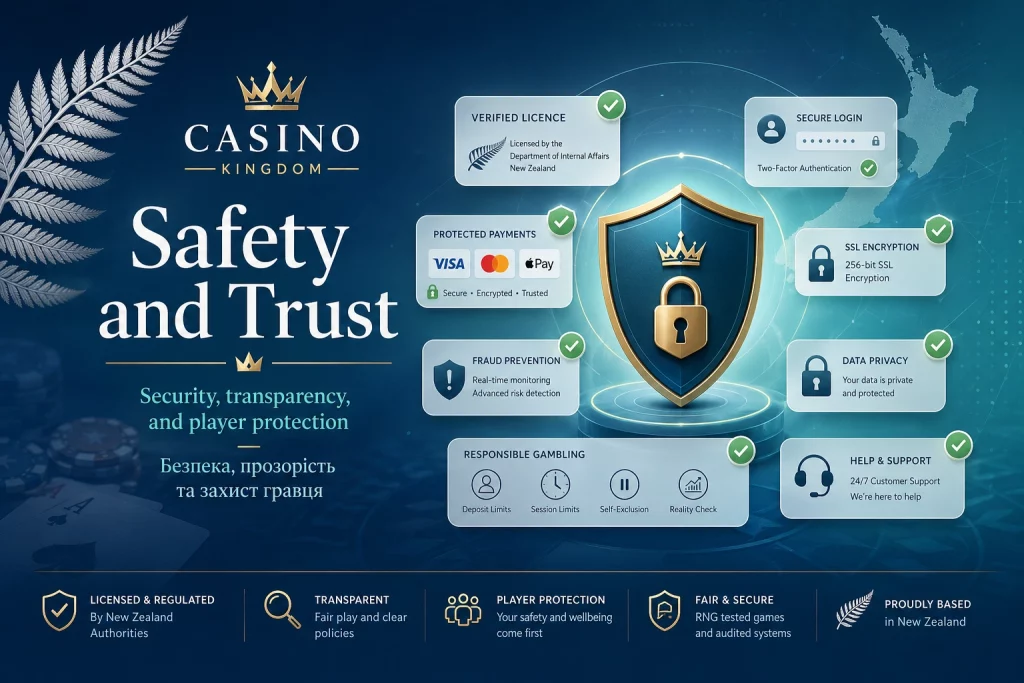
Casino Kingdom treats safety and trust as a complete review category, not as a single technical feature. A safe casino is not defined only by SSL encryption. A trustworthy casino is not defined only by a licence badge. A reliable platform is the result of several layers working together: secure account access, transparent ownership, verified licensing, responsible data handling, fair payment procedures, realistic bonus terms, fraud prevention, scam awareness, visible support, and practical responsible gambling controls.
This section connects the full safety journey. Previous Casino Kingdom guides have examined topics such as how safe online casinos are in New Zealand, how casinos protect player data, SSL encryption, fraud prevention, scam warning signs, how to identify a legitimate casino, and casino licence verification. This page brings those ideas together into one central framework. The goal is simple: help NZ players understand what to check before registration, before deposit, before accepting an offer, before uploading documents, and before trusting a casino with long-term use.
A safe casino should not ask players to rely on faith. It should provide evidence. The website should explain who operates it, which rules apply, how payments work, how data is protected, how verification is handled, what support channels exist, and how players can control their accounts. If that information is missing, hidden, inconsistent, or difficult to understand, caution is justified.
Why Safety and Trust Must Be Checked Before Registration
The safest time to evaluate a casino is before registration. Once a player creates an account, they begin sharing information. Once they deposit, the risk becomes financial. Once they upload documents, the risk becomes more sensitive. That is why the review should begin at the earliest stage.
Before using Sign up, players should inspect the casino’s identity. Does the platform show clear operator information? Are the terms and privacy policy accessible? Does the site use a secure connection? Are payment rules visible? Does the casino explain verification requirements? Are responsible gambling tools easy to find? These checks do not require expert knowledge, but they reduce avoidable risk.
A trustworthy casino should make registration feel structured rather than rushed. It should not push players through account creation before they can read key conditions. It should not hide withdrawal requirements until after deposit. It should not use exaggerated promotional language to distract from weak legal or payment details.
For NZ players, this early caution matters because offshore casino access can vary widely. Some international casinos provide professional security, clear payment systems, and usable account controls. Others rely heavily on marketing while giving little practical information. Casino Kingdom’s safety framework is designed to separate those two experiences.
The Core Layers of Casino Trust
Casino trust is built in layers. If one layer is weak, the whole platform becomes less reliable. A secure site with unclear withdrawal rules still creates risk. A licensed casino with poor support still leaves players exposed during disputes. A casino with good games but weak data protection still deserves caution.
The first layer is technical security. This includes HTTPS, SSL/TLS encryption, secure account pages, protected payment forms, safe mobile access, and stable session handling. Players should not see browser warnings when entering account details or using cashier pages.
The second layer is operator transparency. A casino should identify who runs it, where it is licensed, which terms apply, and how complaints are handled. Vague claims such as “trusted worldwide” or “fully certified” are not enough without specific details.
The third layer is payment reliability. Deposits should be easy to understand, but withdrawals are the real trust test. A safe casino explains processing times, limits, fees, verification requirements, and payment ownership rules before money enters the account.
The fourth layer is player protection. This includes responsible gambling tools, account limits, self-exclusion options, support access, and clear communication around risk. A trustworthy casino should give players control, not only opportunities to deposit.
The fifth layer is platform behaviour over time. Safety is not only what the homepage claims. It is how the casino behaves during login, account management, gameplay, bonus use, withdrawal requests, verification, and support contact.
Secure Account Access and Login Protection
Account security is one of the clearest trust signals. A player’s casino account can contain personal details, payment history, bonus activity, withdrawal records, verification status, and responsible gambling settings. If account access is weak, the whole casino experience becomes less secure.
A safe Login process should use encrypted pages, stable session handling, and secure password recovery. The login form should not appear through suspicious pop-ups, copied pages, private social media links, or unclear domains. Players should always check that the page is secure before entering credentials.
Support should never ask for a password. Password resets should happen through official casino systems, not through plain-text messages. If a casino sends recovery links from strange addresses or moves account recovery into unofficial chat channels, that is a warning sign.
NZ players should also protect their own accounts by using unique passwords and securing their email accounts. Casino security is shared between the platform and the player. A secure casino connection helps, but it cannot protect an account if the same password is reused across several risky websites.
Main Safety and Trust Signals for NZ Players
| Trust Area | What NZ Players Should Check | Strong Safety Signal | Risk Signal |
|---|---|---|---|
| Website Security | HTTPS, SSL encryption, browser warnings, secure account pages | All sensitive pages load securely without warnings | Broken padlock, HTTP pages, or unsafe redirects |
| Operator Transparency | Company name, licence reference, legal terms, complaint process | Clear operator details and consistent legal information | Vague licensing claims with no company or jurisdiction |
| Payment Safety | Withdrawal rules, limits, fees, verification, payment ownership | Cashier rules are visible before deposit | Deposits are clear but withdrawals are vague |
| Data Protection | Privacy policy, document handling, secure verification uploads | Data use and verification requirements are explained clearly | Documents requested through unclear or unofficial channels |
| Support Quality | Official channels, response clarity, complaint escalation | Support answers payment and account questions directly | Generic replies, password requests, or private-message support |
| Responsible Gambling | Deposit limits, time-outs, self-exclusion, account controls | Tools are visible and usable before problems appear | Responsible gambling page is hidden, broken, or purely generic |
How Data Protection Supports Trust
Player data protection is central to casino safety. During normal use, a casino may collect a player’s name, date of birth, address, email, phone number, payment details, transaction history, identity documents, and account behaviour. This is sensitive information. A trustworthy casino should explain how it is collected, used, protected, and stored.
The privacy policy should not feel like generic filler. It should identify what data the casino collects, why it collects it, how it may share information with payment or verification partners, and how players can contact the operator about data concerns. If the privacy policy is missing, copied, vague, or disconnected from the operator details, the casino becomes weaker from a trust perspective.
Document upload is especially important. Casinos may request identity verification before withdrawals or account changes. That can be legitimate, but the upload route should be secure and official. Players should not send passports, ID cards, bank statements, or proof of address through random links, social media messages, or unverified email threads.
A safe casino explains verification before it becomes urgent. It tells players what may be requested, when it may be needed, and how documents should be submitted. That level of clarity protects both the player and the platform.
Why SSL Encryption Is Only the Starting Point
SSL encryption is essential, but it is not the full definition of safety. HTTPS protects data in transit between the player’s browser and the casino server. That matters during login, registration, payments, verification, and account management. Without encrypted access, sensitive information is more exposed.
However, SSL encryption does not prove that a casino is fair, licensed, transparent, or reliable with withdrawals. Even a risky site can use HTTPS. This is why Casino Kingdom treats SSL as a baseline rather than a final trust decision.
Players should check that the secure connection remains active across the full journey: homepage, account pages, cashier, verification upload, support, mobile access, and game launch. If the secure connection breaks in sensitive areas, that is a problem.
The correct approach is layered. SSL confirms that the data channel is protected. Licensing checks confirm accountability. Payment review confirms financial transparency. Support testing confirms operational quality. Responsible gambling tools confirm player-control standards. Each layer supports the next.
Safety Around Bonuses and Promotions
Bonuses are often presented as value, but they can also reveal whether a casino is transparent. A safe casino should explain promotion conditions clearly before the player opts in. A risky casino may advertise large rewards while hiding important restrictions in complex or difficult-to-find terms.
A Bonus should be judged by its conditions, not only by its headline amount. Players should check wagering requirements, expiry time, maximum bet rules, game contribution rates, restricted games, country eligibility, payment exclusions, and withdrawal caps.
A trustworthy casino does not make players guess how an offer works. It should show key rules close to the promotion and provide full terms through an accessible link. If the offer looks generous but the rules are unclear, players should slow down.
Casino Kingdom treats bonus transparency as part of safety because unclear promotions often lead to disputes. A player may deposit, play, and only later discover that a game, bet size, payment method, or account condition affected withdrawal eligibility. Clear terms prevent that problem.
Safety Is About Behaviour, Not Slogans
Many casinos use safety language. They may say they are secure, trusted, licensed, fair, protected, verified, or player-focused. Those words only matter when the platform supports them with visible behaviour.
A safe casino behaves consistently. It protects account pages. It explains licensing. It publishes payment terms. It handles verification through secure routes. It gives support through official channels. It makes responsible gambling tools accessible. It does not pressure players into fast deposits before they understand the rules.
A weak casino does the opposite. It uses broad trust language but hides details. It promotes deposits more clearly than withdrawals. It displays badges without explanation. It gives vague support answers. It delays payouts without clear reason. It makes account controls difficult to find.
For Casino Kingdom, trust is not a feeling created by design. It is a pattern of evidence across the full player journey.
Payment Security, Licence Verification, and Fraud Prevention
Payment security is one of the strongest trust tests for any casino. A site may look professional during browsing, but the real standard becomes visible when money moves through the account. For NZ players, safe payments are not only about fast deposits. A trustworthy casino should explain deposits, withdrawals, verification requirements, processing times, fees, payment ownership rules, and possible review triggers before the player funds the account.
Casino Kingdom reviews payment safety as part of the wider trust structure. The cashier should not feel like a separate hidden system. It should be clearly connected to the casino account, protected by secure pages, and supported by transparent rules. If deposits are promoted heavily but withdrawals are vague, the platform becomes weaker from a trust perspective.
A safe casino should also explain why verification may be required. Identity checks, payment ownership confirmation, and anti-fraud reviews can be legitimate. The issue is not the existence of checks. The issue is whether those checks are clear, secure, and proportionate. A casino that waits until withdrawal to reveal strict requirements creates avoidable distrust.
Payment Security Before Deposit
Before depositing, players should check whether payment methods are explained in practical detail. The casino should show accepted deposit options, supported withdrawal methods, minimum and maximum transaction limits, expected processing times, and any fees. If the payment page only displays logos without rules, it is incomplete.
Payment ownership is another important area. A trustworthy casino usually expects the payment method to belong to the same person who owns the casino account. This protects against stolen payment methods, account misuse, and withdrawal disputes. The rule is reasonable, but it should be visible before deposit.
Players should also check whether the casino allows the same method for deposits and withdrawals. Some payment options may support deposits only. Others may require bank transfer or e-wallet withdrawal after verification. These conditions are not necessarily negative, but they must be clear.
Casino Kingdom treats payment transparency as a practical safety signal. A casino that explains how money leaves the account earns more trust than one that only makes funding easy.
Withdrawal Reliability and Player Trust
Withdrawals reveal whether the casino’s safety claims have practical value. A safe casino should not make players guess what is happening after a payout request. It should provide clear withdrawal status, explain verification needs, and give realistic processing timelines.
A withdrawal delay is not automatically suspicious. Casinos may review payouts for identity verification, payment ownership, bonus compliance, fraud prevention, or unusual activity. These checks can protect genuine players and the platform. The warning sign is repeated vague delay language without clear next steps.
If support says “your withdrawal is under review” once, that may be normal. If the same answer repeats for days without explanation, confidence declines. A trustworthy casino should explain whether the issue relates to documents, payment method, account details, bonus terms, or security checks.
NZ players should avoid cancelling withdrawals under pressure. Some casinos may offer reverse-withdrawal options, but player control matters. A safe platform should allow players to request payouts without being pushed back into play.
Licence Verification as a Trust Filter
Licence verification gives players a way to assess accountability. A casino licence does not guarantee a perfect experience, but it helps answer basic questions: who operates the site, which jurisdiction applies, what rules govern the account, and whether there is a complaint route.
A trustworthy casino should provide specific licensing information. Generic claims such as “fully licensed” or “trusted worldwide” are not enough. Players should look for an operator name, licence reference, legal terms, privacy details, responsible gambling information, and complaint procedures.
Licence details should remain consistent across the website. The footer, terms page, privacy policy, cashier, and support information should not contradict each other. If different company names appear without explanation, players should inspect the structure more carefully.
Casino Kingdom treats licence verification as the first accountability check. A casino that cannot explain who operates it should not be trusted with personal data or deposits.
Fraud Prevention and Account Integrity
Fraud prevention protects both the player and the casino. It helps reduce account theft, payment misuse, fake accounts, duplicate registrations, bonus abuse, identity fraud, and unauthorised withdrawals. A safe casino should have fraud controls, but those controls should not become vague excuses for poor treatment.
Good fraud prevention is visible through structured account rules. The casino should explain one-account policies, verification requirements, payment ownership rules, password security, and suspicious activity checks. It should also warn players about phishing and unofficial support channels.
Fraud prevention should also be balanced. If every normal player action triggers unexplained restrictions, the system is too opaque. If the casino checks nothing, the platform is unsafe. The best approach is clear, proportionate monitoring.
Players should also protect themselves. Use a unique password, avoid public Wi-Fi for payments, do not click suspicious casino links, and never share passwords with support. Safe casino use depends on both platform controls and player habits.
Payment, Licence, and Fraud Trust Signals
| Safety Area | What Casino Kingdom Reviews | Strong Trust Signal | Weak Trust Signal |
|---|---|---|---|
| Deposit Rules | Available methods, limits, fees, currency, payment ownership | All deposit conditions are visible before funding | Only payment logos appear with no practical explanation |
| Withdrawal Rules | Processing times, payout methods, limits, verification triggers | Withdrawal path is clear before deposit | Important rules appear only after payout request |
| Licence Details | Operator name, jurisdiction, licence reference, legal consistency | Specific information appears across footer and terms | Vague claims without regulator or company details |
| Fraud Controls | Duplicate-account rules, payment checks, suspicious activity review | Security checks are explained and proportionate | “Security review” is used repeatedly without detail |
| Account Recovery | Password reset, email confirmation, identity checks for recovery | Recovery uses official secure channels | Support asks for passwords or redirects to private messages |
| Mobile Payment Safety | Secure cashier behaviour on phone browsers and mobile platforms | Mobile cashier matches desktop security standards | Mobile redirects through unclear or unrelated pages |
Core Trust Factors in Casino Safety Reviews
Scam Warning Signs That Reduce Trust
Scam warning signs often appear before money is lost. A risky casino may use unrealistic offers, unclear licence claims, copied branding, suspicious login pages, fake support accounts, hidden payment rules, or pressure-based messaging. NZ players should treat these signs seriously.
One common warning sign is urgency. A casino or fake message may claim that an offer expires immediately, an account will close, or verification must be completed through a special link. This pressure is designed to make players act before checking details.
Another warning sign is unclear support. A trustworthy casino should provide official support channels and direct answers. Scam-style support may move players to private messages, ask for passwords, request documents through unsafe links, or avoid payment questions.
Players should also check the casino’s internal Links carefully. Important pages such as terms, privacy policy, payment rules, responsible gambling, and complaints should be easy to reach from the official website. If the site pushes players through random external pages or broken links, trust declines.
Support Quality and Complaint Handling
Support is where safety becomes practical. A casino can publish strong-looking terms, but support behaviour shows how the operator handles real questions. Before depositing, players can ask about withdrawals, verification, bonus terms, payment ownership, and account limits. The response quality helps reveal whether the platform is organised.
A safe casino should answer directly or link to the correct policy page. It should not push players to deposit before answering. It should not give contradictory answers between live chat and email. It should not ask for passwords or full payment details.
Complaint handling is also important. Even legitimate casinos can have disputes. A player may face a delayed withdrawal, rejected document, unclear bonus issue, or technical problem. The casino should explain how to escalate unresolved cases.
Casino Kingdom treats complaint visibility as a trust signal. A casino that gives players a structured route for problems is stronger than one that offers only generic contact forms.
Mobile Safety and App Use
Mobile casino access should match desktop safety standards. A secure mobile experience should protect account pages, cashier forms, verification uploads, support communication, and game launching. The player should not lose transparency just because they are using a phone.
If a casino promotes an App, the download route should be clear and official. Players should avoid unknown installation files, suspicious APK pages, excessive permission requests, or pop-ups claiming that the app is required to unlock withdrawals. A safe mobile product should be explained calmly and transparently.
Mobile screens can make warning signs harder to notice. A strange URL, browser warning, or small disclaimer may be easier to miss. NZ players should slow down before entering credentials, uploading documents, or using payment pages on mobile.
A trustworthy casino provides convenience without reducing protection. Mobile access should be smooth, but not at the cost of security.
How Safety Connects to Game Access
Trust also extends to the game lobby. A casino should identify software providers, organise game categories clearly, and launch titles through stable, secure pages. Players should not see suspicious redirects, broken frames, or unclear provider information.
This matters because game quantity alone does not prove quality. A casino can list many titles while giving little information about where they come from. A safer platform names providers and offers clear rules for game types.
Players should check whether categories such as Games open cleanly and whether provider names are visible. If the casino offers jackpots, live dealer tables, instant games, or special titles, the rules and limits should be understandable.
Casino Kingdom treats game transparency as part of trust. A casino that asks players to wager real money should not hide the source or structure of its games.
Responsible Gambling, Data Protection, and Game Fairness
Safety and trust are not limited to payment pages and licence information. A casino can show basic legal details and still create risk if it fails to protect player data, hides account-control tools, or makes the game environment unclear. For Casino Kingdom, a reliable casino must support safe play across the entire user journey: browsing, registration, account access, payment activity, gameplay, verification, support, and responsible gambling controls.
For NZ players, this wider view is important because trust is built through repeated behaviour. A casino may pass the first check by using secure pages, but the review should continue. Does the platform explain how personal data is handled? Are responsible gambling tools visible? Are game providers named? Are promotion rules consistent with wagering rules? Does support give clear answers? These details show whether the casino is built around long-term player confidence or short-term acquisition.
A trustworthy casino should make safety practical. It should not only publish generic statements about protection. It should give players working tools, clear policies, stable game access, and understandable account rules. If safety information exists only in vague footer text, the platform is weaker.
Responsible Gambling as a Trust Signal
Responsible gambling tools show whether a casino gives players meaningful account control. A safe casino should allow users to set limits, take breaks, request time-outs, use self-exclusion options, and access support information without unnecessary friction. These tools should not be hidden behind multiple menus or available only after contacting support several times.
For NZ players, responsible gambling visibility is part of basic trust. A casino that focuses heavily on deposits and promotions but makes limits hard to find is showing the wrong priority. Player control should be part of the normal account structure.
Responsible gambling pages should also be practical. A page that only says “play responsibly” is not enough. It should explain what tools exist, how they work, whether changes are immediate, and how players can contact support for account restrictions. If a player wants to reduce access, set a deposit limit, or close an account, the process should be clear.
Casino Kingdom treats responsible gambling as a safety category because it affects real player outcomes. A trustworthy casino should support balanced play, not only continuous play.
Data Protection and Privacy Clarity
Player data protection is one of the most important trust areas. Online casinos may collect sensitive information: legal name, date of birth, address, email, phone number, payment details, transaction history, gameplay records, verification documents, and support messages. A safe casino should explain how this information is protected and why it is collected.
The privacy policy should identify what data is collected, how it is used, whether it is shared with payment processors or verification providers, and how long it may be retained. The language should be understandable enough for ordinary players. If the privacy policy looks generic, incomplete, or unrelated to the casino brand, caution is justified.
Verification data is especially sensitive. If a casino requests identity documents, the upload process should be secure and official. Players should avoid sending documents through social media, random email links, or private chat accounts. A serious casino should provide a protected upload page or recognised verification process.
Good data protection also includes account communication. Password reset links, verification updates, payment notices, and support messages should come through official channels. If the casino communicates through unclear addresses or asks for sensitive information in unsafe ways, trust declines.
Game Fairness and Provider Transparency
Game fairness is another core part of casino safety. Players should be able to identify where games come from and whether the casino uses recognised software providers. A large lobby is not enough. Quantity does not prove fairness, quality, or reliability.
A trustworthy casino should organise its lobby clearly and show provider names where possible. Categories such as live casino, table games, jackpots, and Slots should open through stable pages without suspicious redirects. Game rules should be accessible before real-money play, especially for titles with special features, jackpots, or bonus conditions.
Provider transparency matters because it makes the game environment traceable. If a casino hides provider names, uses copied-looking thumbnails, or launches games through strange pages, the player has less confidence in the product. This does not automatically prove fraud, but it weakens the safety profile.
Casino Kingdom checks whether game transparency matches the casino’s wider trust claims. A casino that says it is safe and fair should not make the game library difficult to verify.
Responsible Gambling, Data, and Game Fairness Checks
| Review Area | What Players Should Check | Strong Trust Signal | Weak Trust Signal |
|---|---|---|---|
| Responsible Gambling Tools | Deposit limits, time-outs, self-exclusion, account closure options | Tools are visible, practical, and easy to use | Only generic “play responsibly” text with no clear controls |
| Privacy Policy | Data collection, storage, sharing, retention, player rights | Policy explains how player information is handled | Copied or vague privacy text with little operational detail |
| Verification Uploads | How ID documents and proof of address are submitted | Secure upload route with clear instructions | Documents requested through random email or private messages |
| Game Providers | Studio names, category filters, game information panels | Recognisable providers and clear game sourcing | Unknown titles, copied visuals, or hidden provider details |
| Game Rules | RTP references where available, table limits, jackpot rules, bonus contribution | Rules are accessible before real-money play | Players must wager first to understand basic conditions |
| Help Content | Support articles, policy explanations, account guidance, FAQ section | Information is structured and easy to understand | Help pages are thin, broken, outdated, or inconsistent |
Player Protection Layers in a Safe Casino
Why Help Pages Matter
Help pages are often ignored, but they reveal how well a casino explains itself. A trustworthy casino should provide accessible guidance on payments, withdrawals, verification, account access, bonuses, technical issues, responsible gambling, and complaints. These pages reduce confusion before support is needed.
A weak help section creates dependence on live chat. That may seem minor, but it becomes a problem when support is slow or inconsistent. Players should not need to contact support for every basic rule. The website should already answer common questions.
A strong help centre also supports safer decision-making. If players can read payment rules, bonus terms, and verification requirements before depositing, disputes become less likely. Clear information protects both players and the casino.
Casino Kingdom reviews help content because transparency should be built into the website, not only offered reactively after a problem appears.
Trust and Consistency Across the Casino Journey
Consistency is one of the strongest trust signals. A safe casino should present the same standards across desktop, mobile, account pages, cashier, support, and game areas. If one section looks professional while another feels unclear or outdated, the platform deserves closer review.
For example, the casino may advertise secure payments on the homepage but provide vague withdrawal rules in the terms. It may promote responsible gambling but make limits difficult to activate. It may name providers in one part of the lobby but hide them elsewhere. It may offer strong bonus messaging while leaving contribution rules unclear.
These inconsistencies matter because they create uncertainty. Players should not have to guess which page is accurate. The casino’s terms, support answers, payment information, and promotional pages should align.
A safe platform behaves coherently. It does not make players piece together rules from scattered or conflicting pages.
Review Methodology for Casino Kingdom
Casino Kingdom’s safety review method follows the actual player journey. It starts before account creation, continues through payment and verification checks, then moves into gameplay, support, and account-control features. This method matters because safety is not a single page or badge; it is the way the whole casino operates.
The first step is visibility. Can the player find legal, payment, privacy, bonus, and responsible gambling information without registering? The second step is clarity. Are the rules understandable? The third step is consistency. Do different pages support the same message? The fourth step is practical testing. Does support answer direct questions? Do account pages behave securely? Does the cashier explain withdrawals?
This approach avoids shallow review. A casino that looks good on the homepage still has to pass operational checks. A casino that claims safety still has to show it in payments, data handling, player control, and communication.
User Feedback and Pattern Recognition
Player feedback can support safety analysis, but it must be handled carefully. A single complaint does not prove that a casino is unsafe, and a single positive review does not prove that it is reliable. Patterns matter more than isolated comments.
Useful feedback includes specific details: withdrawal timing, verification problems, bonus disputes, support quality, account restrictions, payment method issues, or mobile stability. Vague praise or vague anger is less useful.
If many players describe the same problem, such as delayed withdrawals, unclear bonus rules, repeated document requests, or unresponsive support, Casino Kingdom treats that pattern as a serious review signal. If the casino’s own terms are also vague in the same area, the concern becomes stronger.
A strong casino should show alignment between its claims and player experience. If the website promises clear payments but players repeatedly report confusing withdrawals, the trust profile weakens.
Practical Guidance for NZ Players
Before trusting a casino, NZ players should check safety in a fixed order. Start with secure access and operator details. Then read payment rules. Then inspect licence information. Then review privacy and verification procedures. Then read bonus terms. Then check game providers and responsible gambling tools. Finally, test support with direct questions before depositing.
This method prevents players from being distracted by the most visible marketing elements. A large promotion or attractive lobby should not come before basic trust checks. Safety comes first; entertainment comes after.
Players should also pay attention to how often the platform appears to be maintained. Regular updates to games, payment systems, security information, and help pages can indicate active management. A casino that looks abandoned, outdated, or poorly maintained may carry higher operational risk.
Finally, players should combine their own review with broader feedback trends. Repeated complaints about delayed withdrawals, unclear bonus terms, or verification errors can show structural weaknesses. One complaint may be noise; a repeated pattern is more meaningful.
Final Casino Kingdom Safety and Trust Checklist
Safety and trust should be reviewed as a complete system. A casino can pass one check and still fail another. Secure pages matter, but they do not replace licence transparency. A licence claim matters, but it does not replace clear payment rules. A strong bonus page matters, but it does not replace fair terms. A large game library matters, but it does not replace provider transparency. A safe casino must be consistent across the whole player journey.
For Casino Kingdom, the final question is not “does this casino look safe?” The better question is “can the casino prove safety through clear, visible, and practical information?” NZ players should be able to answer that question before they register, deposit, claim promotions, upload documents, or play for real money.
A trustworthy casino should make its security standards easy to inspect. It should show secure access, operator accountability, payment transparency, licence details, data protection, fraud prevention, support quality, responsible gambling tools, and clear game information. When these areas align, trust becomes evidence-based rather than emotional.
Final Safety Checklist Before Registration
Before registration, players should check whether the casino website is secure, consistent, and accountable. The site should use HTTPS, avoid browser warnings, and keep branding stable across all major pages. The operator information should be easy to find. The terms, privacy policy, payment rules, and responsible gambling page should be accessible before account creation.
Players should also check whether registration conditions are clear. The casino should explain age requirements, country eligibility, duplicate-account rules, identity verification expectations, and payment ownership standards. If these rules are hidden until later, the registration process is weaker.
The Sign up stage should never feel like a trap. It should be a structured account-opening process, not a rushed funnel toward deposit. A safe casino gives players enough information to decide before they share personal details.
If a casino makes basic information difficult to find before registration, that is a warning sign. A trustworthy platform does not need to hide its rules.
Final Safety Checklist Before Deposit
Before deposit, players should focus on payment and withdrawal rules. The cashier should explain deposit methods, withdrawal options, transaction limits, fees, processing times, verification requirements, and payment ownership rules. It should not only show payment logos.
Withdrawals are especially important. A safe casino should explain how payouts work before money enters the account. If a player can deposit instantly but cannot understand how withdrawals are processed, the trust level is incomplete.
Players should also read bonus conditions before depositing with a promotion. A large Bonus should not distract from wagering requirements, expiry times, maximum bet rules, restricted games, payment exclusions, and withdrawal caps. If the terms are unclear, the player should avoid the offer.
A good casino supports informed deposits. A weak casino encourages fast deposits and explains restrictions later.
Final Safety Checklist Before Gameplay
Before gameplay, players should check game provider transparency and category structure. The casino should identify software providers and make game rules accessible. Categories such as Slots, table games, live casino, jackpots, and other Games should open through stable pages with no suspicious redirects.
Players should also check whether game contribution rules are explained if a promotion is active. Some games may not count fully toward wagering. Some may be excluded entirely. A safe casino should not let players discover those restrictions only after play.
Game fairness is difficult for ordinary players to test directly, but transparency helps. Recognisable providers, clear rules, stable launches, and consistent balance behaviour all support trust.
If the game lobby looks impressive but provider details are missing, caution is reasonable. Quantity does not prove legitimacy.
Safety and Trust Checklist for Casino Kingdom
| Player Stage | What to Check | Safe Casino Signal | Warning Signal |
|---|---|---|---|
| Before Registration | Secure access, operator details, legal pages, registration rules | Rules are visible before account creation | Important details appear only after registration |
| Before Deposit | Deposit methods, withdrawal rules, limits, fees, verification | Cashier explains both deposits and withdrawals | Deposits are clear but withdrawals are vague |
| Before Bonus Use | Wagering, expiry, maximum bet, eligible games, withdrawal caps | Promotion terms are clear before opt-in | Large headline offer with hidden restrictions |
| Before Gameplay | Provider names, game rules, stable launches, category clarity | Game library is transparent and traceable | Unknown providers, copied visuals, or suspicious redirects |
| Before Verification | Document requirements, upload route, review timing | Secure upload page with clear instructions | Documents requested through private messages or unclear links |
| Before Mobile Use | Mobile site, app route, session security, cashier behaviour | Mobile access matches desktop safety standards | Forced downloads, strange redirects, or excessive app permissions |
| Before Support Contact | Official channels, answer quality, complaint route | Support gives specific replies through verified channels | Password requests, vague replies, or private-message support |
| Before Long-Term Use | Responsible gambling tools, account controls, maintenance, user feedback | Platform remains consistent, updated, and player-focused | Repeated complaints, outdated pages, or inaccessible account tools |
How This Safety and Trust Section Fits Together
The Safety and Trust section on Casino Kingdom should work as a connected resource hub. Each supporting guide covers one major layer of the review. The page on how safe online casinos are in NZ explains the broad safety framework. The guide on how casinos protect player data NZ focuses on privacy, verification, and data handling. The SSL encryption casinos NZ article explains secure connections and protected account access.
The casino fraud prevention NZ guide covers suspicious activity, payment ownership, identity checks, phishing, and account integrity. The scam casino warning signs NZ article helps players identify risky behaviour before they deposit. The how to identify legit casino NZ page gives a full legitimacy checklist. The casino license verification guide explains how to check operator accountability and licence claims.
This current Safety and Trust page should connect all those topics into one central overview. It gives players the structure first, then directs them toward deeper checks when they need more detail. That makes the section useful both for beginners and for players who want a more careful review process.
Why Trust Must Be Proven Repeatedly
Trust is not established once. A casino should prove it repeatedly across different stages of use. The homepage may show security claims, but the login page must also be secure. The footer may show licence information, but the terms must match it. The cashier may show deposit options, but withdrawals must also be clear. The promotion page may look attractive, but the bonus rules must be understandable.
This repeated proof matters because casino risk appears in different places. Some risks appear before registration, such as fake websites or vague licensing. Others appear after deposit, such as unclear withdrawal conditions. Others appear during play, such as hidden bonus contribution rules. Others appear during support contact, such as vague responses or unsafe document requests.
A safe casino reduces uncertainty at every stage. It does not force players to trust unsupported claims. It provides usable information before each decision.
For NZ players, this approach is practical. It helps them slow down, check evidence, and avoid platforms that depend on rushed decisions.
How Casino Kingdom Reviews Long-Term Reliability
Long-term reliability depends on more than the first impression. Casino Kingdom looks at how the platform behaves over time. Does it keep payment information updated? Does it maintain help pages? Does it respond to repeated player concerns? Does it update game libraries and security information? Does it keep responsible gambling tools visible?
A casino that is actively maintained generally inspires more confidence than one with outdated pages, broken help links, old promotions, or inconsistent terms. Regular updates can indicate that the operator is managing the platform rather than letting it run unattended.
User feedback also matters when viewed as a pattern. One complaint may not prove a systemic issue. Repeated complaints about delayed withdrawals, unclear verification, hidden bonus restrictions, or poor support deserve more attention. If repeated feedback matches weak information on the casino site, the risk signal becomes stronger.
Casino Kingdom’s review method combines visible site checks with player-experience patterns. This creates a more balanced trust assessment.
Practical Safety Routine for NZ Players
A simple routine can reduce most avoidable risk. First, check the website connection and operator identity. Second, read payment and withdrawal rules. Third, inspect licence information. Fourth, review privacy and verification procedures. Fifth, read bonus terms. Sixth, check game providers. Seventh, test support. Eighth, confirm responsible gambling tools. Ninth, avoid suspicious links and unofficial support accounts.
This routine should happen before money is deposited. It does not take long when a casino is transparent. If it takes too long because basic information is hidden, that is already useful evidence.
Players should also keep records of important terms, payment confirmations, and support messages. This is especially useful when claiming bonuses, submitting documents, or requesting withdrawals.
The safest decision is often the simplest one: if the casino cannot explain itself clearly, do not continue.
Final Recommendation for Casino Kingdom Readers
NZ players should approach casino safety with the same discipline they would use for any financial account. A casino account can contain personal data, payment history, identity documents, and real funds. It deserves careful handling.
A trustworthy casino should protect account access, explain payments, verify identity securely, identify game providers, show responsible gambling tools, and communicate through official support channels. It should not rely only on design, slogans, badges, or oversized promotions.
Casino Kingdom’s Safety and Trust section exists to make that evaluation easier. Each supporting article handles one part of the process, while this page gives the full overview. Together, they help players identify safer platforms, avoid suspicious ones, and understand which signals matter before real money is involved.






Comments