
Legality at Casino Kingdom
How I Read New Zealand Gambling Law Before Trusting Any Casino
When I review legality for Casino Kingdom, I do not start with a casino homepage, a promotion, or a payment method. I start with the legal structure around gambling in New Zealand. A casino may look polished, secure, and professional, but if the legal position is unclear, every later step becomes weaker. For me, legality is not a decorative compliance label. It is the first layer of trust.
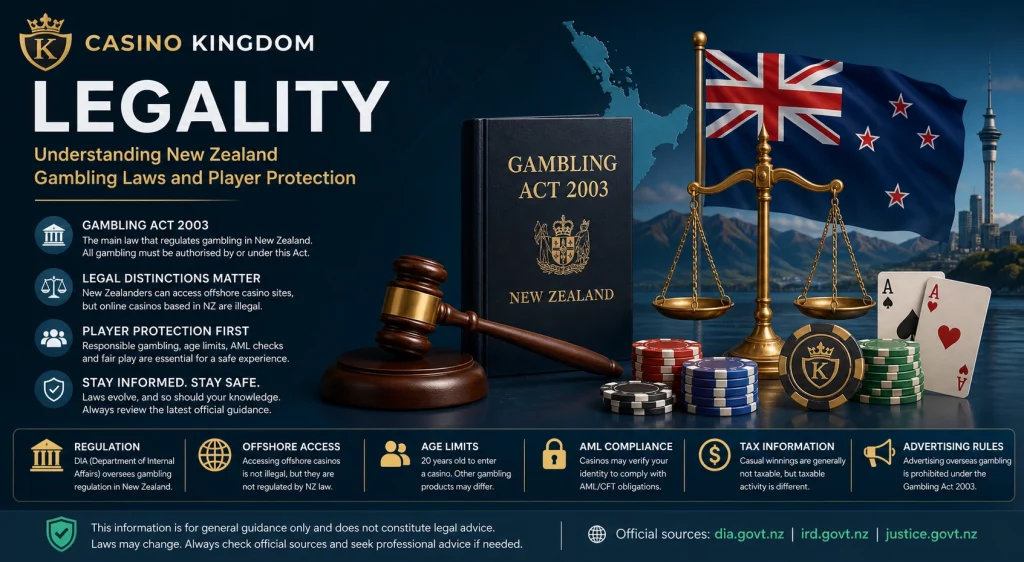
New Zealand gambling law is structured around the Gambling Act 2003, which sets the core framework for what is authorised, restricted, or prohibited. The Department of Internal Affairs explains the general rule clearly: gambling in New Zealand is illegal unless it is authorised by or under the Gambling Act 2003. The same official guidance also identifies remote interactive gambling and advertising overseas gambling as prohibited areas under the Act.
That does not mean every online gambling question has the same answer. The legal position depends on who operates the gambling service, where it is based, who is being targeted, how it is advertised, and whether the activity is authorised under New Zealand law. This is why I separate “Can a New Zealand player access a site?” from “Can a New Zealand-based operator legally run an online casino?” Those are different legal questions.
The Department of Internal Affairs currently states that it is legal for New Zealanders to gamble on offshore casino gambling websites, while online casinos based in New Zealand are illegal. The same DIA page also notes that online casino gambling is now regulated by the Online Casino Gambling Act 2026 and that implementation of the new law has begun. Because the legal framework is changing, I treat any legality page as something that must be kept updated rather than written once and forgotten.
Why I Treat Legality as a Player-Safety Issue
I do not treat legality as a dry technical subject. It directly affects player safety. If a casino operates under a clear legal framework, players can usually understand who runs the platform, which rules apply, how complaints may be handled, and what standards the operator is expected to follow. If the legal position is vague, players may struggle to know which protections exist.
A legal review also affects account expectations. Before anyone uses Sign up, the basic legal questions should already be visible. Is the casino allowed to target the player’s location? Does it identify its operating company? Does it explain licence details? Does it restrict underage users? Does it state payment and verification rules? Does it explain responsible gambling tools?
These checks matter because legality is not only about whether a website loads. A site may be accessible from New Zealand, but that does not automatically make every operator transparent, compliant, or safe. Access and trust are separate issues. I always review them separately.
New Zealand’s legal framework also distinguishes different gambling environments. Land-based casinos, Lotto, racing and sports betting, class-based gambling, and online casino-style gambling are not treated identically. This is why a single phrase like “gambling is legal in New Zealand” is too broad. It needs context.
The Core Legal Question: Local Operation vs Offshore Access
The first major distinction is local operation versus offshore access. New Zealand law has historically prohibited remote interactive gambling, with limited exceptions. DIA guidance on remote interactive gambling explains that the Gambling Act 2003 prohibited remote interactive gambling, with limited exceptions for the Lotteries Commission, the Racing Board, and certain sales promotion schemes.
At the same time, DIA’s current online casino information states that New Zealanders may gamble on offshore casino gambling websites, while online casinos based in New Zealand are illegal. This distinction is important because it prevents oversimplified claims. A player-facing legal page should not imply that all online casinos are locally authorised in New Zealand. It should explain the difference carefully.
The Online Casino Gambling Act 2026 is also relevant because it signals a shift toward a regulated online casino environment. DIA says implementation has started to ensure a safe, fair, and well-controlled online gambling environment for New Zealanders. This means Casino Kingdom’s legal section should remain update-sensitive. Any page discussing legality, offshore casinos, licensing, advertising, AML, or player obligations should be reviewed regularly as the new regime develops.
From my review perspective, the safest wording is precise: offshore access may be treated differently from operating a New Zealand-based online casino. That does not make every offshore site trustworthy. It only describes the legal distinction at a high level.
Why the Gambling Act 2003 Still Matters
The Gambling Act 2003 remains central to understanding gambling law in New Zealand. It provides the framework for authorised gambling, prohibited gambling, licensing structures, casino regulation, advertising restrictions, and harm minimisation. Any serious legality section should refer back to this Act as the foundation.
The Act also matters because many related questions branch from it. “What is prohibited gambling NZ?” connects to the Act. “Who regulates gambling in New Zealand?” connects to DIA’s regulatory role. “Online vs land based gambling law NZ” connects to how different gambling products and venues are treated. “Gambling advertising rules NZ” connects to prohibitions around overseas gambling advertising. DIA’s prohibited gambling page specifically identifies advertising overseas gambling as a prohibited area under the Act.
For Casino Kingdom, I would treat the Gambling Act 2003 guide as the legal anchor article. Other pages can then explain specific angles in simpler terms: online casino legality, offshore access, licence types, tax, legal age, crypto casinos, VPN use, AML checks, and advertising rules.
Main Legal Topics in the Casino Kingdom Legality Section
| Legal Topic | What the Page Should Explain | Why It Matters for NZ Readers |
|---|---|---|
| Online gambling laws in New Zealand | How NZ gambling law treats remote, local, and offshore gambling activity | Prevents oversimplified claims about what is legal or illegal |
| Gambling Act 2003 full guide | The core framework for authorised gambling, prohibited gambling, licensing, and harm minimisation | Acts as the foundation for the whole legal section |
| Is online casino legal in NZ | The difference between NZ-based online casino operation and offshore access | Helps readers understand the main legal distinction |
| Can NZ players play offshore casinos legally | How offshore access is described in official guidance and why operator trust still matters | Separates accessibility from safety and accountability |
| Who regulates gambling in New Zealand | The role of the Department of Internal Affairs and other relevant bodies | Shows where official oversight and compliance information comes from |
| Gambling tax in New Zealand | When prize or gambling-related money may or may not be taxable | Helps readers avoid assuming every win has the same tax treatment |
Legal Age: Why 18 vs 20 Needs Clear Explanation
Legal age is another area where vague wording creates confusion. Different gambling products may have different age restrictions. DIA’s casino guidance states that patrons must be 20 years of age to enter a casino. That is an important fact for any Casino Kingdom page covering “Legal gambling age NZ (18 vs 20).”
The reason this topic needs its own page is that readers often search for simple answers. They may ask whether the gambling age is 18, 20, or different depending on the product. A good legal guide should explain that age rules can vary by gambling type and venue, instead of giving one broad answer for all gambling.
For online casino-related content, I would avoid implying that younger users can participate. The page should be clear that age restrictions, identity verification, and responsible gambling standards are central to lawful gambling access. A serious casino platform should prevent underage participation and apply verification where required.
Tax: Why Gambling Winnings Need Careful Wording
Tax is another topic that needs precise language. Inland Revenue explains that raffle, Lotto, draw prizes, and TAB race prize money are generally not taxable, but prize money won as part of someone’s taxable activity is generally taxable and must be included as business income or as a schedular payment where relevant.
That distinction matters. A Casino Kingdom tax page should not say “all gambling winnings are tax free” without qualification. It should explain that many casual prizes may not be taxable, but tax treatment can change if the activity is connected to business or taxable activity.
For Casino Kingdom, I would handle “Gambling tax in New Zealand” and “Is gambling income taxable NZ” as related but separate pages. One can provide the broad overview; the other can focus on specific income questions, record-keeping, and when professional advice may be needed.
Why Advertising Rules Matter
Advertising rules matter because they affect how gambling services may be promoted to New Zealanders. DIA’s prohibited gambling guidance identifies advertising overseas gambling as prohibited under the Gambling Act framework. This is important for any page about gambling advertising rules NZ.
From a content perspective, this means legal pages should be written carefully. They should inform, explain, and help readers understand risks. They should not make unsupported promotional claims or encourage people to bypass rules. A legality section is strongest when it functions as a compliance-oriented information hub.
Casino Kingdom can use this section to explain legal principles, not to create confusion between information and advertising. That distinction matters in a regulated gambling environment.
Where the Internal Links Fit Naturally
This “Legality” hub should connect to practical site areas without becoming promotional. For example, a reader checking legal access may later want to understand account entry, so a single internal reference to Login can appear naturally in the account-safety context. A reader checking promotions may need the separate bonus-terms page, so a single reference to Bonus can appear where promotion legality and advertising claims are discussed.
The key is restraint. Legal content should not be overloaded with commercial calls to action. It should prioritise clarity, compliance, and reader safety. Internal linking should help readers find related explanations, not push them into fast decisions.
My Review Standard for Legal Casino Content
When I write or review legal casino content, I use a conservative standard. I avoid broad claims. I avoid unsupported certainty. I separate official law from practical platform behaviour. I also treat legal topics as time-sensitive because regulation can change.
That is especially important now because New Zealand’s online casino framework is shifting with the Online Casino Gambling Act 2026 implementation noted by DIA. A legal page should therefore be maintained, not treated as static.
For Casino Kingdom, the “Legality” section should work as a structured legal map. It should not replace legal advice, but it should help readers understand the main legal categories: what is authorised, what is prohibited, what is changing, who regulates gambling, how licence types work, how tax questions are framed, and why age and AML rules matter.
Who Regulates Gambling in New Zealand, Licence Types, and Prohibited Gambling
When I build the legality section for Casino Kingdom, I treat regulation as the practical bridge between law and player protection. A law can describe what is allowed or prohibited, but the regulator is what gives that framework operational meaning. In New Zealand, the Department of Internal Affairs is the key gambling regulator for licensing, compliance, prohibited gambling guidance, casino and non-casino gaming oversight, and public information about gambling rules. DIA also explains that gambling activities in New Zealand are classified under the Gambling Act 2003, with Classes 1 to 4 covering different risk and turnover levels, while casino gambling and New Zealand Lotteries Commission gambling are treated separately under the Act.
For me, this means a legality page should not only say “regulated” or “legal.” It should explain who regulates what. A land-based casino licence, a Class 4 gaming machine licence, a Class 3 lottery, a private gambling arrangement, a Lotto product, TAB betting, and online casino access do not sit in one simple bucket. They are regulated through different rules, permissions, and restrictions. That is why this Casino Kingdom section needs separate articles for “Who regulates gambling in New Zealand,” “Gambling license types NZ,” “What is prohibited gambling NZ,” and “Online vs land based gambling law NZ.”
The core point is that legality depends on structure. Who offers the gambling? Where is the operator based? Is the activity authorised under the Act? Is it a local activity, a casino venue activity, a community gambling activity, a lottery, racing/sports betting, or remote interactive gambling? These questions matter more than the general phrase “online gambling.”
The Role of the Department of Internal Affairs
I treat the Department of Internal Affairs as the primary official reference point for gambling legality in New Zealand. DIA manages public guidance on gambling regulation, explains prohibited gambling, provides licensing information, and publishes material about remote interactive gambling and casino/non-casino gaming. Its official guidance states that the Gambling Act 2003 classifies gambling into four classes other than casino gambling and New Zealand Lotteries Commission gambling.
This matters because many casino-related pages online blur legal categories. They may talk about “New Zealand casinos” without distinguishing between licensed land-based casinos, offshore online casinos, Lotto products, racing and sports betting, and community gambling. I avoid that. For Casino Kingdom, I would keep the structure precise.
A regulator page should explain that DIA is central, but it should also identify where other entities fit. Lotto NZ and TAB-related betting have their own authorised structures. Land-based casinos operate under casino-specific legal permissions. Community gambling may fall into Classes 1 to 4 depending on stakes, turnover, risk, and whether a licence is required. DIA describes Class 1 as low-stake, low-risk gambling and Class 4 as high-risk, high-turnover gambling, with casino operations treated separately.
That distinction helps readers understand why one law section cannot answer every gambling question in one sentence.
Gambling Licence Types in New Zealand
The “Gambling license types NZ” article should explain the difference between the main categories without making the topic unnecessarily legalistic. In simple terms, the Gambling Act framework separates lower-risk gambling from higher-risk gambling, and different classes have different requirements.
DIA explains that gambling classes range from Class 1 to Class 4. Class 1 represents lower-stake, lower-risk gambling, while Class 4 represents high-risk, high-turnover gambling. Casino operations and New Zealand Lotteries Commission gambling sit outside those four ordinary classes as separate categories under the Act.
A useful Casino Kingdom explanation would separate the categories like this: small low-risk gambling, larger society-based gambling, gaming-machine gambling outside casinos, licensed land-based casino gambling, and authorised lottery or racing-related products. That layout helps readers understand why licence type matters.
For online casino readers, this is especially important because a casino licence in one context does not automatically mean another form of gambling is authorised. A land-based casino licence is not the same thing as authorisation to run a New Zealand-based online casino. The legal article should explain that distinction clearly rather than using “casino licence” as a broad label.
What Prohibited Gambling Means
The “What is prohibited gambling NZ” article should be written carefully because prohibited gambling is one of the most important legal topics in this section. DIA states that gambling in New Zealand is illegal unless it is authorised by or under the Gambling Act 2003, and its prohibited gambling guidance includes remote interactive gambling and advertising overseas gambling among prohibited areas.
This is where I would use conservative wording. I would not tell readers that all online gambling is simply legal or illegal. Instead, I would explain the categories. Remote interactive gambling has historically been prohibited under the Gambling Act, with limited exceptions for entities such as the Lotteries Commission, the Racing Board, and certain sales promotion schemes in the form of a lottery.
At the same time, DIA’s current online casino guidance states that New Zealanders may gamble on offshore casino gambling websites, while online casinos based in New Zealand are illegal, and it also notes that the new Online Casino Gambling Act 2026 implementation has begun.
That creates a legal landscape that must be explained with precision: New Zealand-based online casino operation, offshore casino access, advertising, licensing, and future regulated online casino activity are not identical issues.
Regulator and Licence Structure for Casino Kingdom Legal Content
| Legal Area | How I Would Explain It | Why It Matters |
|---|---|---|
| Department of Internal Affairs | Main regulator and official source for gambling guidance, licensing, and compliance information | Gives readers an official reference point for NZ gambling law |
| Class 1 to Class 4 Gambling | Different gambling classes based on risk, prizes, turnover, and licensing requirements | Prevents all gambling activities from being treated as one category |
| Casino Gambling | Handled separately from Classes 1 to 4 under the Gambling Act framework | Explains why land-based casino rules differ from ordinary community gambling |
| Remote Interactive Gambling | Historically prohibited under the Gambling Act, with limited exceptions | Clarifies why online gambling needs careful legal wording |
| Offshore Casino Access | DIA states New Zealanders may gamble on offshore casino gambling websites, while NZ-based online casinos are illegal | Separates player access from local online casino operation |
| Advertising Overseas Gambling | Identified by DIA as a prohibited gambling-related area under the Act | Important for content, affiliate, media, and promotion compliance |
Legal Topic Weighting in the Casino Kingdom Legality Section
Offshore Casino Access and Legal Caution
The page “Can NZ players play offshore casinos legally” needs especially careful wording. I would state the official distinction plainly: DIA says New Zealanders may gamble on offshore casino gambling websites, while online casinos based in New Zealand are illegal. I would then immediately add that access does not automatically equal safety, licence quality, payment reliability, or strong player protection.
That second sentence matters. Some readers may wrongly assume that if they can access an offshore casino, every offshore operator is legitimate. That is not a safe conclusion. Offshore sites can vary widely in licensing quality, terms, payment transparency, support standards, and dispute routes.
For Casino Kingdom, this is where legal content should connect back to safety content. A legal article can explain the access position, while related trust articles can explain how to review licence claims, payment rules, data protection, SSL, fraud prevention, scam signs, and operator transparency.
I would also avoid encouraging readers to bypass restrictions. If a site blocks a location, refuses a payment method, requires identity checks, or says a jurisdiction is excluded, that should be respected. Legal content should not teach evasion.
Online vs Land-Based Gambling Law
The “Online vs land based gambling law NZ” page should explain that land-based gambling is structured around authorised venues, licences, physical entry rules, and regulated products. Online casino gambling raises different legal questions because it involves remote access, operator location, digital advertising, and cross-border payment systems.
DIA’s casino guidance states that patrons must be 20 years old to enter a casino. This is different from some other gambling contexts where age rules may vary. A legal section should not collapse all gambling into one universal age answer.
Land-based casinos also operate in a venue-based environment. Identity checks, entry restrictions, surveillance, harm minimisation procedures, and venue supervision are different from the online environment. Online gambling, especially offshore access, may involve an operator outside New Zealand and different complaint procedures.
This is why I would keep online and land-based pages separate. They answer different legal questions.
Are Crypto Casinos Legal in NZ?
The “Are crypto casinos legal in NZ” page should avoid simplistic answers. Crypto is a payment method or digital asset layer; it does not automatically make a gambling activity legal. The legal question still depends on the gambling operator, where it is based, whether the activity is authorised, whether it targets New Zealand, and whether payment, AML, tax, and identity rules are handled properly.
Crypto also creates practical risks. Some crypto casinos may have unclear operator details, limited dispute routes, volatile payment values, weak verification standards, or poor responsible gambling controls. Even if a player can technically access a crypto casino, that does not establish trust.
I would frame the page around questions rather than promises: Who operates the casino? Is the licence verifiable? Are New Zealand players accepted under the terms? Are withdrawals clear? Is identity verification required? What happens if a dispute occurs? Are crypto deposits and payouts explained?
Legal content should not present crypto as a shortcut around regulation. It should explain that gambling legality and payment technology are separate issues.
Is VPN Allowed for Online Gambling NZ?
The VPN article should also be conservative. I would not advise players to use a VPN to access gambling platforms, bypass geo-blocks, avoid restrictions, or hide location. That would create legal, account, and payment risks.
Instead, the page should explain the issue from a compliance perspective. Casinos often use location checks because their terms, licences, and payment permissions depend on jurisdiction. If a player uses a VPN to appear somewhere else, they may violate site terms, create verification problems, or risk account closure. The legal and contractual consequences can be serious.
For Casino Kingdom, the safest wording is that players should follow the casino’s terms and local law, and they should not attempt to bypass access restrictions. If a site is not available in a player’s jurisdiction, that restriction should be treated as meaningful.
This fits the wider legality section: explain risks, do not instruct circumvention.
AML Rules and Player Verification
AML rules belong in the legality section because they explain why casinos may ask for identity checks, payment ownership confirmation, source-of-funds information, or transaction monitoring. In a legitimate gambling environment, verification is not only a casino preference. It can be part of anti-money-laundering and counter-fraud controls.
The “AML rules for NZ players in casinos” article should explain what players may encounter: identity verification, proof of address, payment method checks, account-name matching, transaction review, and additional questions for unusual activity. It should also explain that these checks should be secure and proportionate.
A casino should never ask for documents through unsafe channels. Verification should happen through official upload tools or clearly identified processes. Support should explain what is needed without asking for passwords or unnecessary sensitive details.
For me, AML content is one of the best ways to connect legality with player experience. It shows why some friction exists, while also warning players against vague or excessive document requests.
This Legality hub can naturally link to commercial and practical pages, but the legal tone should remain controlled. If a reader wants account access information, Login can be connected to account legality and identity checks. If the reader wants mobile-use information, App can appear in the VPN, location, and mobile access context.
I would keep these links sparse. Legal pages should not feel like promotion pages. The goal is to help readers move from legal explanation to relevant site guidance, not to push immediate gambling activity.
Gambling Tax, Legal Age, Advertising Rules, and AML Checks
When I review legality for Casino Kingdom, I treat tax, age rules, advertising limits, and AML checks as practical legal topics rather than side notes. These areas affect how gambling is presented, who may participate, how payments are reviewed, and why identity verification may be required. They also help prevent a legality page from becoming too narrow. Online casino legality is not only about whether a website can be accessed. It is also about player eligibility, tax context, advertising restrictions, payment monitoring, and compliance controls.
For New Zealand readers, these subjects need careful wording. A general statement like “gambling winnings are tax-free” is too broad. A simple claim like “the gambling age is 18” can also be misleading because age rules depend on gambling type. Advertising rules are also sensitive because New Zealand law treats promotion of overseas gambling differently from ordinary informational discussion. AML checks add another layer because casinos and gambling-related businesses may need to identify customers, monitor transactions, and investigate unusual behaviour.
My approach is to explain these topics without turning the page into personal legal or tax advice. The goal is to give readers a structured overview and show why each topic matters inside the wider Casino Kingdom Legality section.
Gambling Tax in New Zealand
The tax topic should be handled with precision. Inland Revenue states that raffle, Lotto, draw prizes, and TAB race prize money are generally not taxable, but prize money won as part of someone’s taxable activity is generally taxable and must be included as business income or handled as a schedular payment where relevant.
That distinction is important. I would not write that “all gambling winnings are tax-free” because that can become inaccurate depending on the facts. A casual one-off prize is not the same as money connected to a business, professional activity, or taxable income stream. For Casino Kingdom, the page “Gambling tax in New Zealand” should explain this difference in plain language.
The related article “Is gambling income taxable NZ” should go deeper into when money may move from casual winnings into taxable activity. It should also recommend that readers seek professional tax advice if gambling-related income becomes regular, organised, or connected to business activity.
I would also mention operator-side tax separately. Inland Revenue explains that offshore gambling operators may need to register for, file, and pay GST if they make NZ$60,000 or more of taxable supplies in a 12-month period from New Zealand residents. That is an operator obligation, not the same as a casual player’s personal tax treatment.
Legal Gambling Age NZ: 18 vs 20
The legal age section needs a careful split between gambling types. DIA’s casino guidance states that patrons must be 20 years old to enter a casino. DIA historical regulatory material also describes age limits as 18 years for TAB, non-casino gaming machines, and Instant Kiwi, and 20 years for entry to and gambling in casinos.
That is why the page “Legal gambling age NZ (18 vs 20)” should not give one universal answer without context. The correct explanation is that age limits depend on the gambling product and setting. Land-based casino entry and casino gambling are treated differently from some other authorised gambling forms.
For online casino content, I would use conservative language. A casino-related page should not imply that underage users can participate. It should frame age verification as a core compliance requirement. Any platform dealing with casino-style gambling should have clear age checks, identity controls, and account restrictions.
This topic also connects with account registration. If a platform does not explain age restrictions clearly before FAQ or terms pages, that weakens the legal clarity of the site. A serious legal section should make eligibility visible before account creation or payment activity.
Gambling Advertising Rules NZ
Advertising rules are one of the most sensitive areas in the New Zealand legal framework. DIA states that advertising overseas gambling is prohibited under section 16 of the Gambling Act 2003, and that an overseas gambling advertisement includes communications that publicise or promote gambling or a gambling operator outside New Zealand, or are reasonably likely to induce people to gamble outside New Zealand. DIA also states the offence carries a fine of up to $10,000.
For Casino Kingdom, this means legal pages should be written as informational and compliance-focused. They should explain legal distinctions, not push readers toward offshore operators. I would avoid exaggerated promotional language, urgency, or claims that encourage immediate gambling activity.
The article “Gambling advertising rules NZ” should explain the difference between education and promotion. A legal guide can describe what the law says, what advertising restrictions cover, and why operators, affiliates, and publishers need caution. It should not blur the line between legal explanation and inducement.
This is also where internal linking should be restrained. Commercial pages such as Slots or promotions should not dominate legal content. If those topics are referenced, they should appear in a compliance context, such as explaining that game advertising and bonus claims need careful wording.
AML Rules for NZ Players in Casinos
AML rules explain why casinos may ask for identity documents, payment ownership evidence, source-of-funds information, or transaction clarification. New Zealand’s AML/CFT system is based on the Anti-Money Laundering and Countering Financing of Terrorism Act 2009 and associated regulations, and official Ministry of Justice guidance describes the AML/CFT framework and supervisory structure.
The gambling sector can carry money-laundering and terrorism-financing risks. A government consultation document on the gambling sector noted that some parts of the gambling sector are known to be high risk for misuse by criminals, and that casinos were included under Phase One of the AML/CFT Act because of that higher-risk profile.
For players, this appears as verification. A casino may ask for ID, proof of address, payment method confirmation, or additional transaction checks. These requests are not automatically suspicious. They can be part of legal compliance, fraud prevention, and account security.
The important point is proportionality and secure handling. A legitimate verification process should explain what is required, why it is required, how documents should be uploaded, and what review timeframe applies. Documents should not be requested through private social messages or unclear links.
Tax, Age, Advertising, and AML Legal Checks
| Legal Area | What I Would Explain | Why It Matters for Casino Kingdom Readers |
|---|---|---|
| Gambling tax in New Zealand | Casual prizes may not be taxable, but prize money connected to taxable activity can be taxable | Prevents broad and inaccurate tax claims |
| Operator-side offshore gambling tax | Offshore gambling operators may have GST obligations when taxable supplies to NZ residents meet the threshold | Separates player tax questions from operator compliance |
| Legal gambling age | Age limits differ by gambling type, with casino entry and casino gambling set at 20 | Stops the page from giving an oversimplified 18-or-20 answer |
| Advertising overseas gambling | Promotion of overseas gambling is restricted under the Gambling Act framework | Important for content tone, affiliate wording, and compliance risk |
| AML checks | Identity verification, payment ownership checks, and transaction monitoring may be required | Explains why casino accounts may require document review |
| Verification handling | Documents should be submitted through secure official channels only | Connects legal compliance with player data protection |
Legal Compliance Areas by Practical Impact
How AML Explains Verification Delays
Verification delays often frustrate players, but AML and anti-fraud checks help explain why they happen. A casino may need to confirm the account holder’s identity, match payment ownership, review unusual transaction patterns, or request clearer documents. These checks can be legitimate when handled properly.
I would not frame every verification delay as suspicious. The better distinction is between clear review and vague obstruction. Clear review tells the player what is required, where to upload documents, and what timeframe applies. Vague obstruction uses repeated “security review” language without meaningful explanation.
For Casino Kingdom, the AML article should make that distinction. Verification is part of regulated financial and gambling environments. But players should still expect secure upload routes, proportionate requests, and clear communication.
Advertising, Bonuses, and Legal Tone
The advertising page should also discuss promotional wording. Bonuses may be part of casino marketing, but legal content should not present them as guaranteed value or risk-free opportunities. If a legal page discusses Bonus conditions, it should do so from a compliance angle: wagering requirements, expiry dates, maximum bets, eligibility, and restricted games.
This is important because gambling advertising can become problematic when it creates unrealistic expectations. A legal section should avoid phrases that imply easy money, guaranteed outcomes, or urgency. It should also avoid language that could be seen as inducing readers to gamble offshore.
I would keep Casino Kingdom’s legality pages informational, not promotional. The tone should be neutral, explanatory, and careful.
Online Casino Law and Game Categories
The article “Online vs land based gambling law NZ” should also explain that legal categories do not always match website categories. A website may group content into casino Games, live casino, poker-style games, lotteries, or sports betting, but legal treatment depends on the underlying activity and operator structure.
This matters because a reader may assume that if one gambling form is authorised, all similar-looking online activities are also authorised. That is not safe reasoning. Legal treatment depends on the specific product, provider, operator location, advertising context, and authorisation status.
A good legal page should avoid turning game categories into legal conclusions. Instead, it should explain that each category needs its own legal context.
Why Legal Pages Should Be Updated Regularly
Legal gambling content should not be static. New Zealand’s online casino framework is changing, and DIA states that online casino gambling is now regulated by the Online Casino Gambling Act 2026, with implementation of the new law underway.
That matters for every page in this section. Offshore casino access, licence types, advertising rules, AML checks, and player protections may all need updates as implementation continues. A page written today may need revision when new licensing details, operator requirements, or enforcement rules become clearer.
For Casino Kingdom, I would mark legal pages as review-sensitive. They should be checked periodically against official DIA, IRD, and Ministry of Justice information.
Final Legal Framework for Casino Kingdom Readers
When I review legality for Casino Kingdom, I treat the whole section as a structured map rather than a single answer. New Zealand gambling law cannot be reduced to one short statement because different rules apply to land-based casinos, offshore online access, advertising, tax, age limits, AML checks, and licensed gambling activities. A reader needs the full picture before drawing conclusions.
The core legal foundation remains the Gambling Act 2003. DIA explains that gambling in New Zealand is illegal unless authorised by or under that Act, and its public guidance identifies areas such as remote interactive gambling and overseas gambling advertising as legally restricted areas.
At the same time, DIA’s current online casino guidance states that New Zealanders may gamble on offshore casino gambling websites, while online casinos based in New Zealand are illegal. DIA also states that online casino gambling is now regulated by the Online Casino Gambling Act 2026 and that implementation of the new framework has begun.
For Casino Kingdom, this means the Legality section should never present access, legality, regulation, safety, and trust as the same thing. A website may be accessible from New Zealand, but access does not prove operator quality, payment reliability, licence strength, or player protection. The legal section should explain this distinction clearly.
Final Legal Checklist for Readers
Before a reader trusts any casino-related claim, I would check several legal areas in sequence. First, I would identify whether the page is discussing New Zealand-based gambling, offshore gambling access, land-based casino activity, Lotto, TAB, crypto gambling, or advertising. These are not interchangeable categories.
Second, I would check whether the casino or gambling activity is connected to a clear operator. If the operator is unclear, the legal risk becomes harder to evaluate. A platform that handles money, identity checks, documents, or account restrictions should not hide the company behind the service.
Third, I would review whether the activity is being promoted or merely explained. This matters because DIA identifies advertising overseas gambling as prohibited under section 16 of the Gambling Act, and DIA’s FAQ states that offshore online casino gambling advertising is illegal in New Zealand.
Fourth, I would separate player-side questions from operator-side obligations. For example, player tax treatment is not the same as offshore operator GST obligations. IRD states that raffle, Lotto, draw prizes, and TAB race prize money are generally not taxable for casual winners, but prize money connected to taxable activity is generally taxable. IRD separately explains that offshore gambling operators may need to register for GST when taxable supplies to New Zealand residents meet the NZ$60,000 threshold.
Casino Kingdom Legality Section Structure
| Section Topic | What I Would Cover | Main Reader Value |
|---|---|---|
| Online gambling laws in New Zealand explained | How New Zealand law treats authorised gambling, remote gambling, offshore access, and changing online casino regulation | Gives readers the foundation before they read narrower legal articles |
| Gambling Act 2003 full guide | The legal framework for authorised gambling, prohibited gambling, licensing, and harm minimisation | Acts as the main legal anchor for the whole section |
| Is online casino legal in NZ | The difference between offshore access and New Zealand-based online casino operation | Prevents broad claims that ignore legal distinctions |
| Who regulates gambling in New Zealand | The role of DIA and how gambling regulation is structured | Shows where official guidance and compliance oversight come from |
| Gambling license types NZ | Class 1 to Class 4 gambling, casino gambling, Lotto, and other authorised structures | Explains why not all gambling licences mean the same thing |
| What is prohibited gambling NZ | Remote interactive gambling, unauthorised activity, and overseas gambling advertising restrictions | Clarifies where legal risk appears |
| Are crypto casinos legal in NZ | Why crypto as a payment layer does not decide gambling legality by itself | Separates payment technology from gambling authorisation |
| Is VPN allowed for online gambling NZ | Why location masking can conflict with site terms, identity checks, and jurisdiction rules | Explains the risk of bypassing restrictions |
| Gambling tax in New Zealand | Casual prize treatment, taxable activity, and operator-side offshore gambling duty | Prevents inaccurate statements about all winnings being treated the same way |
| AML rules for NZ players in casinos | Identity verification, payment ownership, transaction checks, and document handling | Explains why verification may occur and how it should be handled securely |
How I Would Connect the Supporting Articles
I would structure the Legality section so each article answers one specific question. The general page should not try to replace all supporting pages. It should introduce the legal framework and then point readers toward deeper explanations.
The “Online gambling laws in New Zealand explained” article should provide the broad overview. The “Gambling Act 2003 full guide” should explain the main law. “Is online casino legal in NZ” and “Can NZ players play offshore casinos legally” should handle the most common online casino questions. “Who regulates gambling in New Zealand” should explain DIA’s role.
The tax pages should be separate because player winnings and operator obligations are not the same topic. IRD’s prize-money guidance distinguishes casual prize winnings from prize money connected to taxable activity, while offshore gambling operator GST rules are a separate compliance area.
The AML page should explain verification in practical terms. A reader should understand why identity checks may occur, why payment ownership can matter, and why document handling must happen through secure channels. Ministry of Justice material identifies the AML/CFT Act 2009 as New Zealand’s framework for anti-money-laundering and countering financing of terrorism obligations, and government consultation material notes that casinos were included under Phase One because parts of the gambling sector can be high risk for misuse.
My Legal Review Method
My method is simple. I start with the official legal category. Then I identify the operator. Then I check whether the activity is local, offshore, land-based, remote, promotional, taxable, age-restricted, or subject to AML checks. Only after that do I look at how the platform presents itself.
This order matters because casino websites often begin with marketing. Legal review should begin with structure. A promotion, brand name, payment logo, or app-style interface cannot answer legal questions by itself. The legal position depends on law, regulator guidance, operator location, authorisation, advertising rules, player eligibility, and compliance obligations.
I also treat legal content as time-sensitive. DIA states that the Online Casino Gambling Act 2026 is now part of the online casino framework and that implementation has started. That means this section should be reviewed regularly as licensing details, implementation steps, and official guidance develop.
Final View on Legality
For Casino Kingdom, the Legality section should give readers a clear legal map. It should explain what the Gambling Act 2003 does, what DIA regulates, how offshore access differs from New Zealand-based operation, why advertising rules matter, how age restrictions work, where tax questions become more complex, and why AML checks can affect account verification.
I would avoid broad claims and focus on distinctions. Online access is not the same as local authorisation. A licence claim is not the same as player protection. Crypto payment is not the same as legal approval. VPN use can create account and jurisdiction problems. Casual winnings are not the same as taxable activity. A casino age rule is not the same as every gambling-age rule.
That is the standard I would use across the whole section: explain the category first, then the rule, then the practical effect for the reader. This keeps the page useful, current, and legally careful without turning it into a promotional page.






Comments