
SkyCity Auckland
First Impressions, Setting, and Core Casino Experience
SkyCity Auckland is best understood as an entertainment complex first and a casino second. The official site presents it as a CBD destination that combines a casino, Sky Tower, three hotels, a theatre, and 14 bars and restaurants in one precinct. That matters because the offline experience is not built around a single gaming floor in isolation. It is built around the idea that gambling sits inside a wider hospitality environment.
For a New Zealand visitor, that changes the way the property feels from the start. Many casinos are essentially gaming venues with a few attached amenities. SkyCity Auckland is the reverse: it feels like a central entertainment district with a casino at its core. The Sky Tower alone gives the property a level of visibility that few regional casino venues can match, and SkyCity’s own material continues to frame the site as one of Auckland’s flagship leisure destinations rather than just a gaming room. The tower stands 328 metres high and has been part of the skyline for more than 28 years, which reinforces the idea that the property is embedded into the city’s identity, not operating on its margins.
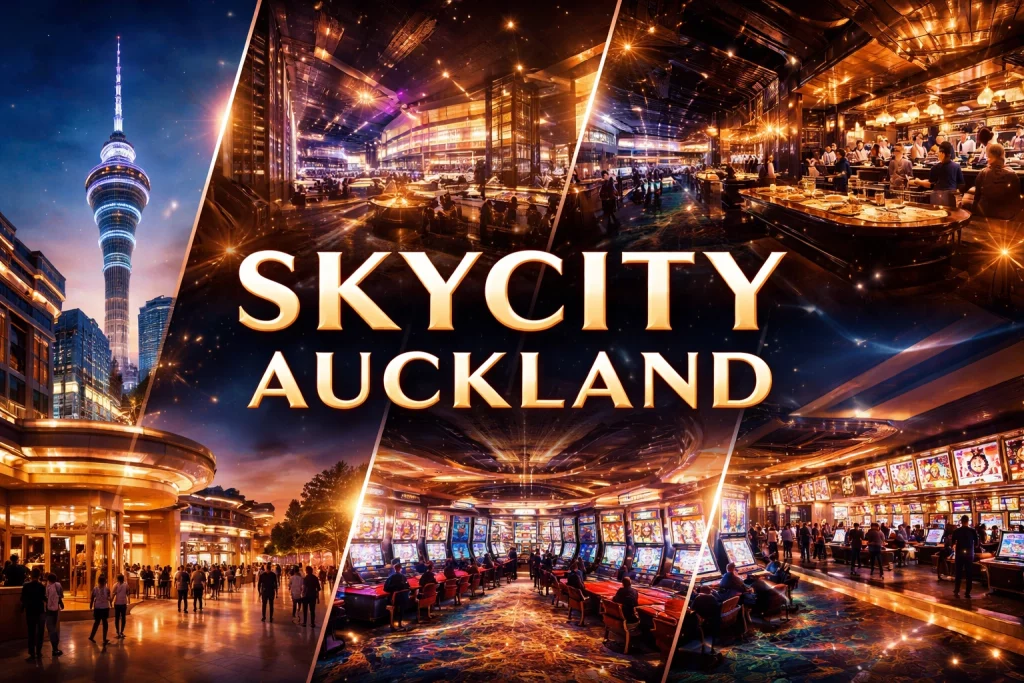
From a practical player perspective, the first useful distinction is that this is an offline casino review, not an online-casino review. The point is not whether the website feels fast or whether a cashier supports instant transfers. The point is how the venue works as a physical gambling environment: how large it is, how accessible it is, what kind of gaming mix it offers, and whether the wider complex improves or distracts from the casino experience. That is where SkyCity starts strongly. The official casino page says the venue has more than 2,100 gaming machines and 150 table games, and that the casino floor is open 24/7 except for Christmas Day, Good Friday, and the restricted ANZAC Day window from 3am to 1pm.
That scale matters because it changes the rhythm of the property. A smaller local casino often feels repetitive after a short visit because the gaming mix is limited. SkyCity Auckland has enough machines, tables, and surrounding non-gaming venues to support several types of visits: quick table sessions, longer weekend stays, restaurant-led evenings, or broader social nights that happen to include gambling. This is where the offline identity becomes more interesting than the online brand extension. The physical site is designed to keep people in the precinct even when they are not actively gambling.
Location and Entry Context
SkyCity Auckland’s biggest physical advantage is where it sits. Because it is in the Auckland CBD, the property benefits from tourist traffic, local footfall, and easy integration into wider city plans. A visitor is not committing to a remote casino trip. They are entering a central urban precinct that can be combined with dining, hotel stays, events, and the tower attraction. That is one reason the property feels more like a destination complex than a standalone gambling floor.
Entry conditions are also clearer than many players expect. SkyCity’s official casino page states “R20 to enter,” which is an important practical point for a New Zealand review. The venue is not just age-restricted in general terms; it is signalling a stricter, clearly stated entry threshold on the casino side. The same page also says that carded play is now required, with a SHOW by SkyCity card or valid Premier Rewards card needed to play any casino games. That is a major operational feature because it means the offline experience is no longer just walk in, sit down, and gamble anonymously. Account-linked play is part of the casino floor structure itself.
That carded-play requirement changes the tone of the venue. It makes the experience feel more systemised and more closely monitored than a traditional anonymous floor. Some visitors will see that as friction. Others will see it as a sign of control and safer play infrastructure. Either way, it is central to how the casino operates now, and it should be part of any serious review.
Find SkyCity Auckland on the Map
SkyCity Auckland is located in the heart of Auckland CBD at the corner of Victoria and Federal Streets, making it easy to reach for both local visitors and tourists.
What the Property Offers Beyond the Gaming Floor
SkyCity Auckland’s strength is that the gaming floor is only one part of the attraction. Because the complex also includes hotels, restaurants, bars, and the tower, the casino can benefit from visitors who did not arrive purely to gamble. That creates a different atmosphere from a venue where every person on site is there for gaming intensity. In practice, this usually produces a more mixed environment: tourists, hotel guests, event attendees, diners, and casino-focused players all circulating through the same precinct.
This matters because it changes how I would frame the casino’s offline value. If a player wants a tightly focused gambling hall, SkyCity may feel broader and more commercial than necessary. If the player wants a full night-out venue where gambling can be combined with dining and skyline attractions, SkyCity’s structure becomes an advantage. The casino benefits from being part of a larger hospitality machine. The trade-off is that it does not feel niche or intimate. It feels large, branded, and institutionally managed.
The first step in that broader journey is still Sign up into the venue’s player ecosystem, because carded play means the physical casino now overlaps with account-style access logic. Even in an offline setting, the customer is no longer interacting only with tables and machines; they are interacting with a tracked player environment. That shifts the experience away from anonymous casino culture and toward a more controlled, loyalty-linked model.
First Practical View of the Gaming Offer
Although this page is about the offline property as a whole, the gaming mix still defines the venue’s core identity. More than 2,100 gaming machines and 150 table games put SkyCity Auckland firmly in the large-scale category by New Zealand standards. That balance suggests a property designed to serve both volume machine play and a serious live-table audience rather than favouring only one side of the casino floor.
The machine volume alone tells you a lot about what the venue expects to drive repeat traffic. Machines are scalable, constant, and easier to integrate into a 24/7 operation than purely table-led formats. At the same time, 150 table games is enough to prevent the place from feeling like a slots floor with decorative live tables around the edges. SkyCity appears to want both groups: players who want continuous machine-led sessions, and players who want a more traditional table environment.
That is where the offline emphasis on Login-style friction from online casinos disappears. In the physical venue, the key question is not how quickly the site loads or how an online wallet behaves. The key question is whether the room feels broad enough, active enough, and professionally structured enough to justify a visit. On paper, SkyCity Auckland clearly does. The remaining question is how those scale advantages hold up once you factor in regulation, harm-minimisation expectations, and the broader reputation context, which I will cover later in the series.
Core Offline Snapshot
| Feature | Official SkyCity Position | Why It Matters | Practical Takeaway |
|---|---|---|---|
| Casino scale | Over 2,100 gaming machines and 150 table games | Defines venue depth and replay variety | Large by NZ standards |
| Opening schedule | 24/7, except Christmas Day, Good Friday, and part of ANZAC Day | Shows serious continuous-floor operation | High accessibility for regular visits |
| Precinct structure | Casino plus 3 hotels, 14 bars/restaurants, theatre, and Sky Tower | Frames the property as a full entertainment destination | More than a standalone gambling floor |
| Entry/play controls | R20 entry and carded play required | Signals a monitored, account-linked environment | Less anonymous than older casino models |
All of these points come directly from SkyCity Auckland’s official property and casino pages.
SkyCity Auckland looks like one of the most structurally complete offline casino destinations in New Zealand. The scale is clear, the setting is central, the hospitality layer is deep, and the gaming floor is large enough to support both machine-led and table-led traffic. At the same time, it is not a casual anonymous gambling hall. The R20 entry rule and carded-play requirement show a more controlled modern venue model.
The Gaming Floor: Machines, Tables, and Overall Rhythm
Once you move past the first impression of the SkyCity Auckland precinct, the next question is whether the casino floor itself justifies the venue’s scale. On paper, the answer is yes. SkyCity states that the casino operates with more than 2,100 gaming machines and 150 table games, and that the floor is open 24/7 except for Christmas Day, Good Friday, and part of ANZAC Day. That is enough volume to place the property firmly in the large-scale category for New Zealand and to support both routine local visitation and destination-style play.
What matters in practice is the balance between those two halves of the room. A venue can advertise a high game count and still feel machine-heavy to the point that the table side becomes symbolic. SkyCity avoids that problem better than many regional venues because 150 live tables is still a serious number. The official table-games page lists Baccarat, Blackjack, Traditional Poker, Royal Poker Progressive, American Roulette, and Tai Sai among the most visible offerings, which suggests a floor designed around both mainstream familiarity and a little bit of diversity rather than only a narrow card-and-roulette core.
The machine side is still hugely important. SkyCity describes its gaming machines as “state-of-the-art” and says they can be played in multiple denominations, with multi-coin and multi-line formats. That matters because machine volume is not only about quantity. It is about whether the venue can support different kinds of session patterns, from low-key repeat play to higher-tempo entertainment-led sessions. In practical terms, the size of the machine floor is one of the main reasons the casino can feel active across a full day rather than only at peak evening times.
Carded Play and How It Changes the Offline Experience
One of the biggest structural differences between SkyCity Auckland and older-style casino expectations is carded play. SkyCity’s official pages state that a SHOW by SkyCity card or a valid Premier Rewards card is required to play casino games, including both gaming machines and table games. That means the gaming floor is not operating as a purely anonymous cash environment anymore. It is a tracked environment where access to play is linked to an identifiable customer profile.
That requirement changes the tone of the venue in a meaningful way. On one hand, it introduces friction for players who prefer old-school anonymity and pure spontaneity. On the other, it aligns with the safer-play positioning SkyCity has been expanding across New Zealand. Public reporting in 2025 described SkyCity’s carded play rollout as a player-safeguard system requiring cards for both machine and table play, which reinforces the idea that this is now part of the company’s long-term operating model rather than a temporary experiment.
From a review perspective, that makes the venue feel more structured and more supervised than a classic free-entry gambling hall. Whether that is a positive depends on what the visitor wants. For some people, the account-linked environment will feel modern and controlled. For others, it will feel like one more step between them and the table. Either way, it is one of the defining practical realities of the current SkyCity floor and cannot be treated as a minor side detail.
Table Play, Poker, and Atmosphere
The live-table side of SkyCity has enough depth to support a real table identity rather than just a casino that happens to have tables. The official table-games page emphasizes 150 table games with a range of minimum and maximum bets, and the poker site confirms that SkyCity runs scheduled poker tournaments for card holders. That combination matters because it shows the venue is not only supporting passive table traffic. It is also supporting a more event-driven competitive layer through poker tournaments and regular fixtures.
This is where the offline venue begins to feel more serious than a tourist-only casino. Poker tournaments, repeat table activity, and a broad live mix suggest a property that expects a committed gambling audience as well as casual visitors. At the same time, because the casino sits inside a hospitality precinct with bars, restaurants, hotels, and the Sky Tower, the atmosphere is likely to remain broader and less insulated than a venue built only for gaming intensity. That mixed environment is part of SkyCity’s appeal, but it also means the floor is serving multiple audiences at once.
One practical consequence is that SkyCity feels better suited to varied visits than to one single type of casino session. A player can enter for a focused table session, but the same venue also works for an evening where gambling is only one part of the plan. This is where the wider precinct matters operationally. The property does not have to force the casino floor to do all the work. The surrounding bars, restaurants, and accommodation create enough gravity that the gambling product can exist inside a fuller entertainment rhythm.
Floor Mix Overview
| Floor Area | Official SkyCity Position | Why It Matters | Practical Reading |
|---|---|---|---|
| Gaming machines | Over 2,100 machines with multiple denominations, multi-coin and multi-line play | Shows deep machine-led capacity | Strong repeat-play engine for the venue |
| Table games | 150 table games, including Baccarat, Blackjack, Traditional Poker, Royal Poker Progressive, American Roulette, and Tai Sai | Confirms broad live-table coverage | Not just a pokies floor with token tables |
| Poker | Tournaments and fixtures published through SkyCity’s poker platform | Adds event-led gambling identity | Supports a committed card-playing audience |
| Carded play | SHOW by SkyCity or valid Premier Rewards card required to play | Defines the operating model of the floor | More controlled and trackable than older casino norms |
How the Venue Feels Structurally
SkyCity Auckland’s biggest strength at this stage of the review is that the gaming floor looks large enough to feel alive without relying on a single attraction. Machines provide continuous density, tables provide visible seriousness, and the poker layer provides repeat event value. This is not a one-note room. It is a casino engineered to operate continuously and absorb several styles of play at once.
At the same time, the structure is unmistakably institutional. The carded-play system, the published opening restrictions, and the integration into a broader SkyCity customer ecosystem make the venue feel less like a loose standalone casino and more like a monitored entertainment asset. That is not inherently negative, but it is central to what kind of offline experience this actually is. Someone expecting an unstructured old-school gambling hall may find it too system-led. Someone who values a clearer operational framework may see that as a strength.
Hotels, Dining, and the Broader Visitor Flow
Once you step back from the gaming floor itself, SkyCity Auckland becomes much easier to understand as a physical destination. The official site describes the precinct as a “world class entertainment complex” in the heart of Auckland’s CBD, with three hotels, 14 bars and restaurants, a casino, a theatre, and the Sky Tower all connected inside one broader environment. That matters because the property is not trying to function as a pure gambling hall. It is trying to function as a full urban leisure precinct where gambling is one major pillar, but not the only reason to visit.
For a visitor, that changes the rhythm of the venue in a very practical way. A standalone casino depends heavily on players arriving with gambling as the primary purpose. SkyCity Auckland can draw from several overlapping groups at once: hotel guests, tourists, diners, event attendees, theatre visitors, and casino-focused players. This creates a more mixed flow through the property. Some people arrive for the casino and stay for dinner. Others arrive for the tower, a restaurant, or an event and then move through the casino as part of the wider night. That kind of foot traffic makes the venue feel less isolated and more integrated into central-city activity.
The fact that the hotels sit inside the same precinct is especially important. The official site lists SkyCity Hotel, The Grand by SkyCity, and Horizon by SkyCity as part of the Auckland complex. From a review perspective, that strengthens the property in two ways. First, it makes the casino viable as a destination stay, not just a short local visit. Second, it adds a constant visitor stream that is not entirely dependent on gaming demand. A strong hotel layer often helps a land-based casino feel active even when gambling traffic alone would not fully carry the room.
Dining Depth and Why It Matters for an Offline Casino
The restaurant and bar list is long enough to affect how the property should be judged. SkyCity’s official site names venues such as The Grill, Metita, SkyBar, Cassia, MASU by Nic Watt, Huami, Orbit 360° Dining, Depot, Federal Delicatessen, Fortuna, Andy’s Burgers & Bar, Onyx, Food Republic, SUCRÉ by SkyCity, and Flare. That range matters because it shows the precinct is designed to support multiple price points and atmospheres rather than one uniform hospitality tone.
For the casino experience itself, this matters more than people sometimes expect. A land-based casino with weak food and drink options often forces visitors into short, narrowly focused sessions. A precinct with varied dining makes longer visits more natural. It allows the casino to become part of a broader evening structure rather than the whole plan. In practice, that tends to make the venue feel more sustainable as a local entertainment destination.
It also changes how different types of visitors will read the property. A dedicated casino player may treat the restaurants as support infrastructure. A social visitor may treat the casino as one stop inside a larger hospitality plan. SkyCity Auckland is clearly designed to satisfy both. The property is large enough that the casino does not have to carry the whole emotional weight of the visit on its own.
How VIP and Loyalty Positioning Fit the Venue
Even without opening every subpage in detail, the official site structure makes clear that SkyCity treats loyalty and premium positioning as a serious part of the physical casino environment. The Auckland site’s main navigation includes SHOW by SkyCity with benefits, promotions, earning points, and join-now functionality, while the casino navigation separately includes VIP Gaming, a Baccarat Room, and Poker. That structure shows that premium and repeat-play segmentation are not hidden extras. They are part of the way the property is organized publicly.
That does not automatically tell you exactly how rewarding the system is in practice, but it does show the operating logic. SkyCity is not just running a gambling floor. It is building a customer ecosystem around tracked play, premium treatment, and repeat visitation.
From a review perspective, the result is an offline casino that feels more institutional than informal. Some visitors will like that because it creates clearer structure and more visible progression. Others may find that it reduces the loose spontaneity older casino models once had. Either way, it is central to understanding the venue.
Why the Precinct Model Changes the Visitor Journey
The biggest structural strength of SkyCity Auckland is that it gives visitors several ways to enter the experience. You can approach it as:
- a casino trip
- a hotel stay with optional gambling
- a restaurant-led evening with casino access nearby
- a tower or event visit that expands into the wider precinct
That flexibility is one of the strongest things the property has going for it. It means the venue does not depend on one kind of customer mood. Someone can come for poker, for a skyline dinner, for a weekend stay, or for a mixed entertainment night. The casino benefits from all of those traffic types because it sits in the middle of them rather than outside them.
This is also why SkyCity Auckland feels more like a civic entertainment node than just a private gambling room. The more the site is woven into tourism, events, and hospitality, the stronger the offline property becomes even for visitors who are not casino-maximizers. That is one of the main reasons the Auckland venue can support both broad social traffic and a serious gaming floor at the same time.
Precinct and Visitor-Flow Overview
| Area | What SkyCity Publicly Shows | Why It Matters | Practical Reading |
|---|---|---|---|
| Hotels | Three hotels: SkyCity Hotel, The Grand by SkyCity, and Horizon by SkyCity | Supports destination stays and non-gaming foot traffic | The casino is integrated into a stay-over precinct |
| Dining & bars | 14 bars and restaurants across the complex | Allows long visits beyond pure gambling sessions | Stronger night-out destination value |
| Tower & attractions | Sky Tower and theatre included in the wider complex | Brings in tourism and event-based visitors | Mixed audience strengthens precinct flow |
| Loyalty / premium signals | SHOW by SkyCity, benefits, earning points, promotions, VIP Gaming, Baccarat Room | Shows tracked-play and premium segmentation are central | More institutional and ecosystem-driven than informal |
How This Shapes the Offline Review
By this stage, SkyCity Auckland looks less like a casino that happens to have amenities and more like a central Auckland entertainment zone with a casino as one of its anchor uses. That distinction matters because it changes how the venue should be judged. If someone wants a narrowly focused gambling hall with minimal surrounding noise, this property may feel too broad and commercially layered. If they want a large, polished destination where gambling sits naturally alongside dining, hotels, and attractions, SkyCity becomes much more compelling.
It also explains why the venue can feel strong even to people who are not purely machine- or table-driven gamblers. The offline property has enough gravity outside the gaming floor to make a full visit worthwhile. In a city-centre entertainment context, that is a major strength.
Regulation, Host Responsibility, and Final Verdict
The final part of the review matters because SkyCity Auckland cannot be judged only by the size of its floor or the strength of its dining precinct. It also has to be judged by how it operates under scrutiny. Official SkyCity pages make its host-responsibility position very visible: carded play is mandatory, and the operator says this is part of its commitment to safer gaming and preventing financial crime. The casino page states that a SHOW by SkyCity card or valid Premier Rewards card is required to play any casino game, and related SkyCity pages repeat that this is tied to host responsibility.
That system changes how the venue should be understood. SkyCity Auckland is not trying to preserve the older model of anonymous floor play. It is moving toward a tracked, account-linked casino environment. For some visitors, that will feel more restrictive. For others, it will feel more credible and easier to trust. Either way, it is a defining feature of the current venue model and one of the clearest differences between SkyCity Auckland and more traditional walk-in gambling environments.
Why Public Accountability Matters in This Review
A serious offline casino review also has to include the public regulatory context. In July 2024, New Zealand’s Department of Internal Affairs announced that SkyCity Auckland agreed to a five-day voluntary closure of its gambling operation following licence breaches relating to harm-minimisation obligations. The DIA later reiterated that closure in September 2024 as a reminder to gambling licence holders about their harm-minimisation duties. SkyCity itself also confirmed the five-day closure period in an NZX market release.
This does not erase the venue’s strengths, but it does make the trust picture more nuanced. SkyCity Auckland is one of the most visible casino brands in New Zealand, but that visibility also means its failures are public and meaningful. From a review standpoint, the right conclusion is not that the venue is weak by default. The more accurate conclusion is that SkyCity combines strong infrastructure with real accountability pressure. That is a more balanced reading than either blind trust or blanket dismissal.
How the Venue Balances Strength and Friction
By this point, the property’s identity is fairly clear. Its strongest assets are scale, central location, integrated hospitality, and a broad gambling mix. Its main frictions are structure, tracking, and the fact that the venue is no longer operating as a low-friction anonymous casino. The same features that make it feel safer and more modern can also make it feel more controlled.
In practical terms, this balance looks like this:
- the casino floor is large enough to feel significant in NZ terms
- the restaurants, hotels, and tower make the precinct stronger than a standalone venue
- carded play and host-responsibility framing reduce old-school spontaneity
- the public harm-minimisation context means trust has to be earned, not assumed
That is why SkyCity Auckland feels more like an institutional entertainment venue than a pure gambling hall. It is large, established, and legible, but it is also more structured than many players instinctively expect from a casino night out.
Evaluation Matrix
| Area | What the Available Evidence Shows | Review Impact | Overall Reading |
|---|---|---|---|
| Casino scale | Over 2,100 gaming machines and 150 table games | Strong physical depth by NZ standards | Major offline gambling venue |
| Precinct quality | Hotels, dining, tower, and central CBD positioning | Improves destination value | Much stronger than a standalone floor |
| Operational model | Carded play required to gamble | Increases structure and reduces anonymity | Modern, monitored, system-led venue |
| Public trust context | 2024 voluntary closure linked to harm-minimisation breaches | Adds caution to brand assessment | Recognizable, but not beyond criticism |
Final Overall Verdict
If I step back and judge SkyCity Auckland as a full offline casino rather than just a gaming floor, it stands out as one of the most complete land-based gambling destinations in New Zealand. The scale is real, the CBD location is a major advantage, the hospitality infrastructure is unusually deep, and the casino product is large enough to support both machine-led traffic and serious table play.
At the same time, this is not a casual old-style casino environment anymore. Mandatory carded play and the wider host-responsibility emphasis make the venue feel more monitored and more procedural. Add the 2024 harm-minimisation breach context, and the final picture becomes clear: SkyCity Auckland is a strong, high-profile entertainment casino with real infrastructure and real scrutiny. That combination makes it one of the most significant offline casino venues in New Zealand, but also one that should be evaluated with more nuance than brand familiarity alone would suggest.






Comments