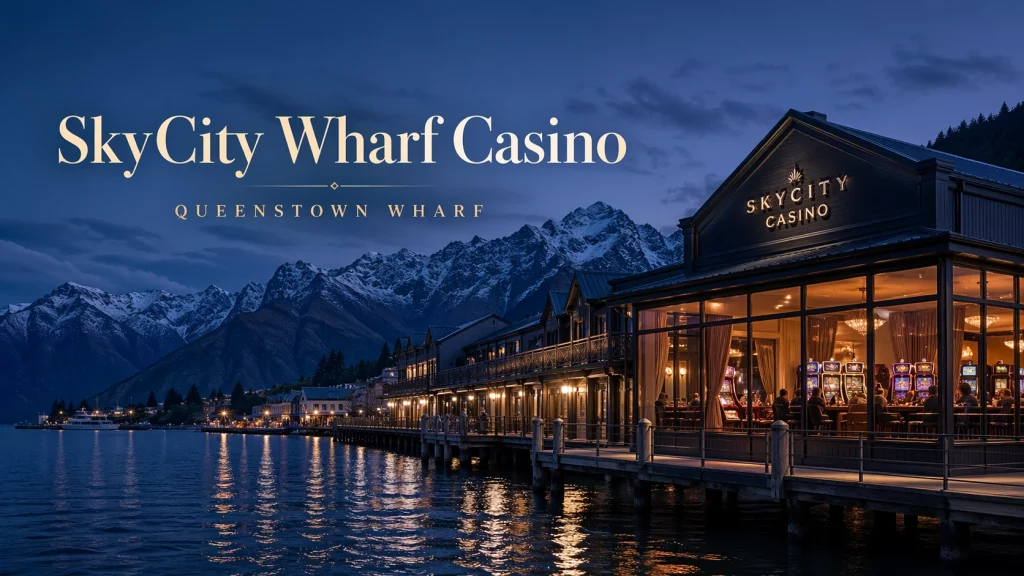
SkyCity Wharf Casino (Queenstown Wharf)
A Different Kind of Casino Setting
SkyCity Wharf Casino in Queenstown operates under a very different logic compared to traditional standalone casino properties. Located directly on the Queenstown waterfront, this venue is integrated into the Wharf entertainment area, which means the experience begins before you even enter the gaming floor. The surrounding environment—restaurants, lake views, pedestrian flow—creates a hybrid atmosphere where casino activity blends with tourism and nightlife rather than dominating it.
This matters more than it might seem. In most casino reviews, the building defines the experience. Here, the location defines it. The waterfront setting changes how people approach gaming sessions. Visitors are not arriving with the sole intention of gambling for hours. Instead, they move fluidly between dining, walking, socializing, and short gaming intervals. That behavioral pattern shapes everything inside the casino.
Boutique Scale and Controlled Environment
SkyCity Wharf Casino is a smaller, boutique-style venue compared to large integrated resorts. That is not a limitation—it is a design decision. The gaming floor is compact, structured, and easy to navigate. Instead of overwhelming players with scale, the venue focuses on accessibility and clarity.
From a usability perspective, this creates a more efficient experience. You can understand the layout within minutes. Machines, tables, and service areas are all within close proximity. There is no need to “learn the space” over multiple visits. This is especially valuable for tourists who may only visit once.
Entry, Identity, and Structured Play
One of the defining operational characteristics of SkyCity Wharf Casino is its reliance on carded play. Similar to other SkyCity properties, access to gaming is linked to a player identification system. This means that before engaging with machines or tables, you will need to complete a Sign up process for a player card if you do not already have one.
This step changes the flow of entry. It introduces a short onboarding phase where identity verification takes place. While this may initially feel like friction, it serves multiple purposes: compliance, security, and tracking of player activity. For a venue located in a high-tourism zone, this structured entry system helps maintain consistency across a constantly changing visitor base.
First Impressions of the Gaming Floor
The gaming floor at Wharf Casino is not designed to impress through scale. It is designed to function efficiently within a limited space. Lighting, machine placement, and table positioning all reflect that constraint.
What stands out is the balance between machines and tables. There is enough variety to support different player preferences, but not so much that the environment becomes chaotic. This creates a calmer, more controlled atmosphere compared to high-density casino floors.
From a behavioral standpoint, players tend to make quicker decisions in this environment. You are not navigating endless options—you are choosing from a curated set of familiar formats.
SkyCity Wharf Casino
Queenstown Wharf
Steamer Wharf, Beach Street
Queenstown 9300, New Zealand
Why Location Drives Player Behavior
Because the casino is embedded in the Wharf area, player sessions tend to be shorter and more fragmented. People come in, play for a defined period, then leave to continue their evening elsewhere.
This pattern has a subtle but important effect on how the venue operates. It reduces long-session dominance and increases turnover. The casino becomes part of a broader entertainment cycle rather than a standalone destination.
That dynamic also affects expectations around Bonus structures. Unlike large online platforms or resort casinos that rely heavily on aggressive promotions, Wharf Casino’s value comes more from its accessibility and location than from layered incentive systems.
System Clarity Over Visual Excess
One of the most consistent themes across SkyCity venues is operational clarity. Wharf Casino follows that same model. The rules are visible, the processes are defined, and the flow from entry to play is structured.
This clarity becomes particularly important for first-time visitors. Instead of guessing how things work, players can move through the system step by step: registration, card activation, machine or table access, and session completion.
In that sense, the venue behaves more like a controlled system than a free-form entertainment space. That may not appeal to every type of player, but it creates predictability.
The Role of Login-Style Access
Although this is a physical venue, the experience mirrors digital systems in one key way: access is account-based. You are effectively “logging in” to the gaming environment through your player card.
This Login-style structure ensures that all activity is tied to a verified profile. It also allows the venue to implement features such as session tracking, spending visibility, and responsible play controls.
For players accustomed to online casinos, this will feel familiar. For others, it may feel more structured than expected in a physical casino setting.
Core Overview of SkyCity Wharf Casino
| Category | Details |
| Location | Queenstown Wharf, Lakefront area |
| Venue Type | Boutique waterfront casino |
| Environment | Integrated with restaurants, bars, and tourism zone |
| Gaming Style | Short-session, high-turnover player flow |
| Access | Card-based, identity-linked play |
| Target Audience | Tourists, casual players, short-session visitors |
| Atmosphere | Compact, controlled, accessible |
If you evaluate SkyCity Wharf Casino using the same criteria as a large-scale resort casino, you will miss the point. This venue is optimized for a specific use case: quick access, clear structure, and integration into a broader entertainment environment.
That makes it particularly effective for visitors who value convenience and clarity over scale and complexity.
The Key Fact: Wharf Casino Is No Longer Operating
Before going deeper, one point has to be stated clearly. SkyCity Wharf Casino is not currently operating. SkyCity’s own regulatory page lists Queenstown Wharf Casino as “NOW CLOSED,” and SkyCity’s 2024 annual report says the SkyCity Wharf casino venue licence was relinquished and cancelled in March 2024 after the venue had remained closed since March 2020.
That changes how this page should be read. It cannot be treated as a guide to a currently active casino floor in the same way as SkyCity Queenstown on Beach Street. Instead, it works better as a structured overview of what the Wharf property represented inside Queenstown’s casino ecosystem, why it mattered, and how its operating logic differed from the main SkyCity Queenstown venue. SkyCity’s own history page still describes it as a waterfront gaming and entertainment venue on the shores of Lake Wakatipu, acquired by SkyCity in 2013.
Why the Wharf Venue Was Strategically Interesting
The Wharf property had a very specific role. It was not designed to compete through scale with a full-sized casino model. SkyCity described it historically as a high-end boutique gaming experience with waterfront views and a more intimate setting. That language matters because it shows the venue was positioned around exclusivity, location, and atmosphere rather than sheer machine volume or broad entertainment sprawl.
Queenstown was unusual in New Zealand because it had two SkyCity-linked casino venues in the same market: the main SkyCity Queenstown site and the Wharf casino. SkyCity’s corporate history and broader company summaries reflect that dual-property structure, which made Queenstown a rare case where one tourist town could support both a central boutique casino and a second waterfront gaming venue aimed at a slightly different use pattern.
Scale and Capacity Tell the Story
The Wharf operation was smaller than many readers might expect. Historical references consistently describe it as licensed for 74 gaming machines and 6 gaming tables. That immediately tells you the venue was not trying to become a giant all-purpose casino. It was built to operate as a compact, selective gaming environment with a narrower floor and a more curated atmosphere.
That smaller scale likely influenced player behavior in predictable ways. In a compact casino, session decisions happen faster. Players do not spend long periods navigating the floor or scanning dozens of game zones. They typically arrive with a clearer intention: a short machine session, a specific table game, or a brief visit as part of a larger evening on the waterfront. In that sense, the Wharf venue appears to have been optimized for precision rather than volume. This is an inference based on its published scale and positioning.
Why the Closure Matters to the Review
The closure is not just a footnote. It affects how any serious review should frame the property. SkyCity’s annual reporting states that the Wharf casino remained closed from March 2020 and that management did not plan to reopen it, with later reporting confirming the licence was relinquished and cancelled in March 2024. That means the venue should now be understood as part of Queenstown casino history rather than part of its current live casino offer.
This also means readers looking for a current visit path should not expect an active entrance, current gaming hours, or live service information for SkyCity Wharf Casino itself. The active current SkyCity casino property in Queenstown is the main SkyCity Queenstown venue, which the official Queenstown website continues to promote as the operating entertainment complex and casino in the CBD.
What the Access Model Likely Felt Like
Although the Wharf casino no longer operates, it is reasonable to interpret its operational model through the same broader SkyCity framework that emphasizes controlled, identity-linked casino access. SkyCity’s Queenstown business is built around structured play, defined venue rules, and responsible-gambling systems, and the Wharf property was part of that broader corporate environment. That suggests the experience would have been less about anonymous, impulsive gambling and more about monitored, rule-based access within a boutique setting. This is an inference drawn from SkyCity’s operating model and corporate handling of its Queenstown assets.
From a player-experience angle, that is important. Boutique casinos often feel more relaxed on the surface because they are smaller and more scenic, but they can actually be more structured underneath because every table, every machine cluster, and every player interaction carries more weight in a limited floor plan. The Wharf model seems to fit that pattern. It was intimate, but not casual in the operational sense.
Was There a Distinct Digital Layer?
For readers wondering about mobile planning, there is no current official evidence of a separate dedicated Wharf Casino App. The present SkyCity Queenstown web presence is centralized under the main Queenstown site, not a standalone Wharf product. So from a practical point of view, Wharf is not a current digital destination with its own active consumer journey; it survives mainly as a historical venue inside SkyCity’s corporate and regulatory record.
The More Accurate Way to Evaluate the Property
The fairest way to judge SkyCity Wharf Casino now is not as an active casino you can compare line by line against today’s live venues. It is better understood as a former waterfront boutique casino that once gave Queenstown an unusually dense gaming footprint for a town of its size. Its importance was contextual. It offered a second casino identity inside the same tourism market: smaller, more intimate, and more location-driven than the main CBD venue.
That makes the Wharf story useful even today. It shows that Queenstown’s casino market was once segmented, not singular. There was room for a main central casino and a separate wharf-based experience. The fact that one survived and one did not also says something about how tourism dependence, lease constraints, and market concentration shape land-based casino viability in smaller destinations. SkyCity’s reporting and regulatory disclosures support exactly that interpretation.
| Wharf Casino Factor | What the Sources Show | Why It Matters |
| Ownership | Acquired by SkyCity in 2013 | It became part of SkyCity’s Queenstown casino footprint |
| Positioning | Waterfront, boutique, high-end gaming venue | Explains why it differed from the main Queenstown casino |
| Licensed Capacity | 74 gaming machines and 6 gaming tables | Confirms the compact, curated nature of the floor |
| Closure Timeline | Closed from March 2020 | It stopped functioning as a live casino during the pandemic period |
| Regulatory Status | Licence relinquished and cancelled in March 2024 | Confirms it is not a current operating venue |
| Current Relevance | Historical rather than operational | The page should be framed as analysis, not a current visit guide |
A Waterfront Casino Never Behaves Like an Inland One
What made SkyCity Wharf Casino interesting was not just that it was smaller. It was where that smaller scale was placed. Contemporary reporting and SkyCity’s own historical description position the Wharf venue at the Steamer Wharf / waterfront side of Queenstown, directly tied to the lakefront leisure zone rather than to a conventional stand-alone casino footprint. That changes the rhythm of gambling activity. A waterfront casino attracts a different type of session: less sealed-off, less all-consuming, and more connected to the movement of visitors through restaurants, bars, scenic walks, and evening tourism.
In practical terms, that means the Wharf casino likely worked as a transitional venue rather than a destination bunker. People were not entering a giant interior world and staying there for six uninterrupted hours. They were more likely arriving as part of a sequence: dinner, drinks, lakefront movement, then gaming. That interpretation is not speculation pulled from nowhere; it follows directly from the venue’s waterfront placement, its boutique positioning, and its relatively modest licensed floor capacity of 74 gaming machines and 6 tables.
Boutique Scale Changes the Psychology of Play
A compact floor affects behavior more than most casual reviews admit. In a larger casino, players often spend time drifting—walking the floor, comparing areas, looking for quieter corners, watching table limits, or waiting for the room to tell them where they belong. A boutique casino works differently. It compresses decision-making. Because the Wharf venue was licensed for 74 electronic gaming machines and 6 gaming tables, the environment would have been legible very quickly. You could understand the floor in minutes. That kind of legibility usually leads to shorter hesitation phases and faster session commitment.
This matters for how the venue should be described. The Wharf casino was probably not the kind of place where a player arrived specifically to “explore the floor.” It was more likely a place where players arrived already knowing roughly what they wanted: machines for a contained solo session, or one of a limited number of tables for a shorter, more focused gaming block. In a boutique setting, the floor does not invite wandering so much as immediate participation. That is one of the clearest structural differences between a property like this and a large regional casino. The sources support that by showing both its small capacity and its high-end boutique positioning.
How Slots Likely Worked in This Environment
Although we do not have a current active game catalogue for the closed Wharf venue, the licensed machine count still tells us something useful. A 74-machine floor is large enough to offer meaningful variety, but not large enough to fragment the room into dozens of micro-zones. That suggests the machine experience was probably organized around familiarity, quick recognition, and high visibility rather than depth through endless categorization. In other words, the Slots side of the venue was likely strongest not because it offered infinite novelty, but because it could deliver an immediate, easy-to-read session inside a scenic and compact setting. This is an inference from the published capacity and the venue’s boutique format.
That also fits the Queenstown tourism market. In a tourist town, many guests are not repeat local players memorizing floor layouts over months. They are visitors. They need fast comprehension. A boutique casino near the waterfront benefits from machine play that is intuitive enough to support drop-in use. That kind of setup reduces cognitive friction. The machine floor does not need to overwhelm. It needs to convert passing curiosity into an actual session without demanding a learning curve. Again, this is an interpretation grounded in the venue’s tourist setting and small footprint.
Table Games Would Have Carried More Weight Per Seat
The same principle applies even more strongly to table Games. With only 6 licensed tables, every seat matters more, every open game matters more, and table visibility matters more. In a boutique casino, the table area is not one zone among many. It becomes a defining feature of the room’s identity. A small number of tables can make the environment feel more intimate, but it also means the venue must rely on core recognizable table formats rather than broad experimentation. That aligns with how boutique casinos usually survive: not by offering every game, but by offering the right games in a setting that feels accessible and socially legible. The key hard fact here is the six-table licence; the rest is a cautious inference from that constraint.
This limited-table logic likely made the Wharf venue more atmosphere-sensitive than larger casinos. In a big floor, one quiet table can disappear into the background. In a small waterfront casino, table activity shapes the entire room. If the tables were lively, the whole venue felt active. If they were quiet, the property likely felt more lounge-like than casino-dominant. That is one reason boutique gambling venues can feel dramatically different from one hour to the next even when the raw capacity does not change. The room’s social intensity is concentrated, not dispersed. This is an inference, but it is a strong one given the venue’s documented scale.
The Waterfront Setting Probably Encouraged Shorter Sessions
One of the most useful ways to understand the Wharf casino is through session length. The venue remained in a tourism-heavy waterfront area, and SkyCity later cited the severe impact of the pandemic on Queenstown’s international tourism market when explaining why the Wharf property had remained closed since March 2020 and why management decided not to reopen it. That indicates just how dependent the venue was on visitor traffic rather than a deep local base. A venue built on tourism usually develops shorter, more intermittent session patterns because the customer base is less routine-driven.
So the likely player flow here was not “arrive, settle in, and commit to a long gambling block.” It was more likely “arrive because you are already at the wharf, step inside because the setting is convenient, play for a contained period, then continue the evening elsewhere.” That makes the Wharf casino structurally different from a city casino that anchors the entire night. Here, the casino probably functioned as one node in a larger leisure circuit. The sources do not spell out that sentence directly, but they strongly support it through the venue’s location, scale, and tourism exposure.
Why This Venue Was More Than a Duplicate of Main SkyCity Queenstown
It would be a mistake to think of the Wharf venue as merely a smaller duplicate of the main Queenstown casino. The point of having both appears to have been segmentation. The main property offered the established CBD casino footprint, while the Wharf site offered a second, more intimate waterfront identity. Even the raw licensing numbers show they were distinct in scale: company disclosures list 86 electronic gaming machines and 12 table games for Queenstown, versus 74 electronic gaming machines and 6 tables for Wharf. That means the Wharf venue was not simply redundant; it was materially smaller and more selective.
That segmentation is what makes the Wharf property historically interesting. Queenstown was one of the few small tourism markets where casino supply was split into two differently positioned venues under the same corporate umbrella. One was central and continuing; the other was waterfront, boutique, and ultimately non-viable once tourism collapsed and the lease could not be renegotiated. That contrast tells you a lot about what kind of casino models can survive in small resort towns.
Why the Venue’s Closure Makes the Atmosphere More Important to Analyze
Because the Wharf casino is now closed, the real value of reviewing it is not to give readers a current visit checklist. It is to capture what kind of land-based casino model it represented. And what it represented was a very specific formula: scenic location, compact licence, boutique positioning, tourism reliance, and probably a shorter-session player profile than most traditional casinos. SkyCity’s historical materials and annual reports make that picture fairly coherent even without a live floor to walk today.
This is also where the idea of a traditional promotional ecosystem becomes less central. A venue like this was unlikely to compete primarily through an aggressive Bonus logic. Its value proposition was the setting itself. The waterfront did part of the work. The room did not need to shout if the location already made the stop feel special. That is not a factual claim about a specific past promo menu; it is an interpretation of how boutique land-based venues generally differentiate when their capacity is constrained and their surroundings are their strongest marketing asset. The sources support the boutique, waterfront, and high-end framing that underlies this interpretation.
| Operational Feature | Historic Evidence | Likely Effect on Player Experience |
| Waterfront placement | Located in Steamer Wharf / Queenstown waterfront area | Encouraged walk-in tourism traffic and shorter entertainment-linked sessions |
| Boutique positioning | Described as a high-end boutique gaming venue | Shifted emphasis from scale to atmosphere and selectivity |
| 74 gaming machines | Published licensed machine capacity | Enough choice for real play, but not enough to create a sprawling floor |
| 6 gaming tables | Published licensed table capacity | Table activity would have had a strong influence on the room’s overall energy |
| Tourism dependence | Closure linked to ongoing tourism-market damage after March 2020 | Suggests the venue relied heavily on visitors rather than a large local base |
| Dual-venue market role | Operated alongside main SkyCity Queenstown property | Likely served a differentiated niche rather than duplicating the CBD venue |
What SkyCity Wharf Casino Ultimately Represented
The most useful way to understand SkyCity Wharf Casino is not as a missing casino building, but as a case study in how location-specific gambling venues function inside resort economies. This was not a generic suburban gaming property that could simply be transplanted elsewhere. It depended on waterfront foot traffic, tourism intensity, and Queenstown’s identity as a high-value leisure destination. SkyCity’s own reporting makes that dependence clear by explaining that the venue had remained closed since March 2020 and that reopening was not planned after the severe impact on Queenstown’s international tourism market.
That single fact tells you a great deal. It suggests the Wharf venue was viable when Queenstown’s visitor ecosystem was strong, but much more vulnerable when that ecosystem contracted. In other words, the casino’s economic logic was not based only on gambling demand. It was tied to place. That is what made it distinctive, and that is probably what made it fragile. The venue worked best when Queenstown itself was working at full tourist intensity. Once that broke, the property’s boutique advantages were no longer enough to guarantee survival.
Why the Licence Cancellation Matters
This is where many casino pages become inaccurate. They keep describing a property as if it still exists in live consumer terms. That would be a mistake here. SkyCity’s regulatory page explicitly lists Queenstown Wharf Casino as closed, and SkyCity’s 2024 reporting confirms the venue licence was relinquished and cancelled in March 2024. So any review that presents this as a currently operating casino would be materially wrong.
That does not mean the venue is no longer worth covering. It means the framing must change. The page should function as a historical review and contextual guide rather than a real-time visitor instruction manual. Readers can still learn a lot from it: how the venue was positioned, how it differed from the main SkyCity Queenstown site, what its scale implied for the player experience, and why a boutique waterfront casino might struggle once the tourism engine behind it weakens.
The Difference Between Wharf and Main SkyCity Queenstown
The closure also makes the comparison with the surviving SkyCity Queenstown property more important. SkyCity’s current Queenstown site remains the active operating venue, while the Wharf property is historical. Corporate materials and public summaries indicate that the main Queenstown venue had the larger continuing footprint, while the Wharf venue remained smaller and more selective. That division reinforces the idea that the Wharf site was never supposed to be the default all-purpose casino for the market. It was the more atmosphere-driven alternative.
That distinction matters for interpretation. If a reader is looking for an active casino in Queenstown today, the correct destination is the current SkyCity Queenstown venue rather than anything branded as Wharf Casino. If, however, the goal is to understand Queenstown’s casino history, then the Wharf property is one of the most revealing pieces of that history because it shows how differentiated casino supply once existed in a small tourism market.
What This Says About Boutique Land-Based Casinos
There is a broader lesson here. Boutique land-based casinos often look attractive on paper because they combine exclusivity, manageable scale, and a distinctive setting. But those same strengths can become dependencies. A large urban casino can survive partly through routine local demand, business traffic, and volume-based resilience. A boutique waterfront casino in a resort town has less margin for disruption. It relies more heavily on ambiance, tourism flow, and premium positioning. When those conditions weaken, the model becomes much harder to sustain. This is an inference from the documented closure history, the venue’s positioning, and Queenstown’s tourism-linked exposure.
That is why SkyCity Wharf Casino is more analytically interesting than its raw size might suggest. It was a small venue, but it exposed a larger truth about land-based gambling economics: the right location can create value, but location-based value is also highly perishable. A casino built into a scenic tourism circuit may thrive when that circuit is dense and emotionally charged. It may struggle quickly when that circuit fractures.
Practical Takeaway for Readers
For a reader landing on this page today, the first practical takeaway is simple: do not treat SkyCity Wharf Casino as a current operational option. It is closed, and the licence is cancelled. The second takeaway is that the venue still deserves attention because it helps explain Queenstown’s broader gambling landscape and the strategic choices SkyCity made in the region over time.
This is also the point where procedural expectations matter. There is no current Sign up path for this casino as a live venue, no dedicated current Login journey for players planning a visit, and no evidence of a standalone current consumer App for Wharf Casino itself. The active digital path for casino visitors in Queenstown runs through the main SkyCity Queenstown web presence, not through a separate Wharf product.
The Most Relevant FAQ for This Page
The most important FAQ is not “What games can I play there tonight?” It is “Is this casino still open?” The answer is no. The next most useful question is “Why is it still worth writing about?” Because the Wharf venue reveals how casino products can be segmented by location, mood, and expected session length even within the same town and under the same corporate group. Those are not trivial details. They explain how gambling venues are designed for specific behavioral patterns, not just for generic market demand.
Another question worth answering is whether the Wharf venue likely had meaningful value even without being large. I think the answer is yes. Its published capacity, boutique branding, and waterfront context all suggest it offered a very specific kind of gambling experience: compact, scenic, tourism-facing, and probably more atmosphere-dependent than system-dependent. That does not make it more important than the main Queenstown venue, but it does make it different in a way that is worth documenting. This is an inference supported by the venue’s published positioning and scale.
Final Judgment
My final judgment is that SkyCity Wharf Casino should be remembered less as a failed casino and more as a narrowly targeted one. It appears to have been built for a specific Queenstown moment and a specific visitor rhythm: waterfront movement, shorter sessions, boutique atmosphere, and premium leisure positioning. Those traits gave it identity. They just did not give it enough resilience once the market changed.
That is why this page works best as a historical analytical review. It is not a live venue guide. It is an explanation of what the Wharf casino was, how it differed from the continuing main SkyCity Queenstown venue, and why its closure tells us something useful about casino economics in tourism-driven towns. For readers who want the current operational path, the right Links are the official SkyCity regulatory page and the current SkyCity Queenstown site. Those are the sources that define the present status accurately.






Comments