
Responsible Gambling NZ Guide
Responsible gambling in New Zealand is not just a personal discipline issue. It is also a public health, legal, and platform-design issue. Gambling can appear casual when it sits inside a phone screen or a casino lobby, but the risk structure is still real: money is being placed on uncertain outcomes, game design can encourage repeated play, and fast digital access can reduce the natural pauses that help people make better decisions.
This guide is written for a New Zealand context and should be understood as harm-minimisation content, not as encouragement to gamble. In New Zealand, gambling harm is monitored as a public health issue, and the Ministry of Health collects data on gambling activity, risk, harm impact, and help-seeking among people aged 15 and over. The Department of Internal Affairs also explains that gambling regulation in New Zealand is designed to reduce harm, prevent crime and dishonesty, protect consumers, and create clearer rules for operators.
A responsible gambling guide should begin with a simple principle: gambling should never be treated as income, a financial plan, a recovery method, or a way to solve stress. It is a paid form of entertainment with built-in risk. If the experience stops feeling controlled, affordable, or optional, the safest decision is to pause and use support tools before the situation becomes harder to manage.
What Responsible Gambling Means in New Zealand
Responsible gambling means setting clear boundaries before gambling starts, understanding the risk of each product, using account controls, and knowing when to stop. It also means recognising that harm is not limited to losing large amounts of money. Harm can include stress, secrecy, chasing losses, disrupted sleep, conflict with family or whānau, missed work or study, and emotional pressure after repeated losses.
In New Zealand, harm minimisation is treated as part of the wider gambling framework. The Department of Internal Affairs states that the Gambling Act and harm minimisation regulations contain measures aimed at limiting gambling harm from pokies and casino gambling. This matters because responsible gambling should not be reduced to a small footer message. It should appear across the whole user journey: account creation, payment pages, promotions, game pages, support areas, and self-exclusion tools.
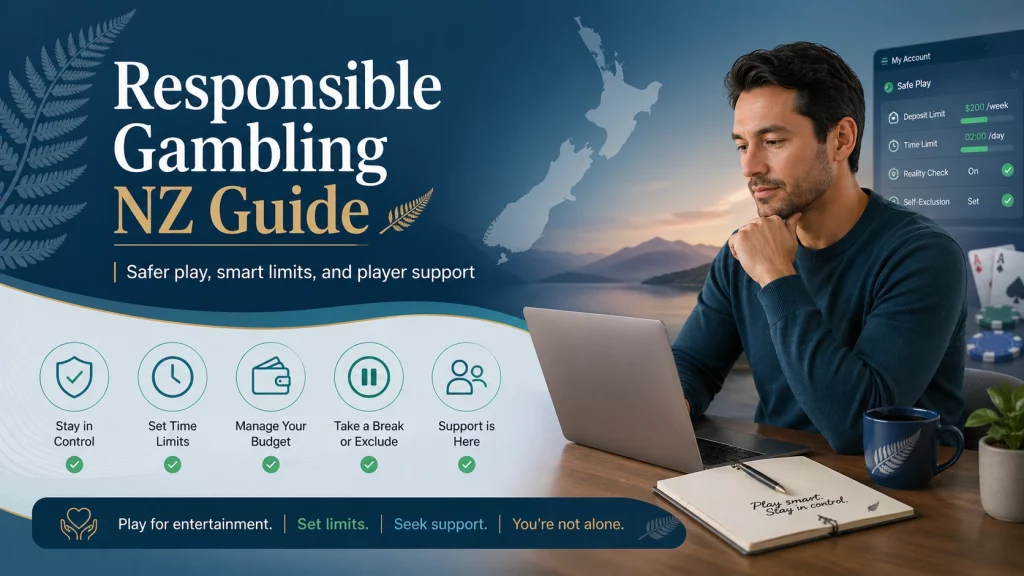
A safe gambling environment should not depend only on the player noticing risk. The platform should also make risk visible. Clear terms, accessible limits, transparent withdrawal rules, and easy-to-find support information all matter. If a gambling site hides harm-minimisation tools or makes them difficult to use, the platform is weaker from a responsible gambling perspective.
For New Zealand players, another important point is the changing online casino environment. The Department of Internal Affairs has stated that New Zealand is introducing regulation for online casino gambling to create a safer and better-controlled environment. That makes responsible gambling guidance especially relevant, because players need to understand not only games and payments, but also how platform rules, limits, and support systems work.
| NZ Responsible Gambling Resource | What It Covers | Why It Matters |
| Ministry of Health Gambling Statistics | Research, gambling harm data, survey findings and risk monitoring | Useful for understanding gambling as a public health issue in New Zealand |
| Department of Internal Affairs Gambling Information | New Zealand gambling rules, legal context and regulatory information | Helps players understand the legal and regulatory environment |
| DIA Harm Minimisation | Measures designed to reduce gambling harm in casino and pokies environments | Shows how harm minimisation connects to regulation and venue obligations |
| Problem Gambling Foundation NZ | Free and confidential support for people affected by gambling harm | Provides practical help for individuals, families and affected communities |
Start With the Account, Not the Game
A responsible gambling review should begin before any game is opened. The account area is where the most important safety controls usually sit. A player should check whether deposit limits, loss limits, session reminders, time-outs, self-exclusion, and account closure tools are visible and usable. If these tools are hard to locate, that is a weak point.
The Login area should not only be a doorway back into gambling. It should also give fast access to account controls. A user who logs in should be able to see balance information, limits, activity history, support links, and security settings without having to search through confusing menus. Responsible gambling works best when the control tools are located close to the behaviour they are meant to manage.
The Sign up stage also matters. A safer registration flow should include age confirmation, identity accuracy, terms visibility, privacy information, and references to responsible gambling tools. Registration should not feel like a rushed path into depositing. The player should have time to understand what kind of account they are creating and what controls are available before money is involved.
Promotions need special attention. A Bonus offer can make gambling feel less risky than it is, especially when free spins, deposit matches, or wagering incentives are presented as extra value. The risk is that a player may focus on the offer and ignore wagering rules, expiry times, maximum bet restrictions, or withdrawal limits. Responsible gambling means reading promotional terms slowly and avoiding any offer that creates pressure to deposit more than planned.
Recognising Early Warning Signs
Responsible gambling is easiest when warning signs are recognised early. Harm often develops gradually. A player may begin by extending a session slightly, then deposit again to recover a loss, then hide the activity, then feel anxious when not playing. These behaviours are more important than the amount lost. A small loss can still be harmful if it creates stress, secrecy, or repeated chasing.
One warning sign is emotional dependence. If gambling becomes a way to escape pressure, boredom, loneliness, conflict, or financial worry, risk increases. Another warning sign is chasing. Chasing means trying to win back losses by gambling more. This is especially dangerous because it shifts gambling from entertainment into recovery behaviour. The more someone tries to “fix” a loss through gambling, the less controlled the situation becomes.
Time distortion is another risk. Online gambling can make sessions feel shorter than they are. Fast rounds, autoplay features, mobile access, and repeated small bets can create a rhythm where the player stops measuring time clearly. Responsible gambling tools such as session reminders and time-outs are useful because they interrupt that rhythm.
Why New Zealand Players Should Use Limits Early
Limits are most effective when they are set before emotions become involved. A player who waits until after a loss may set limits too late or avoid setting them altogether. A better approach is to decide the maximum affordable spend, maximum session length, and maximum deposit frequency before gambling begins.
Deposit limits are usually the most basic control. They restrict how much money can be added to the account over a selected period. Loss limits go further by controlling how much can be lost. Session limits or reminders help with time management. Time-outs create a temporary break. Self-exclusion is stronger and is used when gambling should stop for a longer period.
The most responsible approach is to treat limits as normal account settings, not as a sign of failure. People set budgets for entertainment, shopping, travel, and subscriptions. Gambling should be no different. In fact, because gambling has uncertain outcomes, limits are more important here than in many other forms of entertainment.
A useful responsible gambling page should also answer practical questions. The FAQ section should explain how limits work, whether reduced limits apply immediately, how long it takes to increase a limit, how time-outs are activated, and what happens during self-exclusion. If these answers are missing, the site is not giving players enough information to manage risk properly.
Support information should also be easy to reach through Links that point to help services, regulatory information, harm-minimisation resources, and account-control guidance. Responsible gambling content should not isolate the player inside the casino website. It should show where external help and independent information can be found.
Money Control, Session Control and Game Risk in NZ Gambling
Responsible gambling becomes practical when it moves from general advice into specific behaviour. It is easy to say “set a budget” or “play carefully,” but those phrases are too vague unless they are connected to real decisions. A New Zealand player needs a working system: decide the money limit before depositing, decide the time limit before opening the lobby, choose games with a clear understanding of volatility, and stop when the session reaches the planned boundary.
The key point is that responsible gambling should happen before emotional pressure starts. Once a player is already frustrated, chasing losses, or trying to “make back” a bad session, judgment is weaker. Limits are not designed for the calm moment after everything goes well. They are designed for the difficult moment when the player is tempted to continue.
Budgeting Before the First Deposit
A gambling budget should be separate from essential money. Rent, food, transport, bills, savings, school costs, family obligations and debt payments should never be part of gambling funds. The safest gambling budget is entertainment money that can be lost without damaging daily life. If losing the full amount would create stress, the budget is too high.
A responsible budget also needs a time frame. A player should not only decide “I can spend this amount.” They should decide whether that amount is for one session, one week, or one month. Without a time frame, the same budget can be reused too often. This is one of the most common problems in online gambling: the deposit amount may be small, but repeated deposits can become serious over time.
The best practical method is to set a fixed monthly gambling limit and then divide it into smaller session limits. If the monthly entertainment budget is low, gambling should either be very limited or avoided completely. Responsible gambling does not mean finding a way to keep playing at any cost. Sometimes the responsible decision is not to gamble at all.
Why Deposit Limits Matter More Than Win Goals
Many players set win goals, but win goals are weaker than deposit limits. A win goal depends on an uncertain result. A deposit limit depends on a decision the player can control. A person cannot control whether a game pays, but they can control how much they deposit and when they stop.
Win goals can also create hidden pressure. If a player says, “I will stop when I win $100,” they may keep playing too long while waiting for that number. If they reach the goal, they may continue because they feel confident. If they miss it, they may chase. A fixed loss limit is clearer because it does not depend on the game producing a preferred outcome.
Responsible gambling works better when the rule is simple: the deposit amount is the cost of entertainment, not an investment. Once that amount is used, the session is over. Any winnings are a possible outcome, not the purpose of the session.
| Control Area | Responsible Approach | Risky Approach | Practical NZ Player Rule |
| Deposit Budget | Use only spare entertainment money | Use money needed for bills or obligations | Never deposit money you cannot lose without stress |
| Session Time | Set a time limit before play starts | Play until balance is gone or emotions change | Use a timer or account reminder before opening games |
| Loss Response | Stop when the planned limit is reached | Deposit again to recover the loss | Treat the limit as final, not negotiable |
| Bonus Use | Read all terms before accepting | Claim offers because they look urgent or generous | Skip any offer that changes your planned budget |
| Game Choice | Understand volatility, RTP and rules | Pick games only because they look exciting | Check the game info panel before placing bets |
Session Control and the Problem of Continuous Play
Online gambling creates fewer natural stopping points than venue gambling. There is no need to travel, stand up, interact with staff, or leave a physical room. A player can move from one game to another instantly. This makes session control one of the most important responsible gambling habits.
A session should have a defined start and end. The end should not depend only on the account balance. If a player says, “I will stop when I feel like it,” the session has no real boundary. A better rule is: “I will play for 30 minutes,” or “I will stop after this fixed deposit,” or “I will stop after this number of rounds.” The exact rule depends on the player, but it must exist before play begins.
Mobile gambling creates another issue. A casino App can make access feel too casual because the casino sits beside ordinary daily tools like messaging, banking, maps and entertainment apps. That convenience can reduce the mental separation between gambling and everyday phone use. For responsible play, mobile access should be treated with stricter boundaries, not looser ones.
Notifications should also be controlled. If promotional messages, reminders or offers create pressure to return, the safest response is to reduce or disable them where possible. Gambling should happen only when the player has made a deliberate decision, not because an alert interrupted the day.
Understanding Game Risk Before Playing
Not all casino games create the same gambling experience. Some games are slower and more structured. Others are fast, repetitive and highly volatile. A responsible player should understand the difference before choosing where to play.
The Slots category is often one of the highest-risk areas for extended online sessions because slot rounds can be fast, visually stimulating and highly variable. A player can place many bets in a short period, especially if autoplay or quick-spin features are available. Volatility also matters. High-volatility slots may produce long stretches without meaningful returns, which can trigger chasing behaviour.
Table games can feel more controlled because rounds may be slower, but they still carry risk. Blackjack, roulette, baccarat and poker-style casino games all have mathematical structures that favour the house or require skill and discipline. Live casino games can also create social pressure because the real-time format feels more immersive.
Instant games and crash-style games can be especially risky for some players because outcomes are rapid and the next round starts quickly. The decision cycle becomes compressed. The less time a player has between bets, the more important pre-set limits become.
Game Speed and Risk Awareness
Game speed is often underestimated. A player who bets $1 per round may think they are playing safely, but if they play hundreds of rounds quickly, the total exposure becomes much larger than expected. Responsible gambling is not only about bet size. It is also about frequency.
This is why players should think in terms of “money per hour,” not only “money per bet.” A small bet repeated quickly can create more risk than a larger bet placed slowly. The session structure matters as much as the stake.
The wider Games lobby should therefore be used carefully. A large game library can be entertaining, but it can also encourage constant switching. Game switching may feel like strategy, but often it is emotional movement: leaving one game after losses and looking for another that “feels due.” Responsible play means recognising that switching games does not reset risk or improve the chance of recovery.
A Safer Session Framework
A responsible gambling session can be structured in a simple way. Before playing, the player decides the budget, the time limit, the game category, and the stop rule. During play, the player avoids increasing stakes emotionally, avoids extra deposits, and takes breaks. After play, the player reviews whether the session stayed within the original plan.
This review stage is important. If a player repeatedly breaks their own limits, that is a warning sign. The issue is not whether they won or lost. The issue is whether their behaviour remained controlled. Responsible gambling is measured by decision quality, not by short-term outcome.
A useful rule is to write down the planned limit before playing. It can be a note on the phone, a written line on paper, or an account limit inside the platform. The point is to create a visible commitment. A limit that exists only in memory is easier to change during emotional play.
When to Stop Immediately
Some situations call for immediate stopping rather than “playing carefully.” A player should stop if they are angry, tired, stressed, intoxicated, hiding gambling activity, borrowing money, gambling after a financial problem, or trying to recover losses. These conditions make gambling riskier because decisions are no longer neutral.
Another stop signal is secrecy. If someone feels the need to hide deposits, delete emails, avoid bank statements, or lie about time spent gambling, the behaviour has moved into a harmful zone. At that point, the best response is not another limit adjustment. It is a break and, if needed, external support.
Responsible gambling also means accepting that gambling is not suitable for everyone. Some people can set limits and follow them. Others find that gambling quickly becomes stressful or compulsive. There is no failure in choosing not to gamble. In many cases, that is the strongest responsible decision.
Warning Signs, Support Options and Self-Exclusion in New Zealand
Responsible gambling becomes most important when play stops feeling optional. A player may still tell themselves that everything is under control, but the behaviour may already show warning signs: repeated deposits, emotional betting, secrecy, chasing losses, borrowing money, avoiding conversations, or returning to gambling after deciding to stop. These signs should not be ignored.
In New Zealand, gambling harm is not viewed only as an individual weakness. It can affect families, whānau, workplaces, friendships and wider communities. Harm can appear through money pressure, emotional stress, conflict, sleep problems, reduced concentration, missed obligations, or damaged trust. A person does not need to lose a dramatic amount of money before support becomes appropriate. If gambling creates distress or repeated loss of control, help is already relevant.
Recognising Behavioural Warning Signs
The clearest warning sign is chasing losses. This happens when a player continues gambling because they want to recover money already lost. Chasing changes the purpose of play. It is no longer entertainment. It becomes repair behaviour, and that is dangerous because the player starts making decisions under pressure.
Another warning sign is increasing deposits after losing. A player may start with a planned amount, lose it, and then add more because the next round “might turn things around.” This pattern can repeat quickly online because payment access is immediate. The result is that the original budget loses meaning.
Time also matters. If gambling sessions regularly last longer than planned, the player should treat that as serious information. The problem is not only the extra time. It shows that the person’s stopping rule is not working. Responsible gambling depends on boundaries that remain active during play, not only before play starts.
Emotional changes are also important. Gambling should not create panic, anger, shame, secrecy or desperation. If the emotional state after play is consistently negative, the activity is no longer functioning as entertainment. It is becoming a source of harm.
| Warning Sign | What It May Look Like | Why It Matters | Safer Response |
| Chasing losses | Depositing again to recover money already lost | Turns gambling into pressure-based recovery behaviour | Stop immediately and take a full break from play |
| Hidden gambling | Deleting messages, hiding bank activity, avoiding questions | Secrecy often indicates loss of control or shame | Talk to a trusted person or support service |
| Longer sessions | Playing beyond the planned time limit | Shows that stopping rules are not holding | Use session limits, time-outs or stronger exclusion tools |
| Borrowing money | Using loans, credit, family money or bill money to gamble | Creates financial harm beyond entertainment spending | Stop gambling and seek financial/support guidance |
| Emotional gambling | Playing when angry, lonely, stressed, tired or upset | Reduces decision quality and increases impulsive play | Delay gambling and use a non-gambling coping activity |
Impact on Family, Whānau and Daily Life
Gambling harm often spreads beyond the person placing bets. Family and whānau may notice changes before the player does. These changes can include mood swings, missing money, unexplained absences, defensive behaviour, secrecy around devices, or sudden interest in financial recovery. The harm may also affect children, partners, friends, flatmates and work relationships.
Financial harm is one part of the issue, but not the only one. Trust can be damaged when gambling is hidden. Emotional pressure can build when a person becomes preoccupied with losses. Daily routines can suffer when gambling disrupts sleep, study, work or family responsibilities. These signs deserve attention even if the person insists that the gambling amount is “not that much.”
A responsible gambling guide should therefore speak not only to players, but also to people around them. If someone is worried about another person’s gambling, they do not need to wait for proof of severe damage. Early conversations can help. The tone should be calm and specific: describe what has changed, avoid personal attacks, and suggest support rather than blame.
When Limits Are Not Enough
Deposit limits and session reminders are useful, but they are not always sufficient. If a player repeatedly breaks limits, opens new accounts, gambles immediately after a break, or feels unable to stop after losses, stronger action is needed. This may include time-outs, self-exclusion, blocking software, financial restrictions, or support from a gambling harm service.
A time-out is usually a short-term break. It can help when a player needs distance after an emotional session or wants to interrupt a risky pattern. Self-exclusion is stronger. It is designed for situations where gambling should stop for a longer period. The player should not treat self-exclusion as a punishment. It is a protective tool.
Self-exclusion works best when combined with practical barriers. These may include removing gambling apps, blocking gambling websites, reducing access to payment methods, speaking with a trusted person, and contacting a support organisation. A person who relies on willpower alone may still be exposed to triggers. Barriers reduce the number of moments where a risky decision can happen.
Support Options in New Zealand
New Zealand has gambling harm support services that can help people affected by their own gambling or someone else’s gambling. Support can include counselling, practical advice, family support, financial guidance referrals, cultural support and tools for reducing access to gambling. A person does not need to reach a crisis point before contacting support.
The Problem Gambling Foundation, for example, provides support for people affected by gambling harm. Other services and helplines may also be available depending on location and need. The important point is that support is not only for the most severe cases. It is appropriate whenever gambling starts to cause stress, secrecy, conflict or financial pressure.
A player may feel reluctant to ask for help because they believe they should solve the issue alone. That belief can make harm worse. Gambling products are designed to be engaging, fast and repetitive. Getting outside support is a practical response to a structured risk environment. It is not a personal failure.
How to Talk to Support or Customer Service
When contacting a support service, the person should be direct about what is happening. Useful information includes how often they gamble, how much they deposit, whether they chase losses, whether they hide gambling, whether bills or family responsibilities are affected, and whether they have tried to stop before. The more accurate the information, the easier it is to choose the right support steps.
When contacting casino customer service about responsible gambling tools, the message should also be clear. A player can request deposit limits, time-outs, account closure, marketing restriction, or self-exclusion. If the request is about gambling harm, the wording should be direct so the platform understands the seriousness of the situation.
Example wording can be simple: “I want to stop gambling on this account. Please apply self-exclusion and remove me from promotional contact.” This is clearer than asking vague questions about account closure. The request should also be saved as a record.
Reducing Triggers and Access
Responsible gambling is easier when triggers are reduced. Triggers may include promotional emails, social media ads, sports events, payday, boredom, late-night phone use, alcohol, stress, or seeing gambling content online. A person trying to regain control should identify the triggers that usually come before gambling.
Removing access can help. This may mean uninstalling gambling apps, blocking gambling websites, unsubscribing from promotional messages, limiting card use online, or asking a trusted person to help monitor financial patterns. Some people also benefit from avoiding gambling-related streams, forums or social media groups because those spaces can normalise risky behaviour.
Late-night gambling deserves special attention. Fatigue lowers self-control. A player who gambles late at night may make faster, less careful decisions and continue longer than planned. One practical rule is to avoid gambling when tired, stressed, or alone with no time boundary. If those conditions are present, the safest choice is to delay.
Why “Winning It Back” Is a Dangerous Idea
One of the strongest gambling harm patterns is the belief that losses can be recovered through continued play. This belief is dangerous because each new bet is independent or governed by the game’s mathematical structure. A previous loss does not create entitlement to a future win.
The phrase “winning it back” also changes the emotional meaning of gambling. It turns the session into a mission. When a player feels they must recover money, they are more likely to increase stakes, ignore limits, play faster, and continue after distress. This is exactly the state responsible gambling tools are meant to prevent.
The safer rule is firm: lost gambling money should be treated as spent entertainment money, not as money that must be recovered. If that feels impossible to accept, gambling should stop. The inability to accept a loss is itself a warning sign.
Practical Responsible Gambling Checklist for NZ Players
Responsible gambling becomes useful only when it is easy to apply. A player does not need a complicated system. The best approach is simple, consistent and written down before gambling starts. Decide the budget, decide the time limit, understand the game, avoid emotional play, use account tools early, and stop when the first serious warning sign appears.
For New Zealand players, the main principle is that gambling should remain optional entertainment. It should not become a way to recover money, handle stress, create income, escape pressure, or fill emotional gaps. When gambling begins to carry those roles, the risk level changes. At that point, the responsible action is not to “play smarter.” It is to stop, reduce access, and use support.
Pre-Play Checklist
Before opening any casino site, a player should check their own condition first. Gambling while calm, rested and financially stable is very different from gambling while stressed, tired, angry or short on money. If the reason for gambling is emotional relief, the session should not start.
The next step is setting limits before play begins. The budget should be small enough that losing it fully will not affect daily life. The session time should be fixed. The payment method should be controlled. Promotional offers should be reviewed slowly. A player should never increase the planned budget because an offer looks attractive.
The safest responsible gambling habit is to make every decision before the first bet. Once the game starts, emotional momentum can change judgment. Pre-play decisions protect the player from making new rules during a losing session.
| Checklist Point | Responsible Standard | Question to Ask Before Playing | Best Action If the Answer Is Negative |
| Money | Only spare entertainment funds are used | Can I lose this amount without stress or consequences? | Do not deposit |
| Time | The session has a fixed end point | Have I set a clear time limit? | Set a timer or skip the session |
| Emotional State | The player is calm and not gambling to escape pressure | Am I gambling because I am upset, bored or stressed? | Choose a non-gambling activity |
| Game Understanding | Rules, RTP, volatility and bet size are understood | Do I understand the risk of this game? | Read the rules or avoid the game |
| Bonus Pressure | Promotions do not change the planned budget | Would I still deposit without this offer? | Skip the promotion |
| Exit Plan | The player knows when to stop | What exact condition ends this session? | Define a stop rule before playing |
Platform Quality Signals
Responsible gambling is not only the player’s job. A gambling platform should support safer behaviour through clear design. A stronger platform makes limits easy to find, explains terms clearly, shows transaction history, gives access to time-outs and self-exclusion, and does not hide support information behind marketing pages.
A weaker platform may push constant promotions, make account tools difficult to locate, use unclear bonus language, or encourage rapid returns after losses. These are not always illegal behaviours, but they are poor responsible gambling signals. The player should notice them.
A responsible platform should also allow players to review account activity. Deposit history, withdrawal history, bonus status, session records and limit settings should be easy to access. When players can see their own behaviour clearly, they can make better decisions.
The tone of the platform matters too. Gambling products should not be presented as financial opportunities. Any message that suggests easy profit, guaranteed success, or recovery from losses should be treated as unsafe. Responsible gambling content should be visible, practical and connected to real tools.
How to Review Your Own Gambling Behaviour
A monthly review can help players notice risk before it becomes serious. This review should be honest and based on behaviour, not only money. The key questions are: did I stay within my budget, did I stop on time, did I gamble when emotional, did I chase losses, did I hide anything, and did gambling affect my mood or responsibilities?
If the answer to any of these questions is concerning, the next month should not simply continue as normal. The player should reduce limits, take a break, remove promotional contact, or contact support. Waiting for the problem to become obvious can make it harder to stop.
A good review also looks at frequency. Gambling once within a strict budget is different from gambling repeatedly throughout the week. Even small deposits can become harmful if they are frequent and emotionally driven. The pattern matters more than a single session.
The player should also compare gambling with other parts of life. If gambling starts replacing social time, sleep, exercise, hobbies, study or family responsibilities, the balance is wrong. Entertainment should fit inside life. It should not slowly reorganise life around itself.
Safer Habits for Long-Term Control
Long-term responsible gambling depends on reducing friction-free access. The easier gambling is, the more important boundaries become. A player can create healthier friction by removing saved payment details where possible, limiting notifications, avoiding gambling when tired, and keeping gambling off work or school devices.
It is also useful to avoid gambling during high-risk emotional windows. These may include payday, after an argument, after drinking, late at night, after a stressful day, or immediately after a previous loss. Each person has different triggers, but the pattern is usually visible after honest review.
Players should also avoid using gambling content as background entertainment. Watching casino streams, following gambling forums, or consuming constant betting content can normalise frequent play. Even when no money is being spent, exposure can increase the urge to return.
The healthiest gambling habit is planned rarity. Gambling should not be automatic, daily or emotionally necessary. If it happens, it should be occasional, budgeted and easy to walk away from.
What to Do If Gambling Feels Out of Control
If gambling feels difficult to stop, the correct response is to act quickly. Do not wait for a larger loss. Do not try to win back money first. Do not negotiate with the next session. Use stronger barriers immediately.
The first step is to stop access. Apply time-out or self-exclusion tools where available. Remove gambling apps. Block gambling sites. Unsubscribe from promotions. Remove saved payment options. Tell someone trustworthy what is happening. Contact a New Zealand gambling support service.
The second step is to protect money. This may mean lowering card limits, using bank controls, speaking with a financial counsellor, or asking a trusted person to help manage access temporarily. The exact action depends on the person’s situation, but the goal is to reduce the chance of impulsive deposits.
The third step is to address the emotional pattern. Gambling harm often connects with stress, loneliness, anxiety, boredom or financial pressure. Stopping access is important, but support is stronger when it also looks at why gambling became difficult to control.
Responsible Gambling and Personal Accountability
Personal accountability does not mean blaming the player. It means recognising the decisions that remain within the player’s control. A player can choose whether to deposit, whether to accept a promotion, whether to set a limit, whether to stop after a warning sign, and whether to ask for help.
At the same time, gambling products are designed to hold attention. Fast rounds, bright interfaces, near-miss effects, jackpots, bonuses and mobile access can all increase engagement. That is why responsible gambling requires both personal boundaries and platform-level protections.
A mature approach accepts both facts. The player is responsible for decisions, and the platform is responsible for fair, transparent and harm-aware design. When either side fails, risk increases. Responsible gambling works best when both sides support the same goal: keeping gambling limited, transparent and optional.
Final Guidance for New Zealand Players
A responsible gambling NZ guide should not end with a Casino Kingdom motivational message. It should end with a practical rule: if gambling causes stress, secrecy, financial pressure or loss of control, stop and seek support. Do not wait until the harm becomes severe. Early action is easier than recovery after serious damage.
For players who continue to gamble, the safest framework is clear. Use only spare money. Set deposit and time limits before play. Avoid chasing losses. Read terms before accepting promotions. Understand game speed and volatility. Keep records of spending. Take regular breaks. Use time-outs when needed. Choose self-exclusion if control is weakening.
Responsible gambling is not about making gambling risk-free. It is about reducing harm, preserving control, and knowing when gambling no longer belongs in a person’s life. For New Zealand players, that means treating gambling as a tightly limited entertainment activity, not a habit, income source, emotional outlet or recovery strategy.
When the limits stop working, the decision should be immediate: pause, block access, contact support, and protect the rest of life from gambling pressure. That is the most responsible outcome, and it is the one every guide should make clear.






Comments