
Gambling Helpline NZ
Gambling Helpline NZ for Casino Kingdom Players
I treat a gambling helpline page differently from a normal casino guide. A page about games, payments or account tools can be analytical. A page about Gambling Helpline NZ has to be more careful. The person reading it may not be browsing casually. They may be stressed after a loss, trying not to deposit again, hiding gambling from whānau, or wondering whether the situation has already gone too far.
For Casino Kingdom, I would not place this page in the site only as a formal responsible gambling requirement. I would treat it as a real safety page. The purpose is not to keep the player inside the gambling environment. The purpose is to show what to do when gambling stops feeling controlled.
Gambling Helpline NZ describes itself as the national freephone support service for people affected by gambling in Aotearoa. It says the service is available 24 hours and can provide immediate support, referral to another gambling support agency, or information for gambling problems. It lists 0800 654 655 as the free phone number and 8006 as the free text option. Healthify also describes Gambling Helpline as free 24/7 support for people worried about their own gambling or the gambling of others.
Why I Would Use a Helpline Before Another Session
If I were reviewing Casino Kingdom from a safer-play perspective, I would look at one question first: what happens when the player is no longer calm? It is easy to read terms, set limits and make good decisions before money is involved. It is much harder after a losing session, especially when the next deposit feels like a way to fix the situation.
That is where a helpline becomes important. It gives the player a different action before the next gambling action. Instead of returning to the account, adding money or opening another game, the player can pause and speak to someone outside the casino environment.
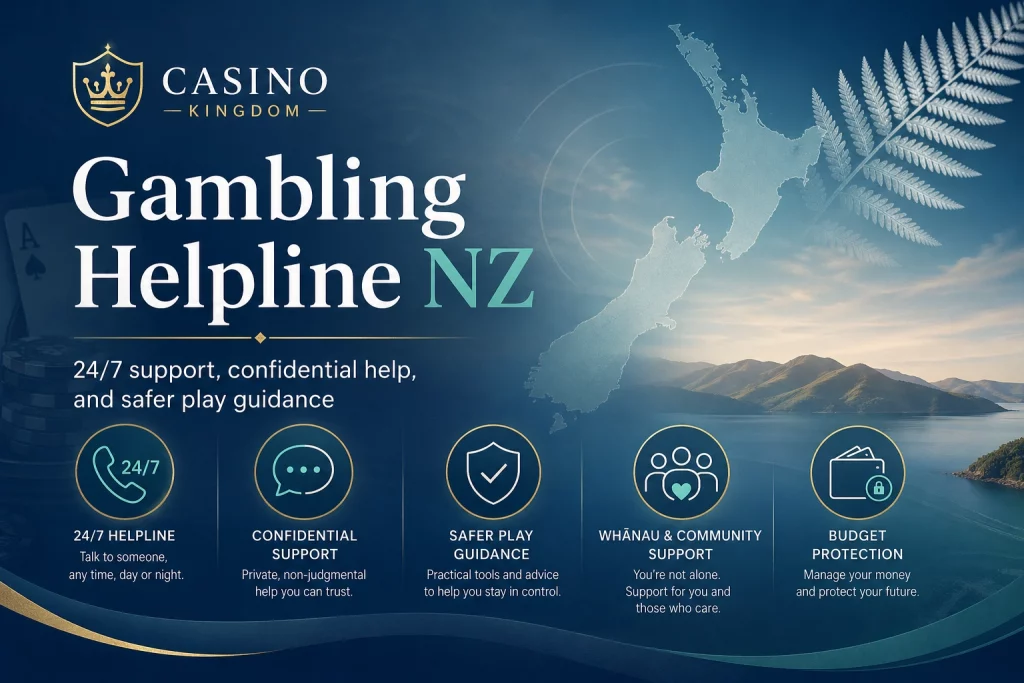
I would use the helpline before gambling again if I noticed any of these signs: I was trying to recover losses, I was hiding activity, I was gambling longer than planned, I was depositing again after promising not to, or I felt anxious while thinking about the account. These are not small details. They show that the session is no longer just entertainment.
The Ministry of Health describes gambling harm as a significant health issue in New Zealand that can negatively affect individuals, whānau and communities. That wider context matters because harm is not only about the size of a loss. It can also show up as stress, secrecy, arguments, sleep disruption, debt pressure and emotional dependence.
| Situation | What I Would Notice | Why the Helpline Matters | Safer First Step |
| After a losing session | The urge to deposit again feels urgent or logical | Support can interrupt chasing before more money is used | Close the page and call or text support before any new deposit |
| Hidden gambling | Deleting messages, avoiding bank statements or hiding time online | Confidential support can reduce isolation and shame | Describe the pattern honestly to a support worker |
| Broken limits | Deposit, time or spending limits are ignored or changed | The helpline can help decide whether stronger barriers are needed | Use time-out, self-exclusion or blocking tools |
| Whānau concern | A partner, parent, friend or family member notices stress or missing money | Support can help affected people set safer boundaries | Ask for guidance before confrontation escalates |
| Relapse after stopping | The person returns after promising to stop | Support can help identify which barrier failed | Stop immediately and strengthen the recovery plan |
Where the Helpline Fits Inside Casino Kingdom
On a Casino Kingdom page, I would not hide helpline information at the bottom. I would place it close to the parts of the site where risk can increase: account access, deposits, bonuses, limits, self-exclusion, payment settings and support pages. When someone is under pressure, they should not have to search.
The Login area is one of the most important points. A person returning to an account after losses may not be making a neutral decision. If they already feel pressure before signing in, helpline information should be visible enough to offer another route.
The same applies to promotions. A Bonus can be harmless for some players, but it can be a trigger for someone trying to stop. Deposit matches, free spins or cashback can create the feeling that returning is justified. If the offer changes someone’s decision after they had planned not to gamble, that offer has become a risk signal.
The Sign up stage also matters. If someone is creating a new account after restrictions, losses or previous attempts to stop, I would treat that as a serious warning sign. Opening a new account can become a way to bypass limits, not a fresh start.
What I Would Say When Contacting the Helpline
The first message does not need to be polished. I would keep it plain: “I am worried about my gambling and I need help stopping.” That is enough. The purpose of the first contact is not to explain everything perfectly. It is to stop being alone with the urge.
If the person can give more detail, I would include the pattern: how often gambling happens, whether losses are chased, whether deposits repeat, whether gambling is hidden, whether bills or essential money are affected, and whether previous attempts to stop have failed.
For example, a clear first message could be: “I keep gambling after losses and I am tempted to deposit again now.” Another could be: “I deleted my gambling app before, but I keep reinstalling it.” Another could be: “My family is worried and I do not know how to talk about it.”
These are practical statements. They help a support worker understand what kind of step is needed: immediate interruption, self-exclusion, money protection, counselling referral, whānau support or relapse planning.
Why Chasing Losses Needs Immediate Support
When I see chasing losses, I treat it as one of the strongest signs that help is needed. Chasing changes the purpose of gambling. The player is no longer paying for entertainment. They are trying to repair damage through the same activity that created the damage.
That is dangerous because every new deposit feels connected to the previous loss. The player may think, “I only need one win,” but the next outcome is still uncertain. The result can be a cycle: deposit, lose, deposit again, regret, promise to stop, return later.
In that moment, the helpline offers a better sequence. Close the gambling page. Move away from the device. Do not deposit again. Contact support. Protect remaining money. Decide on the next barrier only after the immediate pressure drops.
The App can make this harder because access is so quick. If gambling usually happens through a phone, I would remove the app, disable notifications and avoid keeping gambling shortcuts near ordinary daily tools. A support contact should be easier to reach than the gambling shortcut.
Game Triggers and Why They Matter
Different gambling formats create different risk patterns. Slots can be risky because the rounds are fast, the visual feedback is constant, and the next spin is always close. Live games can feel immersive. Instant games can compress decisions. A broad Games lobby can make browsing feel harmless even when it is the first step back into gambling.
If I were advising a Casino Kingdom player, I would not ask only how much money was lost. I would ask which product pulls them back most often. If the trigger is fast games, the protection plan should include stronger session barriers and blocking tools. If the trigger is promotions, marketing removal matters. If the trigger is late-night mobile access, device restrictions matter.
The helpline can help identify that pattern. It can turn “I keep going back” into a clearer map: when, where, why, with what device, and after which emotion.
How I Would Use the FAQ and Links Sections
A responsible FAQ should not only explain account settings. It should answer urgent questions clearly: how to contact Gambling Helpline NZ, how to request self-exclusion, how to remove marketing, how to close an account, how to protect payment access, and what to do if gambling feels difficult to stop.
The Links section should also point people toward support, not only internal navigation. If a person is reading about gambling harm, the next click should not push them toward another game or promotion. It should make help easier to reach.
Problem Gambling Foundation also says it offers free and confidential support for anyone affected by gambling, with live chat, freephone, text and email options during listed service hours. That makes it useful as a longer-term support pathway after an immediate helpline contact.
How the Helpline Connects With Self-Exclusion and Money Protection
When I look at gambling harm from a practical point of view, I do not treat the helpline as a separate resource outside the player journey. I treat it as the bridge between noticing a problem and taking action. A person may know they need to stop, but still not know what to do first. That is where Gambling Helpline NZ becomes useful. It can help turn the situation from “I feel out of control” into “these are the next barriers I need.”
For Casino Kingdom players, this connection matters because gambling harm often happens through several linked points: account access, payment access, promotions, game triggers, phone access and emotional pressure. Solving only one part of the pattern may not be enough. A helpline conversation can help identify which part needs attention first.
Using the Helpline Before Self-Exclusion
Self-exclusion can feel like a big step, especially if someone is not sure whether their gambling is “serious enough.” I would not wait for the situation to become extreme. If someone repeatedly breaks limits, chases losses, hides gambling, opens new accounts, or feels unable to stop, self-exclusion is already worth considering.
A helpline conversation can help the person decide whether they need a short time-out, account closure, self-exclusion, payment barriers or longer-term counselling. The difference matters. A time-out may help after one risky session. Self-exclusion is stronger and more suitable when gambling has become repetitive, secretive or difficult to control.
If I were writing to Casino Kingdom support after speaking with a helpline, I would keep the wording clear:
“I am experiencing gambling harm. Please apply self-exclusion to my account, restrict access where possible, remove me from all marketing communication, and confirm this in writing.”
That wording is better than simply saying “close my account,” because it explains that the request is connected to harm prevention. It also asks for marketing removal, which is important. A person trying to stop should not continue receiving deposit offers, bonus reminders or promotional emails.
| Player Situation | What I Would Do First | How the Helpline Helps | Next Practical Barrier |
| One risky session after stress | Pause gambling and contact support before another deposit | Helps calm the urge and decide whether a short break is enough | Time-out, session limit or temporary device block |
| Repeated chasing losses | Stop access immediately and protect remaining money | Helps shift from recovery gambling to harm reduction | Self-exclusion and payment restrictions |
| Opening new accounts after trying to stop | Avoid further registration and contact support | Helps identify account creation as a relapse route | Website blocking and broader exclusion planning |
| Family or whānau conflict | Seek guidance before a heated conversation | Helps plan safer communication and boundaries | Whānau support, counselling or financial boundaries |
| Relapse after exclusion | Stop immediately and review how access happened | Helps identify which barrier failed | Stronger blocks, support follow-up and money protection |
Money Protection Should Happen Early
If gambling has become hard to stop, I would protect money before trying to analyse everything. The reason is simple: while money remains easy to access, the next urge can become another deposit very quickly. Saved cards, instant bank transfers, phone wallets and remembered payment methods all reduce friction.
Money protection is not a punishment. It is a safety barrier. A person trying to stop should remove saved cards from gambling accounts, reduce online spending limits, separate essential funds, and use bank alerts where available. If bills, food, rent, transport, school costs, debt payments or family obligations are at risk, gambling access should be cut off immediately.
A helpline can help the person think through money routes. Where does the money usually come from? Which card is used? Is there a saved wallet? Does the person deposit after payday? Do they borrow after losing? Do they move money between accounts during urges? These details matter because each route needs a barrier.
I would never treat gambling as a way to repair gambling debt. That is one of the most dangerous beliefs in the cycle. If the person feels they need to win money back before stopping, that is exactly when support should be contacted.
Why Marketing Removal Matters
Marketing can be a relapse trigger. This includes emails, SMS offers, app notifications, cashback messages, VIP contact and free-spin reminders. For someone trying to stop gambling, those messages are not neutral. They can create urgency, curiosity or the feeling that returning is justified.
If I were helping someone prepare a support request, I would always include marketing removal. The wording should be direct:
“Please remove me from all promotional communication, including email, SMS, phone calls, push notifications and bonus offers.”
This should happen alongside exclusion, not later. A person should not block account access but continue receiving reminders to return. That weakens the protection plan.
The same applies outside Casino Kingdom. If the person receives gambling emails from multiple operators, they should unsubscribe, block senders, filter inboxes and avoid opening old promotional messages. Recovery works better when gambling cues are reduced across the digital environment.
How the Helpline Can Help Whānau
A gambling helpline is not only for the person gambling. It can also help people affected by someone else’s gambling. From my point of view, this is essential because gambling harm often becomes a household issue before the player is ready to admit it clearly.
A partner may notice missing money. A parent may notice secrecy. A friend may notice mood changes. A whānau member may feel unsure whether to confront, lend money, step back or demand account access. These situations are difficult, and acting from anger can make the conversation worse.
A helpline can help affected people plan a safer conversation. The goal is to describe specific changes, avoid humiliation, set boundaries and encourage support. A useful statement might be:
“I have noticed repeated gambling and money stress. I am worried, and I think we need support.”
That is more useful than accusation alone. It keeps the focus on behaviour, harm and next steps.
What I Would Do After the First Helpline Contact
After contacting the helpline, I would not leave the situation vague. I would take one protective action immediately. That could be deleting an app, removing a saved card, requesting self-exclusion, telling a trusted person, blocking a website, or writing down the next 24-hour plan.
The action should be small enough to finish the same day. A large recovery plan can feel overwhelming. One completed barrier creates momentum and reduces immediate risk.
I would also write down what the support conversation clarified. The notes do not need to be long. They can include:
The main trigger was payday.
The next action is removing saved payment details.
The support contact suggested self-exclusion.
The next high-risk time is tonight.
The plan is to keep the phone away after 9 p.m.
These notes matter because urges can erase clear thinking. Written notes keep the plan visible.
Relapse Planning Without Shame
Relapse should be taken seriously, but it should not be turned into shame. Shame often makes gambling harm worse because the person hides what happened and continues alone. I would treat relapse as evidence that the barrier system needs strengthening.
The right questions are practical:
How did access happen?
Was it through an app, website, payment method, email, venue or social trigger?
Was the person tired, stressed, lonely or under money pressure?
Which barrier failed?
What needs to be added before the next urge?
If relapse happened through a saved card, payment protection must become stronger. If relapse happened through a new gambling site, blocking tools must become broader. If relapse happened after promotional contact, marketing filters need tightening. If relapse happened after stress, emotional support and replacement routines need more attention.
A relapse does not mean “start again later.” It means stop immediately, protect remaining funds and contact support again.
Support Should Replace Gambling Action
One of the most useful habits is replacing the first gambling action with a support action. Instead of opening the casino account, open the saved helpline contact. Instead of checking promotions, send a text to support. Instead of reviewing losses, leave the device and call someone.
This sounds simple, but it changes the path. Gambling harm often becomes automatic. The goal is to build a different automatic response.
If Casino Kingdom presents helpline information properly, the page should make that replacement easy. A player should see direct guidance: pause, do not deposit, contact support, use account barriers, protect money.
Preparing for a Gambling Helpline NZ Conversation
When I think about a helpline conversation, I do not see it as a formal interview. I see it as a practical pause. The person does not need to sound organised, calm or certain. They can call or text while confused, embarrassed, frustrated or worried. The main point is to contact someone before the next gambling decision happens.
If I were preparing for that conversation, I would focus on the pattern, not on perfect wording. A support worker does not need a polished story. They need enough detail to understand what kind of barrier might help. The conversation can start with one sentence: “I keep gambling after I decide to stop.” That is already useful.
What I Would Share First
The first thing I would share is the immediate risk. If the person is about to deposit again, that should be said directly. If they have just lost money and feel tempted to chase, that should come first. If they are hiding gambling from whānau, that matters. If they are opening new accounts after previous restrictions, that matters too.
I would not begin by trying to justify the gambling or explain every detail. I would say what is happening now. For example: “I am trying not to gamble tonight,” or “I just lost money and want to deposit again,” or “I have promised to stop before but keep going back.”
Those statements help the support worker understand urgency. They also help the person hear the pattern clearly. Sometimes saying it plainly is the first step away from secrecy.
A useful support conversation can then move into details: how often gambling happens, what triggers it, which device is used, what time of day it happens, what payment method is involved, and whether previous stop attempts have failed.
| Detail to Share | Example Wording | Why It Helps | Possible Next Step |
| Immediate urge | “I am about to deposit again and need help stopping.” | Shows that the first priority is interrupting the current moment | Close device, delay, contact support, protect money |
| Chasing losses | “I keep gambling because I want to win back what I lost.” | Identifies a high-risk recovery pattern | Stop access and use stronger barriers |
| Device habit | “I usually gamble on my phone late at night.” | Shows where the access barrier should be placed | Remove app, use device blocks, change evening routine |
| Payment route | “My card is saved and I deposit very quickly.” | Shows why money protection is urgent | Remove saved card, lower limits, add bank alerts |
| Previous attempts | “I deleted the account before but opened another one.” | Shows that simple account closure may not be enough | Self-exclusion, blocking tools, broader support plan |
Questions I Would Ask the Helpline
If I were speaking to Gambling Helpline NZ, I would ask practical questions. I would not keep the conversation general. General advice can help emotionally, but the next step must be concrete.
The first question would be: “What should I do in the next 20 minutes so I do not gamble?” This is useful because urges are time-sensitive. The person needs a short-term action before a long-term plan.
The second question would be: “How do I make access harder tonight?” That can lead to app removal, website blocking, account restriction, time-out, self-exclusion or payment barriers.
The third question would be: “How do I protect my money before payday or before the next urge?” This matters because gambling often returns when funds become available.
The fourth question would be: “Should I use self-exclusion?” If the person has repeatedly failed to stop, self-exclusion may be more appropriate than another private promise.
The fifth question would be: “What ongoing support should I use after this contact?” One call or text may be enough for an immediate urge, but repeated harm often needs follow-up.
How I Would Prepare Before Contacting Support
Preparation should be short. I would write down five facts: when gambling usually happens, what triggers it, how money is deposited, what has already been tried, and what needs to stop first. This can be written in a note app, on paper or in a message draft.
For example:
Gambling usually happens late at night.
The trigger is stress and losses.
Deposits happen through a saved card.
I already deleted the app once.
I need help stopping tonight.
That is enough. The person does not need a full personal history. The support worker can ask follow-up questions if needed.
If the person feels too embarrassed to talk by phone, text support may feel easier. If they cannot explain everything, they can send a short message first. The goal is contact, not perfect communication.
Why I Would Not Stay on the Casino Page During the Call
If someone is contacting support during an urge, I would advise moving away from the gambling page first. Staying on the casino page while talking about stopping can keep the urge active. The screen itself becomes a trigger: account balance, deposit buttons, game images, promotional banners and previous losses can all pull attention back.
The safer sequence is: close the page, put the phone down or move to another room, then contact support. If the person needs the phone to call or text, they should avoid reopening gambling content during the conversation.
This is also why Casino Kingdom should avoid placing helpline content beside strong promotional cues. A user reading help information should not be visually pushed toward play. The page should feel calm, direct and supportive.
How to Move From Helpline Contact to Long-Term Recovery
A helpline conversation can interrupt one risky moment, but long-term change usually requires a structure. After the first contact, I would move toward a practical recovery plan. That plan should include access blocking, money protection, marketing removal, self-exclusion where needed, replacement routines and support follow-up.
The most important step is to act immediately after the conversation. If the person waits too long, the urge may return. One completed barrier is better than a long plan delayed until tomorrow.
Examples of immediate post-call actions include deleting a gambling app, blocking a website, removing a saved card, asking Casino Kingdom support for self-exclusion, telling one trusted person, or writing down the next high-risk time.
If the helpline recommends ongoing counselling or another support service, I would treat that as part of the plan, not as optional. Repeated gambling harm usually needs repeated support.
What I Would Track After the First Contact
After contacting support, I would track whether the barriers are working. This does not need to be complicated. A short weekly check is enough.
The questions are:
Did I gamble this week?
Did I have urges?
What triggered them?
Did I contact support before acting?
Did payment barriers work?
Did any gambling marketing reach me?
Did I hide anything?
Do I need stronger exclusion?
These questions keep the plan active. They also prevent the person from assuming that one good week means the risk has disappeared.
If the person had urges but did not gamble, that is progress. If they relapsed, the review should focus on how access happened. The response should be stronger protection, not shame.
How Whānau Can Be Included
If gambling has affected family or whānau, I would include them carefully. Not every person needs to know everything, but at least one trusted person can make recovery less isolated.
The conversation should be direct and specific. A person might say: “I have been struggling with gambling and I contacted support. I need help keeping barriers in place.” That is clearer than vague reassurance.
Whānau can help by supporting account exclusion, protecting shared money, encouraging follow-up contact and reducing secrecy. They should also be able to contact support themselves if the gambling has affected them.
The goal is not control through humiliation. The goal is safer structure.
Complete Gambling Helpline NZ Checklist for Casino Kingdom Players
If I had to reduce this whole page to one rule, it would be this: use the helpline before the next gambling action, not after the next loss. That timing matters. A person who contacts support before depositing has more options. A person who waits until after another session may be dealing with more stress, more shame and more financial pressure.
For Casino Kingdom players in New Zealand, Gambling Helpline NZ should be treated as a practical safety contact. It is not only for people who have reached a crisis. It is also for people who notice that gambling is becoming repetitive, emotional, secretive, financially stressful or difficult to stop. When those signs appear, support is already relevant.
My Helpline-Use Checklist
I would keep the checklist simple because gambling urges can narrow thinking. During an urge, long explanations do not help much. A person needs a sequence they can follow without negotiation.
| Step | What I Would Do | Why It Matters | When to Use It |
| Pause access | Close the casino page, put down the phone or move away from the laptop | Breaks the immediate connection between urge and gambling action | As soon as gambling feels urgent |
| Do not deposit again | Avoid top-ups, new payment methods or another account | Prevents chasing and protects remaining money | After any emotional or losing session |
| Contact support | Call or text Gambling Helpline NZ and describe the pattern plainly | Creates immediate human support outside the gambling environment | Before the next gambling decision |
| Protect money | Remove saved cards, reduce payment access and separate essential funds | Makes impulsive deposits harder during stress | Same day, before the next urge |
| Use account barriers | Request time-out, account closure, marketing removal or self-exclusion | Creates stronger protection than another private promise | When gambling feels difficult to control |
| Plan the next 24 hours | Set one safe routine, one support contact and one device boundary | Reduces relapse risk after the first support contact | Immediately after calling or texting support |
What I Would Do During a Strong Urge
During a strong urge, I would not try to analyse the whole problem. I would focus only on not gambling in the next few minutes. That is enough. Urges can feel urgent, but they usually change when the person does not act immediately.
The first move is distance. Close the Casino Kingdom page. Move away from the device. Do not keep staring at the balance, deposit button or game lobby. Staying inside the gambling environment while trying to stop keeps the trigger active.
The second move is contact. I would call, text or message support before making any gambling-related decision. The first sentence can be direct: “I am having an urge to gamble and I need help waiting it out.” That is not dramatic. It is practical.
The third move is delay. I would wait at least 20 minutes while doing something that does not involve gambling content. Walk outside, make tea, shower, clean something, write down the trigger or message a trusted person. The goal is not to feel perfect. The goal is to avoid acting at the peak of the urge.
Relapse Response Without Shame
If relapse happens, I would not treat it as proof that stopping is impossible. I would treat it as evidence that the current barriers were not strong enough. Shame usually makes gambling harm worse because the person hides what happened and continues alone.
The first response after relapse should be immediate stopping. Do not keep gambling to recover the relapse loss. Do not move to another game. Do not open a new account. Do not deposit again. Stop the session and protect whatever money remains.
Then I would review the access route. Did the relapse happen through a saved card, a phone app, an email offer, a new website, a physical venue, a stressful evening, payday or boredom? That answer tells me where the next barrier belongs.
If the relapse happened through a saved card, payment protection needs to be stronger. If it happened through a gambling app, the app must be removed and downloads restricted where possible. If it happened after marketing, promotional messages must be blocked. If it happened through emotional stress, support and replacement routines need to be stronger.
How Casino Kingdom Should Present Gambling Helpline NZ
On Casino Kingdom, I would place Gambling Helpline NZ information where users may need it most: near account limits, payment sections, self-exclusion instructions, responsible gambling pages and help content. A person seeking support should not be forced to pass through promotional content first.
The language should be calm and direct. I would use wording such as: “If gambling feels difficult to control, pause before depositing and contact support.” That sentence gives a clear action. It does not blame the user, and it does not minimise the risk.
I would also avoid placing heavy promotional design near the helpline section. A page about support should not visually push a person back into gambling. The design should reduce pressure: clean layout, visible support information, clear account-barrier instructions and no aggressive calls to play.
Casino Kingdom should also make it clear that stopping completely may be the safest option for some players. Responsible gambling does not always mean continuing with limits. If gambling has become secretive, stressful or hard to stop, exclusion and support are safer than another controlled-play attempt.
Keeping Support Active After the First Contact
A helpline contact can interrupt one dangerous moment, but the plan should continue after that. I would keep support visible and easy to access. Save the number. Write down the next step. Keep support contacts near high-risk times such as payday, late night or after stress.
A weekly review can help. I would ask:
Did I gamble this week?
Did I have urges?
What triggered them?
Did I contact support before acting?
Did payment barriers work?
Did I receive gambling marketing?
Did I hide anything?
Do I need stronger self-exclusion or blocking tools?
These questions are not about blame. They are a maintenance check. If the plan worked, keep it. If it failed, strengthen it. If gambling returned through a new route, block that route.
Progress should not be tested by returning to gambling content. I would not check whether I can safely browse games again. I would not open promotions “just to look.” Recovery is protected by keeping barriers active.
Safer Action Pathway After Contacting Support
Final Guidance for Casino Kingdom Players in New Zealand
If I were giving one practical recommendation, it would be this: do not wait until gambling becomes a crisis before using support. If gambling has started to feel stressful, secretive, repetitive or difficult to stop, that is enough reason to contact Gambling Helpline NZ.
The safest sequence is simple. Pause access. Do not deposit again. Move away from the device. Contact support. Protect money. Remove marketing triggers. Use account barriers. If needed, request self-exclusion and involve one trusted person.
For Casino Kingdom users, the helpline should be seen as a route away from the next risky decision. It is not a judgment. It is not a punishment. It is a practical way to interrupt the cycle before more harm happens.
Gambling should not become a method for recovering losses, managing stress or hiding financial pressure. When it starts taking that role, continuing is not the safer choice. Support is the safer choice. For New Zealand players, Gambling Helpline NZ gives a direct path toward that safer choice before the next deposit, the next relapse or the next hidden session.






Comments