Casino License Verification Guide
Why Licence Checks Should Come Before Registration
A casino license verification guide is useful because licensing claims are among the most important trust signals on any real-money casino website. A casino may look polished, advertise fast withdrawals, show modern payment icons, and promote a large game library, but none of that should be trusted blindly. Before a player registers, deposits, or sends documents, they should understand who operates the platform and whether the casino’s licence information can be checked.
For Casino Kingdom, licence verification is not a decorative step. It is part of the basic review process. A licence claim should connect to a real operator, a real jurisdiction, and a set of rules that explain how the casino is supervised. If a casino says it is “licensed,” “regulated,” or “officially approved” but gives no company name, jurisdiction, licence number, or regulator reference, that claim is weak.
Licence verification is especially important for players who use international casino sites. Many online casinos serve multiple regions, and some offshore platforms can be professionally operated. Others use vague regulatory language to appear safer than they really are. The goal is not to reject every offshore casino automatically. The goal is to separate casinos with verifiable accountability from those that only use trust language.
A proper licence check should happen before Sign up. Once an account is created and money is deposited, the player has already accepted more risk. It is better to check licensing, payment rules, verification requirements, and complaint routes before entering personal data. A legitimate casino should make this information easy to find.
What a Casino Licence Actually Means
A casino licence is a form of authorisation from a gambling regulator or licensing jurisdiction. It usually means the operator has applied to offer gambling services under certain rules. Depending on the jurisdiction, those rules may cover player funds, anti-money laundering checks, game fairness, advertising standards, responsible gambling, data protection, dispute handling, and operator reporting.
Not all licences are equal. Some regulators apply strict monitoring, complaint systems, technical testing, and enforcement. Others provide lighter oversight. This is why players should not stop at seeing the word “licensed.” They should identify which authority issued the licence and what practical protection that licence offers.
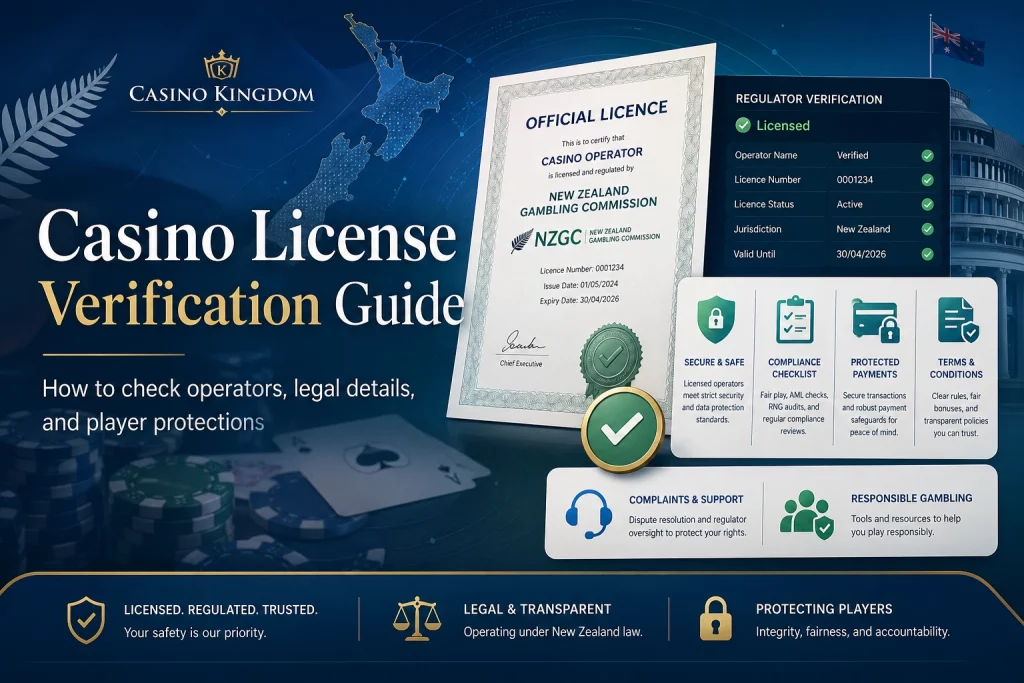
A licence also does not guarantee that every player experience will be perfect. Even licensed casinos can have slow support, strict verification, difficult bonus rules, or delayed withdrawals. However, a verifiable licence usually gives players more information about operator accountability than a casino with vague or missing regulatory details.
The key issue is traceability. A licence should help answer basic questions: Who runs the casino? Where is it registered? Which authority supervises it? What rules apply? Is there a complaint route? If the website cannot support those questions, the licence claim is not strong enough.
Where to Find Casino Licence Information
A legitimate casino normally displays licence information in predictable areas. The footer is the most common place. Players may also find licence details in the terms and conditions, privacy policy, responsible gambling page, about page, or legal information section. Some casinos include a licence badge or seal that links to a regulator or verification page.
Players should not rely on a badge alone. A graphic can be copied. A licence seal is useful only if it leads to real information or matches details elsewhere on the site. If the casino shows a shield icon but gives no operator name or jurisdiction, that is marketing, not verification.
The Login page can also reveal consistency. A legitimate casino should not move players from a branded homepage to a different-looking login portal with unclear ownership or strange domains. If the account access page appears separate from the licensed entity, players should inspect it carefully.
Casino Kingdom reviews licence visibility as a trust signal. The information should not be buried so deeply that ordinary players cannot find it. Real accountability should be accessible.
Licence Claims That Deserve Caution
Some licence claims sound impressive but provide little value. Phrases such as “internationally licensed,” “fully certified,” “globally trusted,” or “regulated worldwide” should be treated carefully if they are not supported by specific details. A serious casino should name the authority or jurisdiction.
Another warning sign is inconsistent licence information. For example, the footer may mention one company, the terms may mention another, and the payment page may show a different brand. This does not always prove wrongdoing, because casino groups can operate multiple brands. However, the relationship should be clear. Players should know which legal entity controls the account they are creating.
A casino may also display outdated licence information. If a licence number is inactive, a company name has changed, or the regulator no longer lists the operator, the claim needs further review. Players do not need to perform a legal audit, but they should notice when basic information does not align.
The most serious warning sign is no licence information at all. If a casino handles real-money play but gives no regulatory details, no company information, and no complaint route, the platform should not be treated as fully trustworthy.
First Licence Verification Checks
| Verification Step | What to Check | Positive Signal | Warning Signal |
|---|---|---|---|
| Footer Review | Licence number, operator name, jurisdiction, regulator reference | Specific information appears clearly at the bottom of the site | Only vague wording such as “trusted” or “certified” |
| Terms Page | Legal entity, account rules, dispute route, governing law | Terms match footer and brand information | Different company names with no explanation |
| Licence Badge | Whether the seal links to real verification details | Badge supports the written licence claim | Badge is only a static image or broken link |
| Account Pages | Whether login and cashier remain under the same trusted structure | Account area matches casino identity and secure access | Strange domains or unrelated account portals |
| Support Confirmation | Whether support can explain licence and company details | Support gives direct references or links to legal pages | Support avoids questions or gives generic replies |
Why Licence Verification Matters for Payments
Licence verification is not only a legal issue. It also affects payment confidence. A regulated operator should normally have clearer procedures for deposits, withdrawals, identity checks, and suspicious activity review. That does not mean every licensed casino pays instantly, but it should mean the payment process is governed by visible rules.
Players should connect licence review with cashier review. If a casino claims to be licensed but gives vague withdrawal terms, unclear fees, hidden verification requirements, or no complaint path, the licence claim does not provide enough comfort. Licensing should support practical transparency.
A legitimate casino should explain whether payment ownership must match the casino account, which documents may be requested, what processing times apply, and what happens if a withdrawal is reviewed. These rules should be available before deposit, not revealed only after a payout request.
Casino Kingdom treats payment transparency as a practical extension of licence verification. A casino that is accountable should also explain how it handles player funds.
Licence Verification and Bonus Rules
Licensing also connects to promotion fairness. A licensed casino should present bonus terms in a way that players can understand before opting in. This includes wagering requirements, expiry dates, maximum bet limits, game contribution rules, country restrictions, payment exclusions, and withdrawal caps.
A large Bonus does not prove that a casino is legitimate. In fact, oversized or unrealistic promotions can sometimes distract players from weak licensing details. Players should check whether the casino is transparent before being influenced by promotional value.
A fair promotion page should link to full terms and keep the most important restrictions visible. If a casino promotes a major reward but hides strict conditions in complicated legal text, that weakens trust.
Casino Kingdom reviews licence claims and bonus terms together because both show whether the operator respects informed player choice. A properly licensed casino should not rely on confusing promotions to attract deposits.
Why Players Should Avoid Licence Assumptions
Players sometimes assume that a casino is legitimate because it appears in search results, has many games, accepts common payment methods, or uses familiar design. These assumptions are risky. None of those features automatically proves licensing.
Search visibility can be bought or achieved through marketing. Payment logos can be displayed without full explanation. Game thumbnails can be copied. Trust badges can be decorative. A real licence check requires looking for specific, consistent information.
Players should also avoid assuming that all casinos using the same software provider have the same licence quality. A casino may include recognised games but still have weak operator transparency. Game providers and casino operators are separate entities. The provider supplies content; the casino handles account rules, payments, support, verification, and player relationships.
The safest method is to verify each casino individually. Do not transfer trust from one brand to another without checking the details.
Casino Kingdom Review Position
Casino Kingdom treats licence verification as the first accountability layer. A casino that handles real-money play should make its legal identity visible. It should show who operates the site, where the licence comes from, and how players can understand the rules that apply.
A verifiable licence does not end the review. It starts the deeper review. After checking licensing, players should inspect payments, verification, bonuses, games, mobile access, responsible gambling tools, and support. A legitimate casino should be consistent across all these areas.
How to Verify Casino Licence Details Step by Step
Casino licence verification should be approached as a practical sequence. A player does not need to become a legal expert, but they should know how to check whether a casino’s regulatory claims are specific, consistent, and usable. The goal is not to read every line of legal text. The goal is to confirm whether the casino gives enough information to trust the account environment before depositing.
For Casino Kingdom, licence verification begins with visible site details and then moves into consistency checks. A casino may display a licence number, but that number should match the operator name, brand name, jurisdiction, and legal terms. If the casino gives several different company names without explanation, uses vague licence language, or hides the legal entity behind marketing phrases, the review becomes cautious.
Players should also understand that licence verification is not separate from the rest of the casino journey. Licensing connects to account rules, payments, verification, responsible gambling tools, game fairness, complaint handling, and promotional conduct. A licence claim that does not support any practical transparency has limited value.
Step One: Check the Footer and Legal Pages
The first place to look is the website footer. A legitimate casino usually places licensing details near the bottom of the site. This may include the operator name, registered company, licence number, jurisdiction, responsible gambling notice, copyright information, and links to terms, privacy policy, complaints, and payment rules.
The next step is to open the terms and conditions. The legal entity named there should match or clearly relate to the footer information. If the footer mentions one operator and the terms mention another, the site should explain the relationship. Some casino groups use parent companies or white-label structures, but the player should not be left guessing.
The privacy policy is also useful. It may identify the data controller, company address, or jurisdiction. Since casinos collect personal data, payment records, and verification documents, the privacy section should not be generic or empty.
A legitimate licence profile usually feels connected. Footer, terms, privacy policy, responsible gambling page, and support section should point toward the same operator identity.
Step Two: Compare Licence Claims With Player Rules
A licence claim is stronger when the casino’s player rules are also clear. If a site claims to be regulated but hides withdrawal limits, identity checks, bonus conditions, and complaint routes, the licence claim does not carry much practical value.
Players should check whether the casino explains account restrictions before Sign up is completed. Important rules include age requirements, country eligibility, one-account policy, duplicate-account restrictions, payment ownership expectations, and document verification procedures.
A licensed operator should not rely on surprise rules after deposit. Verification may still occur later, especially before withdrawal, but the possibility should be clear from the start. Players should know that account details must match official documents and payment methods.
Casino Kingdom treats licence verification and account transparency as linked checks. A casino that is truly accountable should explain how the player account is governed.
Step Three: Ask Support Direct Questions
Support can reveal whether licensing information is understood internally or only copied into the footer. Before depositing, players can ask support direct questions: Who operates the casino? Where can I find the licence information? Which terms apply to New Zealand players? What happens if there is a complaint? Where are responsible gambling tools located?
A good support team does not need to give legal advice, but it should be able to point players to the correct pages. If support avoids licence questions, gives generic answers, or pushes the player to deposit first, that is a weak signal.
Support should also use official channels. Players should ask through live chat, account help centre, or official email listed on the site. Licensing questions should not be moved to private social media accounts or messaging apps.
A legitimate casino should not treat basic accountability questions as unusual. If the platform handles real-money play, players have the right to ask who is responsible for it.
Step Four: Check Licence Consistency Across Cashier and Account Areas
The licence claim should remain consistent when the player moves into the cashier, account area, and verification sections. A casino homepage may look clean, but payment pages and account tools reveal whether the platform structure is stable.
The Login area should remain under the same recognisable brand and secure site structure. If the account page redirects to unrelated domains, uses different branding, or looks disconnected from the licensed operator, players should investigate before entering credentials.
The cashier is even more important. Payment processors may use external pages, and that can be legitimate. However, the transition should be clear and professional. Players should understand whether they are still interacting with the casino, a payment partner, or a verification provider.
A licence claim loses strength when the user journey becomes fragmented. The player should not feel as if each stage belongs to a different company.
Step-by-Step Casino Licence Verification
| Verification Step | Player Action | Strong Signal | Weak Signal |
|---|---|---|---|
| Footer Check | Look for operator name, licence reference, jurisdiction, and legal links | Specific licence and company details are visible | Only generic “trusted casino” language appears |
| Terms Review | Compare legal entity, governing rules, account limits, and complaints process | Terms match the footer and explain player rules | Different company names appear without explanation |
| Privacy Policy | Check data controller, document handling, and player information use | Data handling is explained clearly | Generic privacy text with no meaningful operator detail |
| Support Test | Ask where the licence information and complaint route are found | Support points to specific legal or help pages | Support avoids the question or pushes registration |
| Account Area | Check whether login, cashier, and verification pages match the casino identity | Secure account flow with consistent branding | Unclear redirects or unrelated account portals |
Main Areas Checked During Licence Verification
Licence Verification and Responsible Gambling
Responsible gambling information should support the licence claim. A casino that claims regulatory oversight should normally provide responsible gambling tools, account limits, self-exclusion options, time-outs, and guidance for players who want control over their gambling activity.
Players should check whether responsible gambling pages are functional, not only decorative. The page should explain what tools exist and how to use them. If the casino only provides generic statements without practical account controls, the responsible gambling section is weak.
This matters because licensing is not only about allowing gambling. It is also about setting minimum standards for how gambling is offered. A serious casino should give players visible ways to manage play, reduce risk, and request support.
Casino Kingdom reviews responsible gambling access as part of licence verification because it shows whether the casino’s compliance language is connected to real player tools.
Licence Verification and Bonus Transparency
Promotions can reveal whether a casino respects transparent regulation. A licensed casino should present bonus terms clearly enough for players to understand the real value of an offer. The headline should not create expectations that the terms later remove.
When reviewing a Bonus, players should check wagering requirements, expiry dates, maximum bet limits, eligible games, restricted games, payment-method exclusions, and maximum withdrawal caps. These details should be visible before the player accepts the promotion.
A weak casino may use licensing language to create trust while using confusing promotion rules to create disputes. The licence claim does not excuse unclear bonus terms. If the offer is difficult to understand, the player should be cautious.
Casino Kingdom treats bonus clarity as an operational compliance signal. A casino that values accountability should not make promotional rules unnecessarily confusing.
Licence Claims and Game Provider Transparency
Licence verification also connects to game transparency. A regulated casino should make it clear which software providers supply its games and how game fairness is maintained. Players should not have to guess whether the casino uses recognised providers or unknown imitations.
The game library should identify providers for Slots, table games, live dealer products, jackpot titles, and other casino games. Provider filters, game info panels, and clear category pages all help players understand the source of the games.
A licence does not automatically prove every game is suitable for every player, but it should support a more transparent game environment. If a casino claims regulation but hides provider names, uses copied thumbnails, or launches games through suspicious pages, trust weakens.
Players should treat game transparency as a secondary licence check. The legal claim and the game environment should point toward the same level of professionalism.
When Licence Information Looks Incomplete
Incomplete licence information does not always mean a casino is deliberately unsafe. Some websites are poorly organised, and some operators use complex brand structures. However, real-money players should not carry the burden of uncertainty. If the casino wants trust, it should explain itself clearly.
When licence information is incomplete, players should not deposit immediately. They should check the terms, privacy policy, payment page, support answers, and complaint section. If all of those areas remain vague, the casino should be avoided.
A legitimate operator can usually provide direct references. If support cannot explain the company behind the casino, the licence jurisdiction, or the complaint process, the site is not transparent enough.
For Casino Kingdom, incomplete licensing is not always a final judgement, but it is a strong reason to slow down. Real-money play should begin only after accountability is clear.
Common Licence Red Flags and Fake Verification Signals
Casino licence verification becomes more useful when players know which red flags to recognise. A legitimate licence claim should be specific, consistent, and connected to the casino’s wider operating structure. A weak licence claim usually depends on vague wording, decorative badges, unclear company names, or broken links. The difference matters because a player may be trusting the platform with money, identity documents, payment details, and account history.
For Casino Kingdom, licence red flags are not judged in isolation. One weak detail may be caused by poor page maintenance. Several weak details together create a stronger warning pattern. If a casino has vague licensing, unclear payment rules, hidden verification requirements, copied game graphics, and support that cannot answer basic questions, the licence claim loses practical value.
Players should treat licence verification as a filter before using real money. The purpose is not to create unnecessary suspicion around every casino. The purpose is to avoid platforms that use regulatory language without offering genuine accountability.
Red Flag One: Generic Licensing Language
The most common red flag is generic language. Phrases such as “fully licensed,” “certified casino,” “trusted worldwide,” “regulated internationally,” or “approved gaming platform” sound professional but do not prove anything by themselves. A real licence claim should include an identifiable authority, jurisdiction, operator name, or licence reference.
A casino that handles real-money play should not make players guess who supervises it. If the casino expects players to create an account, deposit funds, claim promotions, and submit documents, it should provide specific legal information.
Generic licensing language is especially weak when it appears next to aggressive promotional claims. A casino may use broad trust phrases to reduce player caution before deposit. The safer response is to pause and look for details. If the site cannot support its own claim, the claim should not influence trust.
Casino Kingdom treats generic licensing language as a starting warning sign. It does not always prove the casino is unsafe, but it means the player needs more evidence before proceeding.
Red Flag Two: Static or Fake Licence Badges
Licence badges can be useful when they link to real verification pages. However, some casinos display static images that look official but provide no way to verify the claim. A shield icon, seal graphic, or “certified” emblem has limited value if it does not connect to regulator information.
Players should click licence badges carefully and check where they lead. A useful badge should open a relevant licence page, regulator record, or operator verification area. A weak badge may lead nowhere, open a broken page, or return to the casino homepage.
Fake badges are a serious issue because they create visual confidence without accountability. Players may see a seal and assume the casino has passed formal checks. That assumption is unsafe if the badge is only decorative.
A legitimate casino does not need fake symbols. It should be able to show written licence details and keep them consistent with its terms, privacy policy, and support information.
Red Flag Three: Operator Names Do Not Match
Operator consistency is one of the strongest licence verification checks. A casino may have a brand name, a company name, a platform provider, and a payment processor. These do not always have to be identical, but the relationship should be understandable.
A warning sign appears when the footer names one company, the terms name another, the payment page uses a third, and support cannot explain the structure. This creates confusion over who is responsible for the account, payments, disputes, and data handling.
Some legitimate casino groups operate multiple brands through one company. That can be acceptable when the terms explain it clearly. The problem is unexplained inconsistency. Players should not need to investigate corporate structures just to know who operates the casino.
This matters during withdrawals and verification. If a player submits documents or requests payment, they should know which entity is processing the account. A licence claim is weaker when the operator identity is unclear.
Red Flag Four: Licence Details Are Hard to Find
A legitimate casino should not hide licence information. Players should usually find it in the footer, terms, legal section, about page, responsible gambling page, or help centre. If a player has to search extensively and still cannot find specific details, that is a weak trust signal.
Hard-to-find licence information may indicate poor transparency. It may also show that the casino prefers promotional messaging over accountability. Either way, players should not ignore it.
The same applies to account-related pages. If licence details are visible on the homepage but disappear from deeper pages, the review should continue carefully. The legal identity of the platform should remain stable across the player journey.
A licence claim should be easy to inspect before deposit. If the casino only gives meaningful details after account creation or through support, it is not player-friendly.
Casino Licence Red Flags
| Licence Red Flag | What It Looks Like | Why It Matters | Safer Player Action |
|---|---|---|---|
| Generic licence wording | “Fully licensed” or “regulated worldwide” with no authority named | Players cannot verify the claim | Look for jurisdiction, regulator, company name, and licence number |
| Static licence badge | Seal or shield image that does not link to verification | Badge may be decorative or copied | Check whether the badge leads to a real record or legal page |
| Company mismatch | Different operator names in footer, terms, cashier, and privacy policy | Accountability becomes unclear | Ask support for the exact operating company and compare documents |
| Broken regulator link | Licence button leads to error page or unrelated page | Licence information may be outdated or unreliable | Do not deposit until the claim is clarified |
| No complaint route | Terms mention licence but give no dispute or escalation process | Players may have limited options if a dispute occurs | Check terms and support before registration |
| Hidden legal pages | Terms, privacy policy, or licence details are difficult to access | Important rules may be intentionally or poorly obscured | Pause account creation until core rules are visible |
Complaint Routes and Licence Value
A licence is more useful when it connects to a complaint process. Players should be able to understand how disputes are handled if support cannot resolve an issue. This may involve internal escalation, a formal complaint email, a regulator process, or an alternative dispute route depending on the licensing structure.
A casino that claims to be regulated but gives no complaint path is weaker. The player needs more than a licence label. They need a practical way to challenge unresolved payment problems, account closures, bonus disputes, or verification issues.
Complaint information does not need to be complicated. It should explain where to contact the casino, what details to provide, how the complaint is reviewed, and whether any external route exists. If those details are absent, players should consider the licence claim incomplete.
Casino Kingdom reviews complaint routes because they show whether licensing has practical value. Accountability matters most when something goes wrong.
Offshore Casino Considerations
Many casinos available to NZ players operate from offshore jurisdictions. Offshore does not automatically mean illegitimate. Some international operators are structured, licensed, secure, and transparent. However, offshore access increases the importance of checking terms carefully because local protections may differ.
Players should check which jurisdiction governs the account and whether NZ players are accepted under the casino’s terms. They should also inspect payment rules, currency handling, verification requirements, and complaint procedures. If the casino serves New Zealand but does not explain how NZ players are handled, that creates uncertainty.
Offshore casinos may also apply international verification standards. These can include identity checks, payment ownership review, address verification, and anti-fraud monitoring. The checks are not the issue. The issue is whether they are explained before deposit.
Casino Kingdom’s approach is practical: do not reject offshore casinos automatically, but do not accept vague offshore claims either. The operator must still explain itself.
Licence Red Flags by Risk Level
Licence Verification and Game Transparency
A casino licence claim should be supported by a transparent game environment. Players should be able to identify game providers, open game rules, and understand category structure. If a casino claims regulation but hides game sources, the trust picture becomes weaker.
This applies to Slots, table games, live casino products, jackpot titles, and instant-win games. Provider names should be visible in the lobby, filters, or game information panels. Games should launch through stable pages without suspicious redirects.
A licence does not mean every game is automatically ideal for every player, but it should support a more professional operating environment. A casino that hides provider details while asking players to trust regulatory claims is not providing enough transparency.
Players should also check bonus contribution rules by game type. If the licence claim is serious, the casino should also explain how different games interact with wagering requirements and promotional restrictions.
Licence Verification and Account Security
Licence verification should also align with secure account access. A casino that claims regulation should protect Login pages, account recovery, cashier areas, verification uploads, and support communication. Legal accountability and technical protection should not be separated.
Players should be cautious if a licence claim appears on the homepage but account pages behave poorly. Browser warnings, strange redirects, insecure forms, or inconsistent account portals weaken trust. The licence claim is less persuasive when the actual user journey feels unstable.
Account security also includes password recovery. A legitimate casino should not ask players to reveal passwords through support chat or email. It should provide secure reset processes and account verification when necessary.
Casino Kingdom treats account security as part of licence credibility. A serious operator should combine legal transparency with technical discipline.
Licence Verification and Support Quality
Support should be able to explain where licence information is located. It does not need to provide legal advice, but it should know how to direct players to terms, responsible gambling tools, payment rules, and complaint processes.
A weak support team may avoid licence questions or provide generic reassurance. Phrases like “do not worry, we are trusted” are not enough. Players need specific references.
Support quality matters because players often rely on it during withdrawals, verification, and disputes. If support cannot handle simple licence questions before deposit, it may not handle serious account issues effectively later.
A legitimate casino should make support useful, not decorative. The best support response is specific, calm, and linked to relevant written policy.
When to Stop the Verification Process
Players should stop the verification process and avoid depositing when several red flags appear together. Examples include missing operator information, broken licence badges, vague withdrawal rules, no complaint process, and support that cannot answer basic questions.
Continuing in that situation means the player is accepting uncertainty before money is involved. That is unnecessary. A trustworthy casino should make the first checks easier, not harder.
Players should also stop if they are asked to create an account before seeing basic legal information. Registration should not be required just to understand who operates the casino or how withdrawals work.
Casino Kingdom’s position is direct: if the casino cannot show accountability before registration, players should not provide personal data or payment details.
Final Casino License Verification Checklist
A casino license verification guide should finish with one practical conclusion: players should never treat licensing as a decorative trust badge. A licence claim only has value when it is specific, visible, consistent, and connected to real player protections. If a casino uses licensing language but hides the operator, avoids payment clarity, gives no complaint route, or cannot explain its own legal structure, the claim is not strong enough.
For Casino Kingdom, licence verification is a first-stage filter. It does not prove that every part of the casino is perfect, but it helps players decide whether the platform deserves deeper review. Once licensing looks credible, the next checks should cover payments, verification, game providers, support, responsible gambling tools, mobile access, and bonus terms.
A legitimate casino should not make players search endlessly for basic accountability. The licence information should be easy to find before registration. The operator name should match the terms. The complaint route should be visible. The account and cashier areas should feel connected to the same platform. If these conditions are not met, caution is justified.
Final Licence Verification
| Verification Area | What Players Should Confirm | Strong Licence Signal | Weak Licence Signal |
|---|---|---|---|
| Operator Identity | Company name, brand owner, registered entity, legal page consistency | Same operator details appear across footer, terms, and privacy policy | Different company names appear without explanation |
| Licence Reference | Jurisdiction, regulator, licence number, verification link where available | Specific licence details can be checked or reasonably traced | Only vague claims such as “fully licensed” or “trusted worldwide” |
| Account Rules | Age limits, country eligibility, duplicate-account rules, verification policy | Player obligations are visible before registration | Important restrictions appear only after deposit or withdrawal |
| Cashier Terms | Deposit methods, withdrawal rules, limits, timing, fees, ownership checks | Payment rules are clear before money enters the account | Deposits are easy but withdrawals are poorly explained |
| Complaint Route | Internal escalation, support process, external dispute option if available | Players know how to raise unresolved issues | No complaint process or only generic contact forms |
| Game Transparency | Provider names, game rules, category structure, bonus contribution details | Recognisable providers and clear game information | Unknown games, copied thumbnails, unclear provider identity |
| Responsible Gambling | Limits, time-outs, self-exclusion, account controls, help information | Tools are visible and usable from the account area | Generic safer gambling text with no practical controls |
| Support Verification | Whether support can point to licence, terms, complaint, and payment pages | Support gives specific references and clear answers | Support avoids accountability questions or gives vague reassurance |
How to Verify a Casino Licence Before Depositing
Players should start with the footer and legal pages. Look for the operator name, licence jurisdiction, legal terms, privacy policy, responsible gambling page, and complaint information. These sections should be easy to access without creating an account.
Then compare the details. The operator named in the footer should match the terms or be clearly connected to the company named there. The privacy policy should not identify a completely unrelated data controller without explanation. The cashier should not suddenly introduce a different brand or unclear company structure.
Next, check whether the casino explains player obligations. A licence claim is stronger when account rules are clear. Players should be able to understand age requirements, country restrictions, duplicate-account rules, payment ownership expectations, and verification procedures before deposit.
Finally, test support. Ask where the licence information is located, where payment terms are explained, and how complaints are handled. A legitimate casino should answer directly or provide relevant links. If support avoids these questions, do not ignore that signal.
Why Licensing Should Be Checked With Payments
Licence verification becomes more useful when it is checked together with payment rules. A casino may display a licence reference, but if the payment section is vague, the player still faces risk. Real-money trust depends on both legal accountability and operational clarity.
Before depositing, players should check withdrawal methods, processing times, verification requirements, minimum and maximum limits, payment ownership rules, and possible fees. These details matter more than promotional claims about speed.
A casino that explains payments clearly is easier to trust. A casino that makes deposits simple but withdrawals unclear should be treated cautiously. Licensing should support transparency, not distract from missing information.
For Casino Kingdom, the strongest licence profile is one where legal details and cashier rules point in the same direction: visible operator, clear terms, secure account access, and predictable payment handling.
Why Licensing Should Be Checked With Bonuses
Bonus rules can reveal whether a casino uses transparent player-facing terms. A licensed casino should not hide key promotion conditions behind vague language. Players should be able to understand the real value of an offer before accepting it.
The most important bonus checks are wagering requirements, expiry time, maximum bet size, eligible games, restricted games, maximum conversion or withdrawal caps, and payment-method exclusions. These conditions should be shown clearly near the offer or linked directly from it.
Players should be careful when a casino uses licence language to build trust but makes promotion terms difficult to understand. A verifiable licence does not excuse unclear promotional rules. The casino still needs to present offers fairly.
A strong platform treats promotional transparency as part of account integrity. The player should not need to discover restrictions only after wagering begins.
Why Licensing Should Be Checked With Game Providers
Game provider transparency is another supporting check. If a casino claims to be licensed, it should also make the game environment understandable. Players should be able to identify providers, game categories, rules, and relevant contribution details for promotions.
This applies across Games, live dealer rooms, jackpot titles, table games, instant games, and slot categories. A legitimate casino should not hide game origins or rely on copied visuals. Recognisable provider information helps players understand whether the lobby is professionally sourced.
Game transparency does not replace licence verification, but it strengthens it. A casino that is clear about licensing and providers shows more operational discipline than one that hides both.
For Casino Kingdom, a licence claim is more credible when the full product environment also looks traceable and consistent.
Practical Licence Verification Routine
The most efficient routine is simple. First, check the footer. Second, open the terms. Third, open the privacy policy. Fourth, review payment rules. Fifth, inspect bonus terms. Sixth, check game providers. Seventh, test support. Eighth, review responsible gambling tools.
This process does not need to take long. A transparent casino makes it easy. A weak casino makes it frustrating. The difficulty of finding basic information is itself a signal.
Players should also keep screenshots of licence details, payment terms, and bonus conditions before depositing. This is useful if the casino later changes a page or support gives a conflicting answer. Clear records help players understand what was shown at the time.
A player should not send documents, deposit money, or accept promotions until the casino has passed these basic checks.
When a Licence Claim Is Not Enough
A licence claim is not enough when the casino fails other trust checks. If support is vague, withdrawals are unclear, provider names are hidden, responsible gambling tools are unusable, or terms contradict promotional pages, the casino still needs caution.
Licensing should be understood as one part of the review, not the whole review. A licence can create accountability, but the player experience depends on how the operator applies rules in practice.
A casino with a credible licence but poor operational behaviour may still create problems. A casino with no verifiable licence and poor operational behaviour should be avoided.
Casino Kingdom uses licence verification as the starting point because it quickly reveals whether the casino is willing to identify itself. After that, the review must continue through the actual account journey.
Final Recommendation for Players
Players should verify casino licences before registration, not after a problem appears. The best time to check accountability is before sharing personal data, depositing money, claiming a promotion, or uploading documents.
A good casino should make this easy. It should show who operates the platform, which licence applies, what rules govern player accounts, how payments work, how disputes are handled, and where responsible gambling tools can be found.
A weak casino makes this information vague, scattered, or unavailable. It may rely on badges, broad claims, or polished design instead of clear legal and operational details. That is not enough for real-money play.
For Casino Kingdom, the strongest advice is direct: trust evidence, not slogans. A casino licence is useful only when it can be understood, checked, and connected to real player protections.
Final View on Casino License Verification Guide
A casino license verification guide helps players separate real accountability from marketing language. The process is not complicated, but it requires discipline. Do not stop at a badge. Do not trust vague claims. Do not assume that a large bonus, modern design, or familiar payment logo proves legitimacy.
A reliable casino should provide specific licence information, consistent operator details, clear payment rules, visible complaint options, transparent game providers, usable responsible gambling tools, and support that can answer basic accountability questions.
Casino Kingdom’s position is that licence verification should come first, but it should never stand alone. The strongest casino platforms combine legal transparency with practical fairness. They explain who they are, how they operate, how players are protected, and what happens if something goes wrong.
Players who follow this method are less likely to trust weak platforms too quickly. They can identify stronger casinos before registration, avoid vague operators before deposit, and approach online gambling with clearer expectations.






Comments