Gambling Support Organizations NZ
Gambling Support Organizations NZ for Casino Kingdom Players
Gambling support organizations in New Zealand play a direct role in reducing harm, supporting recovery, helping whānau, and giving people practical ways to step away from gambling when it stops feeling controlled. For a Casino Kingdom help page, this subject should be handled with care. The goal is not to promote gambling activity. The goal is to make support visible, easy to understand, and accessible before gambling harm becomes more serious.
In New Zealand, gambling harm is treated as a health and wellbeing issue, not only as a financial problem. The Ministry of Health states that gambling harm is a significant health issue in New Zealand and can negatively affect individuals, whānau, and communities. This means a responsible Casino Kingdom information page should explain where people can find help, how different services work, and when someone should reach out.
Support is not only for people who have lost large amounts of money. It is also relevant when gambling creates stress, secrecy, arguments, repeated chasing of losses, broken limits, debt pressure, or emotional dependence. A person may need help even if they still appear functional at work, school, or home. Harm often starts quietly, and early support is usually easier than crisis intervention.
Why Gambling Support Organizations Matter in New Zealand
A gambling support organization gives people a route outside the gambling environment. This matters because a person experiencing harm may feel trapped inside a cycle: urge, deposit, play, loss, regret, promise to stop, and return. Support services interrupt that cycle by offering confidential advice, counselling, referral, family support, cultural support, self-exclusion guidance, and practical planning.
For Casino Kingdom, the support section should be positioned as a core safety resource, not a decorative legal page. A user who reaches the Login area while feeling stress or pressure should be able to step away and find help information quickly. Responsible gambling content should not be hidden behind multiple clicks or written in vague language.
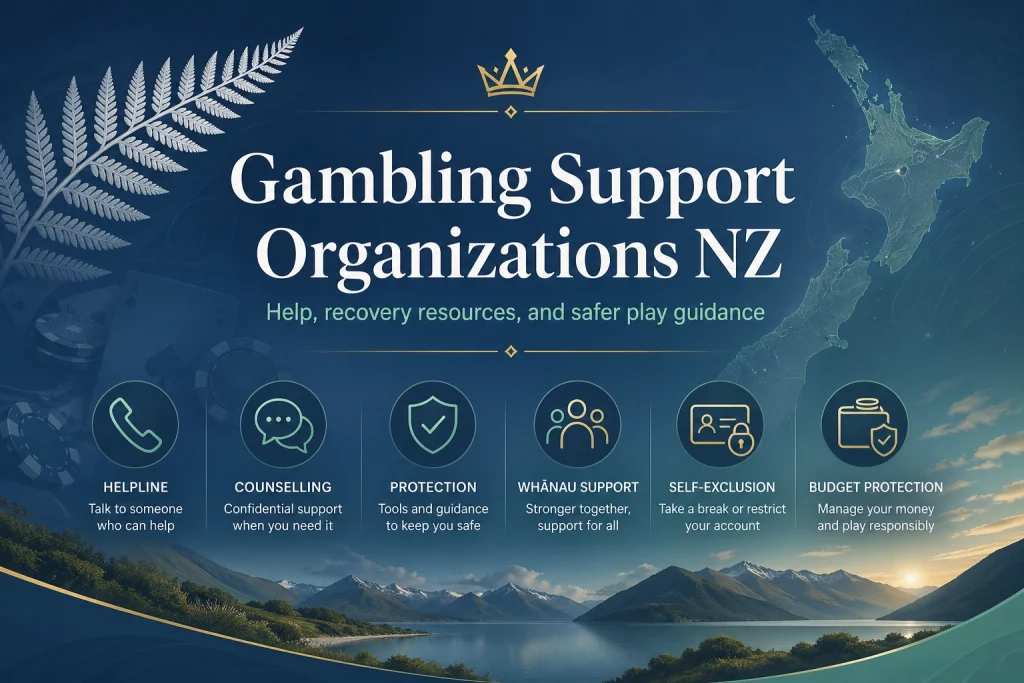
A support organization can help with several specific problems. It can help someone understand whether their gambling has become harmful. It can help them set stronger barriers. It can support self-exclusion. It can help family or whānau understand how to respond. It can also help people deal with shame, financial pressure, and relapse without turning the situation into secrecy.
The Gambling Helpline NZ describes itself as a national freephone support service for people affected by gambling in Aotearoa, available 24 hours, with support by phone and text. That kind of service is important because gambling urges do not only appear during business hours. A person may need immediate support late at night, after a loss, during payday pressure, or after a relapse.
| Organization | Type of Support | Who It Can Help | Official Resource |
| Gambling Helpline NZ | 24-hour phone and text support, referral and information | People affected by their own gambling or someone else’s gambling | Gambling Helpline NZ |
| Problem Gambling Foundation | Free confidential counselling, advice and support | Individuals, whānau and support people affected by gambling harm | Problem Gambling Foundation NZ |
| Ministry of Health | Public health information, strategy and gambling harm research | Readers looking for official NZ health context and harm prevention information | Ministry of Health Gambling Harm |
| Department of Internal Affairs | Gambling regulation and harm minimisation information | Players who want to understand NZ gambling rules and operator responsibilities | DIA Harm Minimisation |
| Asian Family Services | Free and confidential support for Asian communities in NZ | Asian New Zealanders needing culturally appropriate counselling support | Asian Family Services |
| Mapu Maia | Pasifika gambling harm support, counselling and education | Pasifika individuals, families and communities | Mapu Maia Support Services |
Gambling Helpline NZ: Immediate Support When the Urge Is Active
The Gambling Helpline is one of the most important support pathways because it is designed for immediate contact. A person does not need to have a perfect explanation before reaching out. The first message can be simple: “I am struggling with gambling and I need help.” That is enough to begin.
This matters for Casino Kingdom users because gambling harm often becomes urgent in short windows. Someone may have lost money, feel tempted to deposit again, or believe that one more session could recover the loss. In that moment, reading a long policy page may not help. A clear helpline route can.
The helpline can provide support, information and referral. It can help people understand what is happening, identify safer next steps, and connect with other services if ongoing support is needed. This is especially useful for people who feel isolated or ashamed.
The safest advice for someone in an active urge is direct: close the gambling page, do not deposit again, step away from the device, and contact support. If a person is tempted by a Bonus offer during that moment, the offer should be ignored. Promotions can become triggers when someone is trying to stop or reduce gambling.
Problem Gambling Foundation: Counselling and Ongoing Help
The Problem Gambling Foundation states that it provides free counselling, advice and support for people affected by gambling, and says whānau or a support person can be brought to appointments. This is important because gambling harm is often not solved by one conversation. Some people need ongoing support to understand triggers, manage money, rebuild trust, and prevent relapse.
Counselling can help someone move from vague intentions to a structured plan. Instead of saying “I will stop soon,” the person can build practical steps: self-exclusion, device blocking, payment protection, marketing removal, support check-ins, and alternative routines.
For Casino Kingdom, this is relevant at the Sign up stage as well. If someone is creating a new gambling account after previous harm, support may be more appropriate than registration. Opening another account can become a way to bypass limits or continue a harmful pattern.
Problem Gambling Foundation support can also help people affected by someone else’s gambling. Partners, parents, friends, and whānau may need advice on boundaries, money protection, communication, and emotional support. They do not need to wait until the person gambling agrees to get help.
Ministry of Health and the Public Health View of Gambling Harm
The Ministry of Health provides the wider public health context for gambling harm in New Zealand. This matters because gambling harm is not only about personal choice. It is shaped by access, product design, social pressure, financial stress, advertising, and community conditions.
A strong Casino Kingdom responsible support page should reflect that broader view. It should not blame users or suggest that gambling harm is simply a lack of discipline. It should explain that help exists, support is normal, and early action is safer than waiting.
Public health information can also help users understand why gambling harm affects more than money. It can affect emotional wellbeing, family stability, relationships, sleep, concentration, and trust. When support pages explain this clearly, users may recognise harm earlier.
The FAQ section on a responsible gambling page should therefore answer practical support questions, not only account questions. It should explain how to set limits, how to self-exclude, how to stop marketing, how to contact support, and what to do if gambling feels difficult to control.
Department of Internal Affairs: Regulation and Harm Minimisation
The Department of Internal Affairs explains that New Zealand’s Gambling Act and Harm Minimisation Regulations contain measures to limit gambling harm from pokies and casino gambling. This shows that harm reduction is also part of the regulatory environment, not only a private responsibility.
For Casino Kingdom, this regulatory context should shape how support information is presented. A responsible site should make help resources visible around account access, payment areas, promotional pages, and safer-play tools. Support should not be buried at the bottom of the site.
The Department of Internal Affairs is especially relevant for understanding gambling rules, harm minimisation, venue obligations, and wider regulatory information. It is not a counselling service in the same way as helplines or community providers, but it gives official context for how gambling harm is addressed in New Zealand.
A user browsing Links should be guided toward official support and regulatory resources, not only internal pages. This helps separate responsible information from marketing content.
Culturally Specific Support: Asian Family Services and Mapu Maia
New Zealand is diverse, and gambling support is more effective when it recognises language, culture, family structure, and community context. Some people may not feel comfortable using a general support pathway first. A culturally specific service can reduce barriers.
Asian Family Services says its Asian Helpline provides nationwide free and confidential services, including support for gambling harm, and offers support in multiple languages such as Mandarin, Cantonese, Korean, Vietnamese, Thai, Japanese, Hindi and English. This can be important for people who need help in a language or cultural setting that feels safer.
Mapu Maia provides Pasifika gambling support services and describes its counselling and education as free, professional, confidential, and culturally appropriate, with language support in English, Samoan and Tongan. For Pasifika families and communities, that culturally grounded approach can make support more accessible.
A Casino Kingdom support guide should recognise that gambling harm does not affect every community in the same way. Some people may need individual counselling. Others may need whānau involvement. Others may need language support or culturally specific guidance. The best support pathway is the one the person is most likely to use.
Support Before Gambling Becomes a Crisis
Support organizations are most useful when contacted early. A person does not need to wait for severe debt, relationship breakdown, or complete loss of control. If gambling has started creating stress, repeated deposits, secrecy, chasing, or broken limits, support is already appropriate.
The safest rule is simple: if gambling feels hard to stop, pause and reach out. If someone is moving between Slots, live games, or other Games while trying to recover losses, the issue is no longer entertainment. It is a harm signal.
Casino Kingdom should present support resources as part of normal safer-play infrastructure. The message should be clear: support is not only for emergencies. It is for anyone who wants to regain control, reduce risk, or stop gambling completely.
How NZ Gambling Support Organizations Help in Practice
Gambling support organizations are most useful when their role is practical. A person affected by gambling harm may already know that gambling is causing problems, but not know what to do next. They may feel shame, panic, debt pressure, family stress, or the urge to continue playing. Support organizations help turn that confusion into a structured plan.
For Casino Kingdom players in New Zealand, the support pathway should be clear: stop the immediate gambling session, protect remaining money, avoid further deposits, use exclusion or limit tools, contact a support service, and involve trusted people where appropriate. This is not about blaming the player. It is about reducing harm before the next urge becomes another gambling session.
Support With Self-Exclusion
Self-exclusion is one of the strongest tools for people who cannot stop gambling through private promises. It allows a person to block or restrict access to gambling accounts, venues, or platforms for a defined period. For someone who repeatedly returns after deciding to stop, this can be more effective than relying only on self-control.
Support organizations can help a person decide whether self-exclusion is needed, how long it should last, and which accounts or venues should be included. This matters because many people exclude from one gambling route but leave others open. If someone blocks one account but keeps another site, phone app, or physical venue available, the risk remains.
A support worker can also help write a clear exclusion request. The request should not be vague. It should say that gambling harm is involved and that the person wants account restriction, self-exclusion, marketing removal, and written confirmation. Strong wording reduces the chance that the request is treated as a normal customer preference.
For Casino Kingdom, self-exclusion information should be easy to find inside account and safer-play sections. A user should not need to search through long terms to find out how to restrict access.
| Support Need | How an Organization Can Help | Practical Result | When to Use It |
| Self-Exclusion | Helps request account blocks, venue exclusion or stronger gambling barriers | Access is reduced before the next urge | When gambling feels difficult to stop |
| Financial Protection | Helps identify risky payment patterns and plan safer money controls | Essential money is separated from gambling access | When deposits repeat or bills are affected |
| Whānau Support | Supports family conversations and safer boundaries | Secrecy is reduced and support becomes more structured | When gambling affects trust or household stability |
| Relapse Planning | Helps identify triggers and prepare responses | The person has a plan before urges return | After previous attempts to stop have failed |
| Emotional Support | Provides confidential space to discuss shame, stress, anxiety or pressure | The person is less isolated and can make clearer decisions | When gambling is linked to mood or coping |
Support With Money Protection
Money protection is usually one of the first practical needs. Gambling harm often becomes worse when deposits remain easy. A person may intend to stop, but if payment details are saved and funds are available during a stressful moment, the pattern can restart quickly.
Support organizations can help someone think through money access. This may include removing saved cards, lowering online payment limits, separating essential funds, using bank alerts, asking about transaction controls, or creating a basic repayment plan if debt exists.
The key rule is that gambling should never be used to fix gambling-related debt. That is chasing in another form. A support organization can help the person move away from “I need one win to repair this” and toward a stable financial plan.
For Casino Kingdom users, payment pages should make limit tools and support information visible. If a player is trying to deposit after repeated losses, the safer choice may be to stop and contact support rather than continue.
Support for Whānau and People Affected by Someone Else’s Gambling
Gambling harm often affects people who are not gambling themselves. Partners, parents, children, friends, flatmates, and whānau members may experience stress, financial pressure, broken trust, secrecy, or emotional conflict. Support organizations can help these people as well.
Whānau members may not know whether to confront, help with debt, monitor accounts, or step back. These decisions are difficult. A support organization can help them set boundaries without escalating shame. Boundaries might include refusing repeated cash loans, protecting shared accounts, supporting self-exclusion, or encouraging counselling.
It is important that support does not become humiliation. A person affected by gambling harm still needs dignity. Strong boundaries and calm communication are more useful than threats or public confrontation.
Casino Kingdom’s responsible gambling content should make this clear. Support is not only for the account holder. It is also for anyone affected by the gambling behaviour.
Support With Relapse Prevention
Relapse prevention means preparing for gambling urges before they happen. Many people relapse because they only plan for calm moments. They do not plan for payday, late-night stress, arguments, loneliness, alcohol use, boredom, sports events, or promotional messages.
Support organizations can help identify these triggers and build specific responses. If payday is risky, money barriers should be in place before payday. If late-night phone use is risky, device restrictions should be active before night. If promotions are risky, marketing removal and email filters should be used.
A relapse prevention plan should be written and simple. During an urge, the person should not need to think through complex instructions. The plan might be: close device, leave room, message support person, wait 20 minutes, use helpline if urge continues.
This works because urges change over time. They can feel intense, but they do not remain at the same level forever. A plan creates time for the urge to weaken.
Support With Emotional Triggers
Gambling is often connected to emotion. Some people gamble when they are stressed, lonely, bored, angry, ashamed, excited, or desperate to recover a loss. If the emotional trigger is not addressed, blocking one account may not be enough.
Support organizations can help identify what gambling is doing emotionally. Is it used for escape? Is it used for excitement? Is it used to avoid thinking about debt? Is it used to feel hopeful after stress? These questions matter because the replacement plan should match the emotional need.
If gambling is used to escape stress, the person needs another way to manage stress. If gambling is used for loneliness, the person may need social support. If gambling is used to chase financial relief, the person needs budgeting or debt support. The replacement cannot be random. It should respond to the reason gambling became powerful.
For Casino Kingdom, this reinforces an important point: safer gambling is not only about account tools. Tools are necessary, but support helps address the reasons behind the behaviour.
Support During an Active Gambling Urge
An active urge can feel like a crisis even if no money has been deposited yet. The person may feel pressure to act quickly, especially if they believe they can recover losses. Support organizations are valuable because they offer an alternative action at the exact moment gambling feels urgent.
The safest sequence is direct. Close the site. Move away from the device. Do not deposit. Contact a support service or trusted person. Wait. Write down the trigger. If the urge continues, use another barrier such as blocking tools or self-exclusion.
The person should not stay inside the gambling environment while deciding. Looking at games, offers, balances, or previous transactions can strengthen the urge. The first step is physical and digital distance.
A support organization can help someone calm the situation and move to practical next steps. That may include removing access, protecting money, or arranging ongoing counselling.
Casino Kingdom and Responsible Support Visibility
For a Casino Kingdom support page, the placement of support information matters. It should not sit only at the bottom of the website. It should be visible near account tools, payment information, responsible gambling pages, promotional pages, and help sections.
If a user is reading about limits, exclusions, payments, or account control, support resources should be nearby. The purpose is to make the safer action easier to choose.
Support visibility should also avoid judgmental wording. Users are more likely to reach out when language is calm and practical. Phrases such as “get help now” can be useful, but they should be supported by clear next steps: call, text, chat, self-exclude, block access, remove marketing, protect money.
A responsible casino support page should also acknowledge that stopping gambling may be the right choice for some users. Safer gambling does not always mean continuing with limits. Sometimes the safer decision is to stop access completely.
Choosing the Right Gambling Support Organization in NZ
Choosing the right gambling support organization depends on the person’s situation. Some people need immediate help during a strong urge. Some need counselling because gambling has become a repeated pattern. Some need help with whānau conversations. Some need culturally specific support. Some need practical help with self-exclusion, debt pressure, or relapse prevention.
For Casino Kingdom players in New Zealand, the key point is that support does not have to begin with a crisis. A person can contact a support service because they feel worried, because they have broken gambling limits, because they are hiding activity, because they are chasing losses, or because family members have noticed changes. Early support is often simpler than waiting until the harm becomes severe.
Immediate Help Versus Ongoing Support
The first distinction is between immediate support and ongoing support. Immediate support is useful when the person is in an active urge, has just lost money, feels tempted to deposit again, or is afraid they will continue gambling. In that situation, the priority is to interrupt the session quickly.
Ongoing support is different. It is useful when gambling has become a pattern over time. Counselling, scheduled support sessions, whānau involvement, budgeting guidance, and relapse-prevention planning can help the person rebuild structure after gambling has affected daily life.
Both types of support are valid. A person may start with a helpline during an urgent moment, then move into counselling or community support later. The first contact does not need to solve everything. It only needs to move the person away from gambling and toward help.
| Support Situation | Best First Step | Why This Helps | Possible Follow-Up |
| Strong urge to gamble now | Contact a helpline or trusted person immediately | Interrupts the urge before another deposit happens | Self-exclusion or blocking tools |
| Repeated losses and chasing | Book counselling or gambling harm support | Helps identify the pattern and build barriers | Financial safety plan |
| Family or whānau affected | Contact a service that supports both individuals and families | Reduces secrecy and helps set safer boundaries | Whānau meeting or counselling |
| Language or cultural barrier | Use culturally specific support where available | Makes help easier to understand and trust | Ongoing culturally appropriate counselling |
| Relapse after exclusion or limits | Strengthen the protection plan with support | Shows which barrier failed and how to improve it | Longer exclusion, stronger payment controls, routine changes |
How to Prepare for a Support Conversation
A person does not need to prepare perfectly before contacting help. However, a few notes can make the conversation more useful. The person can write down how often they gamble, which products they use, how much money is involved, whether they chase losses, whether they hide gambling, and whether they have tried to stop before.
They should also note the main triggers. These may include payday, late-night phone use, stress, loneliness, alcohol, debt pressure, boredom, sports events, or promotional messages. The trigger information helps the support worker build a plan that matches the real pattern.
If the person feels ashamed, they can start with one sentence: “I am worried about my gambling and I do not know what to do next.” That is enough. Support workers are used to hearing incomplete, emotional, or uncertain first messages.
For Casino Kingdom users, preparation may also include checking account tools before the support conversation. If the user has access to account limits, time-outs, or self-exclusion, they can mention whether those tools have already been used. If they have not been used, the support worker may help decide which option fits.
Moving From Casino Tools to External Support
Casino tools can be useful, but they are not always enough. Deposit limits, session reminders, time-outs, account closure and self-exclusion can reduce access. External support helps with the reasons the person keeps returning.
For example, a limit can stop one deposit. Support can help explain why the person wanted to deposit again after a loss. A self-exclusion request can block one account. Support can help prepare for the urge to open another account. A time-out can create a break. Support can help the person decide what to do during that break.
This distinction matters. Casino Kingdom account tools should be used when gambling risk appears, but users should not rely only on platform tools if the problem is repeated or emotional. External support adds human guidance, accountability and wider planning.
A person should move to external support when they repeatedly break limits, feel unable to stop, hide gambling, borrow money, experience conflict at home, or gamble to manage stress. At that point, the issue is no longer only account settings. It is a pattern that needs support.
Culturally Specific Support in New Zealand
Culturally specific support can be important because gambling harm is shaped by family structure, community expectations, language, stigma, migration experience, financial pressure and trust in services. Some people may not feel comfortable explaining gambling harm in a general service first. A culturally appropriate service can make the first step easier.
Asian Family Services can be relevant for Asian New Zealanders who prefer language-specific or culturally informed support. Mapu Maia can be relevant for Pasifika people and families who need culturally grounded counselling and education. Māori health and community services may also be appropriate depending on local availability and personal preference.
The important point is that support should feel usable. If a person avoids help because the service does not feel culturally safe, they may remain isolated. Casino Kingdom’s support page should therefore list different types of help, not only one general route.
Support should also recognise whānau. In many situations, gambling harm is not managed by the individual alone. Family, partners, elders, community workers or trusted people may be part of the recovery plan. Good support allows for that where appropriate.
How Support Helps With Self-Exclusion and Blocking
Self-exclusion can feel simple in theory but difficult in practice. A person may not know which accounts to block, how to word the request, how long exclusion should last, or what to do if they keep finding new gambling sites. Support organizations can help make the process more complete.
A strong exclusion plan covers all known gambling accounts, relevant physical venues, marketing removal, app deletion, website blocking and payment barriers. If only one route is blocked, the person may still return through another. Support can help identify those routes.
The person should keep records of exclusion requests. These may include screenshots, emails, chat transcripts, dates and operator names. Records help if marketing continues or access remains open.
Support can also help after relapse. If the person gambles after exclusion, the plan should be strengthened rather than abandoned. The question becomes: how did access happen, and which barrier needs to be improved?
Support for Financial Recovery
Financial pressure is one of the strongest reasons people continue gambling. They may believe they need a win to repair the damage. This is dangerous because it keeps the person inside the same risk system that caused the loss.
Support organizations can help a person move away from gambling-based recovery and toward real financial steps. This may include listing debts, protecting essential income, separating bill money, reducing payment access, speaking with creditors, or finding budgeting support.
The person should not wait until debt is severe. If gambling has started affecting bills, rent, food, savings, or family money, financial protection is already needed.
For whānau, financial support also matters. Family members may need guidance on whether to lend money, cover debts, or protect shared accounts. Support services can help set boundaries that reduce harm without abandoning the person.
Gambling Support Checklist for Casino Kingdom NZ Players
A gambling support page is most useful when it gives people clear actions. Someone affected by gambling harm may not have the patience or emotional space to read vague advice. They may be under pressure, trying not to deposit again, hiding the problem, or unsure how to ask for help. The page should therefore make the next step obvious.
For Casino Kingdom players in New Zealand, the safest support structure is simple: stop the session, protect money, avoid further deposits, use account tools, contact external support, and involve a trusted person if needed. These steps should be visible before the situation becomes urgent.
Complete Support Checklist
A checklist helps because gambling harm can create confusion. After a loss or during an urge, a person may feel panic, shame, frustration or hope that one more session will fix the problem. In that state, long explanations are less useful than direct steps.
The checklist below can be used by a player, whānau member, support person, or website editor building a responsible gambling section for Casino Kingdom.| Support Step | What to Do | Why It Helps | Who Can Support It |
| Stop the session | Close the casino page, step away from the device and do not deposit again | Interrupts the immediate harm cycle | Player, trusted person, helpline |
| Protect money | Remove saved cards, reduce payment access and separate essential funds | Prevents impulsive deposits during stress | Player, bank, whānau, budgeting support |
| Use account tools | Set limits, request time-out, account closure or self-exclusion | Creates formal barriers beyond private promises | Casino support, responsible gambling team |
| Stop marketing | Request removal from email, SMS, phone and push promotions | Reduces triggers from offers and reminders | Casino support, player |
| Contact external help | Use helpline, counselling, community or culturally specific support | Adds guidance outside the gambling environment | Gambling support organization |
| Tell someone safe | Speak with a trusted person, partner, whānau member or counsellor | Reduces secrecy and builds accountability | Trusted support person |
| Review triggers | Identify payday, stress, late-night use, boredom or promotion triggers | Shows where stronger barriers are needed | Counsellor, support worker, player |
How Casino Kingdom Should Present Support Information
For Casino Kingdom, gambling support information should not be buried in a low-visibility footer. It should be part of the normal player journey. Responsible support links should appear near account tools, payment pages, promotional terms, account closure sections, limit settings, and self-exclusion information.
The language should be practical and non-judgmental. A person experiencing gambling harm may already feel shame. A support page should not increase that shame. It should give direct options: pause play, set limits, block access, request exclusion, remove marketing, contact support, and protect money.
Support information should also be separate from promotional language. A responsible gambling page should not sit next to aggressive calls to deposit, claim offers, or continue playing. If a person is reading help information, the page should reduce gambling pressure, not increase it.
Casino Kingdom should also make clear that stopping gambling completely may be the safest option for some users. Responsible gambling is not always about continuing with limits. If a person has lost control, self-exclusion and external support are more appropriate than another attempt at careful play.
Support Pathway Strength
What NZ Players Should Do During an Active Urge
An active gambling urge should be treated as a short-term risk moment. The person does not need to solve everything immediately.They need to avoid gambling during the next few minutes.
The safest first step is distance. Close the page, put down the phone, leave the room, or move away from the device. Remaining on the gambling page while trying to decide is risky because visual cues, balance information and game access can increase the urge.
The second step is contact. Message a trusted person or use a support service. The message can be short: “I am having an urge to gamble and need help waiting it out.” This reduces secrecy and creates a pause.
The third step is money protection. Do not deposit. Do not move funds. Do not open another payment method. If possible, remove access to saved cards and banking apps during the urge window.
The fourth step is delay. Wait at least 20 minutes while doing a non-gambling action. Walk, shower, make tea, do a household task, or call someone. Urges often reduce when the person changes location and behaviour.
Support for Whānau and Friends
Whānau and friends may feel unsure how to help. They may want to solve the problem quickly, pay debts, confront the person, or monitor every action. Some of these responses can be understandable, but not all are helpful.
The safest approach is to combine compassion with boundaries. A person affected by gambling harm needs dignity and support. At the same time, whānau should protect household money, avoid repeated cash bailouts without a plan, and seek guidance themselves.
A useful conversation begins with specific observations rather than blame. For example: “I have noticed missed payments and late-night gambling. I am worried and want us to get support.” This is clearer and safer than insults or threats.
Whānau members can also contact gambling support organizations for themselves. They do not need to wait for the person gambling to agree. Support can help them understand what boundaries are reasonable and how to reduce harm in the household.
How to Keep Support Active Over Time
Support should not stop after one good week. Gambling harm can return during stress, payday, loneliness, boredom, debt pressure or after exposure to promotional content. A person who has stopped gambling should keep support systems active even after urges reduce.
A monthly support review can help. The person can ask: Have I gambled? Have I had urges? What triggered them? Did my barriers work? Have I received gambling marketing? Are my payment protections still active? Have I been honest with someone?
If the answers show risk, the plan should be strengthened. This may mean longer exclusion, stricter payment limits, more frequent counselling, stronger device blocking or more whānau involvement.
Progress should be protected, not tested. A person should not check whether they can safely browse gambling sites again. Opening gambling content “just to see” can restart the cycle. Recovery is stronger when barriers remain in place.
Casino Kingdom Responsible Support Standards
A Casino Kingdom support page should meet several standards. It should provide external NZ support resources. It should explain limits, time-outs, self-exclusion and account closure clearly. It should separate help content from promotions. It should encourage early support, not only crisis support.
It should also recognise that gambling harm affects more than the player. Partners, family, whānau and friends may need help. A good support page should mention this directly and include resources for affected others.
The tone should remain factual and calm. Overly dramatic language can create shame. Overly soft language can minimise risk. The best tone is clear: if gambling is causing harm, stop access and contact support.
Casino Kingdom should also make account actions easy. A user should not need to negotiate repeatedly to set limits, take a time-out, close an account or request self-exclusion. The safest design is one where help tools are visible, direct and fast to use.
Final Guidance for Gambling Support Organizations NZ
Gambling support organizations in New Zealand provide practical help for people affected by gambling harm. They can help during active urges, after losses, during recovery, while setting self-exclusion, when protecting money, and when rebuilding trust with whānau.
Support is not only for crisis. It is useful as soon as gambling becomes stressful, secretive, repetitive, financially harmful or emotionally difficult to stop. Early support can prevent deeper harm and give the person more options.
A responsible Casino Kingdom page should make those options visible. The user should never have to search hard for help. Gambling support organizations exist to move people toward safety, stability and recovery, and they should be treated as essential resources in any New Zealand gambling information page.






Comments