
RNG Explained for NZ Players
What RNG Means in an Online Casino
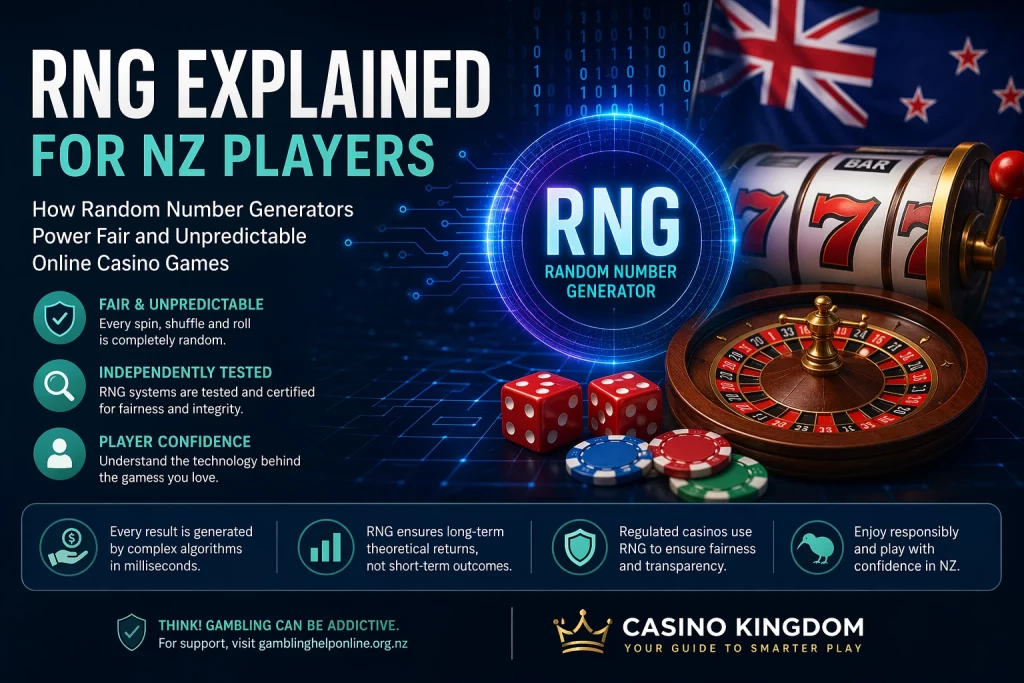
RNG stands for Random Number Generator. In an online casino context, it is the system that produces unpredictable game outcomes in digital casino games. When a New Zealand player spins a slot, deals a digital blackjack hand, opens an instant-win game, or plays a virtual roulette round, the visible animation is only the surface. The actual result is created by mathematical software before the player sees the final symbols, cards, numbers, or payout.
This is one of the most important ideas for Casino Kingdom players to understand. The spin animation does not “decide” the result while the reels are moving. The flashing symbols, suspense sounds, near-miss effects, and final stop sequence are visual presentation layers. The RNG has already produced the outcome according to the game’s mathematical rules. The screen then shows that outcome in a format the player can understand.
A common misunderstanding is that online casino games work like physical machines where the visual motion itself determines the result. Digital games are different. In a regulated and properly tested game, the RNG continuously produces possible outcomes, and when the player presses spin or play, the game records a result from that random process. The reels then animate to display it.
For NZ players, this matters because it separates game reality from game feeling. A slot may feel “due” after a long quiet period, but the RNG does not remember frustration. A blackjack hand may feel unlucky after several bad rounds, but the next digital result is still generated independently according to the game structure. A roulette number may seem ready to change after repeating, but digital randomness does not follow emotional patterns.
Why RNG Exists
The purpose of RNG is to make digital casino games unpredictable. Without RNG, an online casino game could become fixed, repetitive, or exploitable. Players could predict outcomes, or operators could manipulate results more easily. RNG is designed to prevent that by producing outcomes that cannot be reliably forecast by the player.
This does not mean every game is equal. Each casino game still has a mathematical design. A slot has a return-to-player percentage, volatility model, reel structure, paytable, bonus frequency, and maximum win potential. RNG decides which outcome occurs on a specific round, but the game model defines the range of possible outcomes and how often different types of results are expected over time.
This is where many players confuse randomness with fairness. A random result can still happen inside a game with a house edge. Fairness means the game follows its tested rules. It does not mean the player has an equal chance of winning money overall. The casino advantage is built into the game mathematics, not usually into the manipulation of individual rounds.
How RNG Relates to Player Accounts
RNG itself is connected to the game, not to a player’s mood, history, or recent deposit. In a proper game environment, the RNG does not decide to reward a player because they are new, punish them because they withdrew, or change results because they claimed a promotion. The casino account system and the game result system should be separate.
This separation is important when players discuss ideas such as “new account luck” or “withdrawal punishment.” These beliefs are common in casino communities, but they are usually based on emotional interpretation of random outcomes. A new account can win early because randomness allows it. An old account can lose repeatedly because randomness allows that too. The presence of a recent deposit, a pending withdrawal, or a completed Login should not change the RNG result in a legitimate certified game.
That does not mean the entire casino experience is neutral. Casinos can influence player behaviour through layout, promotions, game placement, reminders, and bonus offers. But influencing player choices is different from changing RNG results. The RNG controls outcomes inside the game. The platform design controls how players move toward games, offers, and deposits.
The Difference Between RNG and RTP
RNG and RTP are connected, but they are not the same thing. RNG creates individual outcomes. RTP describes the theoretical long-term percentage returned to players across a very large number of rounds. For example, a slot with 96% RTP is designed, over extensive long-term play, to return about 96 units for every 100 units wagered. That does not mean every player receives 96 back after betting 100.
RTP is a game-level statistic. RNG is a round-level mechanism. RTP tells you about the design. RNG determines each immediate outcome. A player can win far above RTP in a short session or lose far below it. That short-term variation is not automatically suspicious. It is part of how random games behave.
For NZ players, the practical interpretation is this: RTP is useful for comparing games, but it should not be treated as a promise. RNG means short sessions can swing sharply in either direction. A high RTP game can still produce a losing session. A lower RTP game can still produce a lucky result. Over time and across massive play volume, the game’s mathematics become clearer, but individual sessions remain uncertain.
RNG and Volatility
Volatility explains how results are distributed. Two games can have the same RTP but feel completely different because their volatility is different. A low-volatility slot may return frequent small wins, keeping the balance moving slowly. A high-volatility slot may produce long empty stretches, then occasionally deliver larger wins or bonus features.
RNG drives both types of games, but the paytable and game model shape how random outcomes feel. A high-volatility game is not “less random.” It is random within a more aggressive payout structure. A low-volatility game is not “more generous.” It simply distributes returns differently.
This distinction matters when NZ players choose Slots. The theme, graphics, and music can make two games look equally entertaining, but their mathematical behaviour may be very different. A player with a small session budget may feel more pressure on a high-volatility title because the balance can drop quickly before any meaningful feature appears.
| Concept | Simple Meaning | What It Does | What NZ Players Should Understand |
|---|---|---|---|
| RNG | Random Number Generator | Creates unpredictable game results for digital casino rounds. | It decides individual outcomes, but it does not guarantee wins or balance recovery. |
| RTP | Return to Player | Shows theoretical long-term return percentage across very large play volume. | It is a comparison tool, not a short-session prediction. |
| Volatility | Result distribution pattern | Controls whether wins tend to be frequent and small or rare and larger. | It strongly affects how stressful or smooth a session feels. |
| House Edge | Built-in casino advantage | Represents the long-term mathematical margin in favour of the game operator. | A fair game can still have a house edge. |
| Game Animation | Visual result display | Shows the outcome through reels, cards, wheels, or bonus screens. | The animation usually presents the result after the RNG has already selected it. |
Why “Near Misses” Feel Important but Usually Are Not
Near misses are common in slot design. A player may see two bonus symbols and a third symbol stopping just above or below the payline. This can feel like the game almost paid. In reality, the result is either a win or not a win. The near-miss animation may increase suspense, but it does not mean the next spin is more likely to trigger a feature.
This is one of the most powerful psychological effects in casino games. The player sees closeness. The RNG only records the actual outcome. That difference between visual feeling and mathematical reality is one reason players should be cautious when interpreting game behaviour emotionally.
A near miss can make a player continue because the game feels “close.” But randomness does not work that way. The next spin is not improved because the previous one looked close. The casino interface may present the outcome dramatically, but the underlying event remains independent unless the game has a clearly stated feature mechanic that carries progress forward.
RNG in Table Games
RNG is not limited to slots. Many digital table games also use random generation. In virtual blackjack, the system may simulate card dealing. In digital roulette, the result may be produced through random selection. In virtual baccarat, poker-style games, or instant-win games, RNG may determine cards, numbers, multipliers, or prize outcomes.
The difference is that table games often have more familiar probability structures. Players understand that blackjack uses cards and roulette uses numbers. But in a digital setting, those outcomes are still handled by software. The player is not watching a physical deck being shuffled unless they are playing a live dealer game. In a digital table game, RNG is doing the work.
Live dealer games are different. They usually rely on physical equipment and real-time video, although digital systems still record bets, manage payouts, and display results. This is why NZ players should distinguish between live casino tables and RNG-powered table simulations. Both can be legitimate, but they do not operate in exactly the same way.
Can Casinos Change RNG Results?
In a properly tested and regulated game environment, the casino should not be able to change individual RNG outcomes manually. The game provider supplies the game logic, and testing laboratories may certify that the RNG and payout model behave as expected. The casino integrates the game and manages the player account, wallet, and site experience.
However, players should still be selective. Not every casino operates under the same standards, and not every licensing environment gives the same level of confidence. A player should check provider names, licence information, game documentation, payment terms, and support transparency before assuming a site is trustworthy.
The key point is that RNG fairness depends on the wider ecosystem: game provider reputation, independent testing, licensing standards, and platform transparency. RNG is a technical mechanism, but player trust comes from the controls around it.
How RNG Fits Into the Player Journey
Why RNG Knowledge Helps NZ Players
Understanding RNG does not help a player beat the casino. It helps the player avoid false assumptions. That distinction is important. RNG knowledge will not reveal the next spin, identify a hot machine, or prove that a game is ready to pay. What it does is protect the player from myths that can lead to poor decisions.
A player who understands RNG is less likely to chase losses because a game “must be close.” They are less likely to increase stakes after a near miss. They are less likely to believe that changing devices, switching times of day, or logging in again will reset luck. They are more likely to treat each round as uncertain and manage the session through budget, time, and risk limits.
This is the correct use of RNG knowledge. It does not create control over results. It creates clearer thinking about results. For NZ players, that clarity is valuable because online casinos are designed to be fast, colourful, and emotionally engaging. RNG understanding slows the decision-making process and makes the player more aware of what is actually happening.
RNG Does Not Follow Player Emotion
One of the hardest things for players to accept is that RNG does not respond to emotion. A session can feel personal even when it is mathematical. A player may lose ten spins in a row and feel that the game is becoming unfair. Another player may trigger a bonus feature early and feel that the slot is “hot.” In both cases, the emotional interpretation is stronger than the technical reality.
Random Number Generator systems do not understand pressure, disappointment, confidence, or frustration. They do not know that a New Zealand player has been waiting for a feature round. They do not know that the balance is almost empty. They do not know that a player has just deposited or that the session started badly. In a properly structured RNG game, each eligible game round is produced through the game’s randomisation system and interpreted through the paytable.
For a site like Casino Kingdom, this explanation is important because players may move across different casino categories during one visit. A player may begin with slots, switch to digital roulette, check a promotion, and return to another game. The experience can feel like one continuous personal journey, but each RNG-based game is still governed by its own mathematical model.
Independent Events and Why They Matter
Most RNG casino rounds are independent events. This means the result of one round does not normally change the probability of the next round. If a slot does not trigger a feature for fifty spins, the next spin is not automatically improved because of that history. If a roulette number appears several times, the next result is not forced to avoid it. If a digital blackjack hand loses, the next hand is not guaranteed to compensate.
This principle is where many gambling myths begin. Players often expect balance. They assume that a bad run must be followed by a good one because that feels fair. But randomness does not work according to emotional fairness. Over a very large sample, game mathematics may move toward expected behaviour. In a short session, results can look strange, uneven, repetitive, or extreme.
That does not mean the casino is changing the outcome. It means short-term randomness can be uncomfortable. Players who understand this are less likely to chase. They know that a losing sequence does not create a debt that the game must repay. They also know that a winning sequence does not mean the game has become easier.
The Gambler’s Fallacy in Online Casino Play
The gambler’s fallacy is the belief that past random outcomes make opposite future outcomes more likely. In casino terms, it sounds like this: “This slot has not paid for a while, so it must be close.” Or: “Black has appeared five times, so red is due.” Or: “The bonus round has not appeared today, so it should come soon.”
These thoughts are common because human brains look for patterns. Pattern recognition is useful in many parts of life, but it can become misleading in random games. The game may produce clusters, dry periods, repeats, and sudden changes without following the story the player creates around them.
For NZ players reading Casino Kingdom content, this is one of the most useful lessons. A game can feel like it is building toward something even when there is no stored progress. Unless the game clearly states that it has a persistent feature, collection meter, jackpot counter, or saved bonus mechanic, the next round should be treated as a fresh random event.
RNG and Bonus Play
Bonus play can make RNG feel more complicated. When a player activates a promotion, the gameplay itself may still rely on RNG, but the account is now also subject to wagering rules. The Bonus does not usually change the random result of a slot. Instead, it changes how the casino account treats wagers, winnings, and withdrawals.
For example, a player may use bonus funds on eligible slots. The RNG still determines each spin outcome inside the game. At the same time, the casino system tracks wagering progress, maximum bet limits, eligible game contribution, expiry time, and whether the resulting funds can be withdrawn. The game outcome and the bonus rules are separate systems working at the same time.
This distinction matters because players sometimes blame the bonus for game behaviour. If a session goes badly after activating a promotion, it can feel as though the game became colder. But the more practical explanation is that random outcomes continued as normal while the bonus conditions affected how the balance was displayed, restricted, or converted.
How Casino Kingdom Players Should Read Game Results
The correct way to read RNG results is not to look for secret timing. It is to look at game structure. Before playing, the player should ask: What is the RTP? What is the volatility? What is the minimum and maximum bet? Does the game contribute to wagering? Are there bonus features? Is there a jackpot? Are results independent, or does the game include any persistent mechanic?
This approach works better than guessing whether the game is hot or cold. Casino Kingdom players should treat each game as a set of rules, not as a personality. A slot does not become friendly because it gave a feature early. A roulette game does not become hostile because several numbers repeated. A blackjack simulation does not know that the previous hand was painful.
| Player Belief | RNG Reality | Better Interpretation | Casino Kingdom Player Tip |
|---|---|---|---|
| The game is due to pay. | Previous losing rounds do not normally improve the next result. | A dry run can continue longer than expected because short-term randomness is uneven. | Do not increase stakes only because a feature has not appeared. |
| A near miss means the bonus is close. | A near miss is usually a visual presentation of a losing or partial outcome. | The game may create suspense without changing the next-round probability. | Treat near misses as entertainment effects, not signals. |
| A new account gets better luck. | Certified RNG games should not change outcomes based on account age. | Early wins can happen naturally, but they are not proof of special treatment. | Do not assume first-session wins will repeat. |
| Changing devices can reset the game. | The game result system is not normally controlled by desktop or mobile preference. | Device changes may affect convenience, not mathematical probability. | Use the device that helps you play more calmly and clearly. |
| RTP protects the session. | RTP is a long-term theoretical figure, not a short-term guarantee. | A high-RTP game can still lose quickly in a short session. | Use RTP for comparison, not prediction. |
Why Short Sessions Can Look Extreme
Short sessions are where RNG feels most confusing. A player may deposit, play for fifteen minutes, and experience a result that feels completely disconnected from the published RTP. That can happen because RTP needs a very large sample size to become meaningful. One short session is too small to represent the game’s long-term design.
This is especially true for high-volatility games. A player can go through many spins without a major return, then suddenly hit a feature that changes the balance dramatically. Another player can trigger a feature quickly but receive a low payout. Both outcomes can be normal within the game model.
At Casino Kingdom, or any similar online casino site, players should avoid judging fairness from one session alone. One lucky result does not prove generosity. One poor session does not prove manipulation. Patterns should be assessed cautiously, and even repeated personal results may not be enough to prove anything about the underlying RNG.
RNG and Game Categories
Different casino game categories use randomness differently. Slots rely heavily on RNG because every spin can involve symbol positions, bonus triggers, multipliers, free spins, wilds, scatters, jackpots, or feature states. Digital roulette uses RNG to produce number outcomes. Digital blackjack uses RNG to simulate card distribution. Instant games may use RNG to determine prize reveal results.
This means a broad Games lobby may contain many forms of randomness under one visual roof. The player sees categories. The system sees different game engines, different providers, different rules, and different risk profiles.
For NZ players, the practical habit is to treat each game category separately. A strategy or expectation from blackjack does not transfer cleanly to slots. Roulette probability does not explain crash games. Slot volatility does not explain baccarat. Each game needs its own reading.
Why RNG Does Not Remove the Need for Rules
Some players think that because RNG is random, rules do not matter. That is wrong. Rules matter because they define what the RNG can produce and how results are paid. The RNG selects outcomes within the game’s structure. The paytable decides value. The volatility model decides distribution. The casino terms decide how account funds behave. The promotion rules decide whether gameplay contributes to wagering.
So the player should not stop at “the game is random.” That is only the starting point. The better question is: random within what system?
A low-value symbol result, a free spin trigger, a jackpot event, a multiplier, or a bonus buy result all exist because the game rules allow those outcomes. Randomness chooses among possibilities, but the game design creates the possibility set. That is why game information is still worth reading.
The Role of Game Providers
Game providers are central to RNG trust. A casino may host the game, but the game provider usually supplies the software. Known providers often publish game information, RTP details, feature descriptions, and sometimes certification references. This does not make every game suitable for every player, but it creates more transparency.
Casino Kingdom players should pay attention to provider names in the game lobby. If a site clearly shows who made the game, players can better compare titles and understand what type of experience to expect. Some providers are known for volatile slots. Others produce classic table games, live casino products, jackpot networks, or casual instant games.
The provider name is not the only trust signal, but it is a useful one. A game without clear provider information is harder to evaluate.
RNG and Mobile Play
RNG does not become different because a player uses a mobile phone. A spin launched from a phone and a spin launched from a desktop should follow the same game mathematics if the same game version is being used. What changes is the player’s behaviour. Mobile play is faster, more private, and more convenient. That can make sessions longer or more impulsive.
This is where the App experience matters if Casino Kingdom offers or promotes mobile access. A clean mobile interface should show balance, wager size, bonus status, and game information clearly. It should not make the player guess what funds are being used or whether a bonus condition is active.
The danger of mobile play is not that RNG becomes worse. The danger is that the player may make decisions faster. Quick taps can turn into repeated spins, repeated deposits, or longer sessions than planned. RNG knowledge helps here because it reminds the player that fast access does not create better odds.
A Practical Session Model for NZ Players
How to Use RNG Knowledge Responsibly
The useful response to RNG is not fear. It is structure. NZ players should decide stake size before the session starts, choose games that match their budget, avoid chasing losses, and stop interpreting every short-term result as a signal. This approach does not make the casino beatable, but it makes the experience more controlled.
A player who understands RNG also becomes less vulnerable to misleading advice. Systems that claim to predict slots, roulette, or digital casino outcomes should be treated carefully. Random games do not become predictable because someone offers a pattern, timing method, or betting progression. Betting systems may change how money is distributed across wagers, but they do not change the underlying RNG.
At Casino Kingdom, this means players should use the platform as entertainment, not as a puzzle to solve. The better question is not “How do I beat the RNG?” The better question is “How do I manage my session knowing the RNG cannot be predicted?”
Why RNG Trust Depends on Testing
RNG is a technical concept, but player trust does not come from the word “random” alone. A casino game can claim to use random outcomes, yet players still need a reason to believe that the system works correctly. That reason usually comes from independent testing, provider reputation, licensing standards, and transparent game information.
For NZ players, the safest way to think about RNG is this: randomness must be supported by verification. A game should not only say that outcomes are random. It should come from a recognised software provider, operate through a casino with visible terms, and ideally be connected to testing or certification processes. This does not mean every player needs to read technical audit reports before playing. It means players should understand that fair RNG is part of a wider control system.
On a site like Casino Kingdom, this kind of explanation is useful because players may see hundreds or even thousands of casino titles in one lobby. The size of the game library alone does not prove quality. What matters is whether the casino presents games from credible providers, whether game details are visible, and whether the platform gives enough information for players to make a controlled choice.
What Independent Testing Usually Looks For
Independent testing laboratories examine whether the game’s randomisation and payout behaviour match the expected design. They may test the RNG algorithm, outcome distribution, game rules, payout tables, return percentages, and technical integrity of the software. The goal is not to make sure every player wins. The goal is to check whether the game behaves according to its stated mathematics.
This distinction is important. Testing does not remove the house edge. Testing does not guarantee that a player will receive a fair-looking sequence in one short session. Testing does not prevent unlucky streaks. Instead, it supports the claim that the game is producing outcomes within the approved mathematical model.
A tested slot can still feel brutal during a short session. A tested digital roulette game can still repeat numbers in a way that looks strange. A tested blackjack simulation can still produce several poor hands in a row. These events are not automatically evidence of failure. Random systems can produce uncomfortable patterns.
RNG Certification Is Not a Winning Signal
Some players see certification references and assume the game is safer in the sense of being more likely to pay them. That is not the correct interpretation. Certification is about technical fairness and compliance with the game model. It does not turn the game into a low-risk product.
A certified high-volatility slot can still drain a balance quickly. A certified table game can still carry a house edge. A certified instant-win title can still produce mostly losing rounds. Certification tells the player that the game should behave as designed, not that the design is favourable for short-term profit.
For Casino Kingdom readers, this is a practical distinction. Trustworthy operation and personal outcome are not the same thing. A player can have a losing session on a legitimate game. A player can also win on a game without fully understanding its risks. The correct goal is not to guarantee winning. The correct goal is to understand the system before accepting the risk.
Common Testing Bodies and Reference Sources
Casino players sometimes see names such as eCOGRA, iTech Labs, GLI, BMM Testlabs, or regulator-linked testing references. These organisations may test gaming systems, RNGs, payout behaviour, or compliance processes, depending on jurisdiction and product type. Players do not need to become technical auditors, but recognising the role of testing bodies helps separate real control mechanisms from empty marketing language.
| Authority Resource | What It Helps Explain | Useful for NZ Players |
|---|---|---|
| Department of Internal Affairs — Gambling | New Zealand gambling regulation, public policy, and local gambling context. | Useful for understanding the official NZ framework around gambling activity. |
| Ministry of Health — Gambling Harm | Information about gambling harm, risk factors, and public health support. | Useful for safer gambling awareness and recognising when gambling stops being recreational. |
| Gaming Laboratories International | Testing and certification services for gaming systems and gambling technology. | Useful for understanding the role of independent technical testing in casino systems. |
| eCOGRA | Testing, inspection, and certification services for online gambling operators and software. | Useful for understanding how fairness and operational standards may be reviewed. |
| UK Gambling Commission | Regulatory guidance, licensing principles, fairness expectations, and consumer protection rules. | Useful as a comparison point for mature online gambling regulation. |
How Players Can Check RNG Credibility Without Technical Knowledge
Most players will not inspect source code, testing reports, or RNG algorithms. That is normal. A practical review does not require advanced mathematics. Instead, NZ players can check visible signals that suggest stronger or weaker credibility.
First, look at provider names. If the casino lists recognised software studios, players can research those providers separately. Second, look for game information pages. A useful game page should explain basic rules, payout features, and sometimes RTP. Third, check the casino’s terms and conditions. If the casino explains game fairness, disputes, voided rounds, malfunction rules, and account responsibilities clearly, that is a stronger sign than a vague promotional page.
Fourth, check support quality. If a player asks where to find RTP or game rules and support cannot answer, the casino’s transparency may be weak. Fifth, compare the mobile and desktop presentation. If the desktop version shows game details but the mobile version hides them, mobile players may be making less informed choices.
RNG Myths That Testing Does Not Support
Testing does not support the idea that casinos can make a specific player lose because they withdrew money. It does not support the idea that the platform makes new players win automatically. It does not support the belief that a player can reset a slot by changing devices, clearing cache, or logging out and back in. These beliefs may come from personal experience, but personal experience inside random systems is often misleading.
The strongest myths usually come from emotionally intense sessions. A player who loses quickly looks for a cause. A player who wins quickly looks for a pattern. A player who nearly triggers a bonus several times may assume the game is deliberately teasing them. But RNG games can create these feelings without any hidden adjustment.
Casino Kingdom content should help players separate what can be checked from what is only guessed. RTP can sometimes be checked. Game rules can be read. Provider names can be compared. Withdrawal terms can be reviewed. But the idea that a slot is “about to pay” cannot be verified in a reliable way.
What Happens When a Game Malfunctions
Casino terms often include a rule stating that malfunctions void plays or payouts. This can sound harsh, but it exists because digital games depend on software, communication between servers, and balance updates. If a game round is interrupted, duplicated, displayed incorrectly, or disconnected from the wallet, the casino and provider may need to review the technical record.
A malfunction is different from an unlucky result. A malfunction involves a technical problem: frozen game screen, balance mismatch, missing round result, server error, incorrect payout display, or incomplete transaction record. If this happens, the player should stop playing that game temporarily, take screenshots, note the time, game name, stake size, and balance before and after the issue, then contact support.
The practical rule is simple: do not keep clicking through a technical error. If a game behaves strangely, document the issue. A reliable casino should be able to trace the round through game logs and provider records.
Why RNG Logs Matter
Behind each digital casino round, there is usually a technical record. The player sees the result. The system records the round ID, stake, game, timestamp, account reference, outcome, and balance movement. If a dispute appears, these records can help reconstruct what happened.
This is another reason why legitimate online casinos behave like transaction systems, not simple entertainment pages. Every round affects money, so every round needs a record. When players contact support, specific information helps. “The game stole my money” is harder to investigate than “At 21:14 NZ time, on this slot, after a $1 spin, my balance changed from $84 to $82 without showing a completed round.”
Casino Kingdom readers should remember that support teams work better with precise details. The clearer the report, the easier it is for the casino to identify whether the issue is a display delay, a completed losing round, a provider problem, or a genuine technical fault.
RNG and Promotional Restrictions
Promotions can create confusion because they add a second layer of rules over random game outcomes. A player may win from RNG gameplay but still be unable to withdraw immediately because wagering requirements are incomplete. That does not mean the RNG failed. It means the account balance is restricted by promotional terms.
This is why players should check the promotion rules before they start playing. Some bonuses allow only specific games. Some exclude jackpots or live dealer games. Some set a maximum bet. Some cap convertible winnings. Some expire quickly. The RNG may operate normally, but the player’s ability to use winnings depends on the bonus contract.
This is also why reading rules matters before using a Sign up offer. A welcome promotion may look simple on the homepage, but the detailed terms decide how the player can actually use the funds.
RNG and Account Restrictions
RNG results should be separate from account restrictions, but the overall player experience can still be affected by account status. If an account is unverified, the player may still be able to play but may not be able to withdraw. If a bonus is active, the player may be restricted from cashing out. If payment ownership is unclear, the casino may pause withdrawals.
These restrictions do not change the random result inside a certified game. They change what happens after the result. That distinction is essential. A player may win through RNG gameplay and still face a document request before payment. The issue is not the result generation. It is account compliance.
For NZ players using Casino Kingdom or comparing similar sites, this means two checks are necessary. First, assess game fairness. Second, assess account and payment clarity. A casino can have legitimate RNG games but still frustrate players through unclear verification or withdrawal rules.
Practical Checklist for RNG Confidence
A player does not need perfect information, but they should look for enough information. Before committing serious play time, ask whether the casino shows game providers, whether game rules are accessible, whether RTP is available where relevant, whether support can explain basic game questions, whether payment terms are clear, and whether responsible gambling tools are visible.
If several of those elements are missing, the player should be careful. The absence of information does not automatically prove that the games are unfair, but it does make the platform harder to evaluate. In online gambling, unclear systems increase risk.
RNG Knowledge Should Change How Players Behave
Understanding RNG is useful only if it changes the way a player approaches casino games. It is not enough to know that results are random. The practical value comes from using that knowledge to avoid false patterns, emotional decisions, and risky assumptions during real sessions.
For NZ players using Casino Kingdom, the main point is simple: RNG does not give advance warnings. A game does not tell the player when it is ready to pay. A losing streak does not guarantee recovery. A winning streak does not prove that the player has found a strong method. Randomness can produce all of those patterns naturally, which is why the player should focus on what can actually be controlled.
The controllable parts are stake size, session budget, game choice, bonus acceptance, time spent playing, and the decision to stop. These are not exciting concepts, but they matter more than trying to read a game’s mood. RNG cannot be predicted, but player behaviour can be planned.
Why Betting Systems Do Not Beat RNG
Many gambling systems claim to manage randomness. Some suggest increasing the stake after losses. Others suggest lowering the stake after wins, changing games after a certain number of spins, tracking colours in roulette, or following repeated symbols in slots. These systems can feel logical because they create structure. But structure is not the same as mathematical advantage.
A betting system changes how money is distributed across wagers. It does not change the probability of the next RNG outcome. If the underlying game has a house edge, the betting system does not remove it. In some cases, aggressive staking systems increase risk because they require larger bets after losses, which can drain a balance quickly or hit table and wallet limits.
For NZ players, the safest interpretation is that betting systems may organise a session, but they do not defeat the game. A player can decide to use flat betting, smaller stakes, or a fixed stop point as a form of budgeting. That is different from believing the system can predict or control the result.
Why Chasing Losses Is Especially Risky in RNG Games
Chasing losses means continuing or increasing play because the player wants to recover previous losses. RNG games make chasing especially dangerous because there is no built-in guarantee of correction. A slot can continue missing. A digital roulette game can keep producing unwanted results. A blackjack simulation can continue delivering poor hands. Randomness does not care how much the player has already lost.
The emotional logic of chasing is understandable. Losing creates pressure. The player wants to restore the balance and end the session feeling neutral. But the technical reality is harsher: the next round is still uncertain, and larger stakes only increase exposure.
At Casino Kingdom, or any similar online casino platform, the better response is to pre-set a loss limit before playing. Once that limit is reached, the session should end. This turns the decision into a rule rather than an emotional negotiation.
How to Choose RNG Games More Carefully
Game choice should be based on structure, not theme alone. A slot with dramatic graphics may look appealing, but the underlying volatility may not suit the player’s budget. A simple-looking game may offer a steadier session. A jackpot game may be exciting but can have a different risk profile from a standard slot. A digital table game may feel strategic but still includes mathematical advantage.
NZ players should check four details where available: RTP, volatility, minimum bet, and bonus contribution. RTP helps compare long-term theoretical return. Volatility explains how uneven the session may feel. Minimum bet affects how long a small balance can last. Bonus contribution matters when wagering rules are active.
If the player is using Casino Kingdom as an entertainment platform, these checks make the session more deliberate. The goal is not to remove risk. The goal is to avoid choosing games blindly.
| Player Goal | Better RNG-Aware Choice | Risk to Avoid | Practical Casino Kingdom Tip |
|---|---|---|---|
| Longer session with small budget | Lower stake sizes and games with steadier payout behaviour | High-volatility games at large bet levels | Check stake size before starting and avoid increasing bets after losses. |
| Using a promotion | Eligible games that clearly contribute to wagering | Playing excluded games or exceeding maximum bonus bet rules | Read promotion terms before accepting the offer. |
| Trying new games | Small test sessions with clear stop points | Assuming early wins prove the game is easy | Use early play to understand pace, not to predict future results. |
| Playing on mobile | Shorter sessions with visible balance and limits | Fast repeated taps and impulsive deposits | Keep the wallet and session limit visible before playing. |
| Understanding fairness | Games from visible providers with accessible rules | Trusting games with unclear provider or payout information | Prefer titles where rules, provider, and RTP details are easier to find. |
RNG and Responsible Gambling
Responsible gambling is directly connected to RNG understanding. When a player accepts that results cannot be predicted, the need for limits becomes clearer. Limits are not a sign of weakness. They are a practical response to uncertainty.
Deposit limits protect the bankroll. Time limits protect attention. Loss limits protect against chasing. Cooling-off tools protect the player when gambling becomes too emotional. Self-exclusion tools are stronger measures for players who need to stop access completely.
For NZ players, these tools should be treated as part of normal casino use. A player does not need to wait for a problem before setting limits. In fact, limits work best when they are set before the first session, while the player is calm and not reacting to wins or losses.
Casino Kingdom content should present responsible gambling as part of system literacy. Understanding RNG means understanding that the player cannot control outcomes. Responsible gambling tools help control the environment around those outcomes.
How to Read Wins Correctly
Wins can be just as misleading as losses. A player who wins early may believe they understand the game. They may increase stakes, extend the session, or move to higher-risk titles. This is where RNG can create overconfidence.
A win does not prove skill in a random game unless the game includes a genuine decision-making component and the player is applying correct strategy. Even then, games with strategy can still involve house edge or variance. In slots and many instant-win games, wins are outcomes, not evidence that the player has discovered a method.
The better response to a win is calm review. Was the win part of a planned session? Has the player reached a pre-set target? Is there an active bonus restriction? Can the funds be withdrawn, or are they still locked behind wagering? These questions matter more than the feeling of momentum.
How to Read Losses Correctly
Losses should also be read carefully. A losing session does not automatically mean the game is broken. Short-term loss is normal in casino gambling. The key is whether the player stayed within planned limits and whether the game behaved technically as expected.
The dangerous moment comes when the player tries to explain the loss as temporary imbalance that must reverse soon. This is how chasing begins. A disciplined player accepts that the session result is one possible outcome of random play. They stop when the planned boundary is reached.
If there is a genuine technical concern, the player should separate it from ordinary loss. A missing payout display, frozen game, balance mismatch, or incomplete round is a support issue. A sequence of losing spins is usually not. Clear separation helps the player respond properly.
When Players Should Contact Support
Players should contact support when there is a specific issue, not simply because the game feels unlucky. Useful support cases include missing deposits, unclear bonus status, document review questions, withdrawal delays, frozen game rounds, incorrect balance display, or a game result that did not settle properly.
The message to support should include details: game name, time, stake size, balance before and after, device used, screenshots if available, and a concise explanation. This gives the support team something concrete to investigate.
At Casino Kingdom, a player-focused support request should avoid vague emotional wording and focus on records. For example, “I had a technical problem during a $2 spin on this game at this time” is stronger than “the game is rigged.” The first version can be checked. The second version is difficult to investigate.
Why FAQ Pages Matter for RNG Education
A strong casino education section should explain common RNG questions in simple terms. The FAQ page can be useful if it answers practical player concerns: whether game results are random, what RTP means, how bonus wagering interacts with game play, what happens during a malfunction, and how to set responsible gambling limits.
If a casino’s FAQ only repeats promotional messages, it is not doing enough. Players need operational clarity, not only marketing language. A useful FAQ should reduce confusion before a player deposits or plays.
For Casino Kingdom, RNG education can make the site feel more trustworthy because it helps players understand both the entertainment side and the risk side. Good casino content does not pretend that randomness can be controlled. It explains how randomness works and how players can manage their own behaviour around it.
RNG Myths NZ Players Should Avoid
Several myths appear again and again in online casino discussions. The first is the “hot game” myth. A game that paid recently is not necessarily more likely to continue paying. The second is the “cold game” myth. A game that has not paid recently is not necessarily due. The third is the “new player boost” myth. A legitimate RNG game should not improve outcomes just because an account is new.
Another myth is the idea that time of day matters. Some players believe games pay better at night, during weekends, or after maintenance. Unless the game has a clearly stated scheduled feature, RNG results should not be treated this way. Time may affect player mood and concentration, but it should not be assumed to improve odds.
A further myth is that switching games after a loss protects the player. Switching may help emotionally if it interrupts chasing, but it does not mathematically recover lost money. The next game has its own rules, volatility, and house edge.
How Casino Kingdom Can Frame RNG for NZ Readers
For the Casino Kingdom page, RNG should be presented as a foundation of digital casino fairness, but not as a guarantee of positive results. This distinction is important for credibility. Players should not leave the page thinking RNG makes games safe or profitable. They should leave understanding that RNG makes outcomes unpredictable within a controlled mathematical design.
The page should also make clear that player protection comes from behaviour, not prediction. Reading rules, choosing games carefully, setting limits, and avoiding chasing are practical habits. They do not beat the casino, but they reduce impulsive decisions.
This balanced explanation is especially useful for NZ players because many online casino articles oversimplify RNG. Some make it sound purely technical. Others use it as a vague trust signal. A stronger Casino Kingdom guide should connect RNG to real player decisions.
Final Perspective
RNG is one of the core systems behind online casino games, but it is often misunderstood. It does not create patterns for players to decode. It does not compensate for frustration. It does not promise short-term balance. It simply produces outcomes within the structure of a game’s mathematical design.
For NZ players at Casino Kingdom, the most useful lesson is not how to predict RNG. It is how to respect it. Every spin, card, number, or instant result carries uncertainty. The player’s control begins outside the result: choosing the game, setting the stake, deciding the budget, reading the terms, and stopping at the planned point.
A player who understands RNG becomes less vulnerable to myths and more attentive to structure. They know that Links to games, promotions, and casino pages should be treated as access points, not promises of outcome. They know that a random game can be fair and still produce losses. They know that the smartest decision is often not another spin, but a clear boundary.






Comments