
How Safe Are Online Casinos NZ
I do not think the question “how safe are online casinos NZ?” has a simple yes-or-no answer. The more accurate answer is this: online casino safety depends on regulation, licensing, payment controls, identity checks, game testing, complaint handling, data security, and responsible gambling tools. If one of those areas is weak, the whole experience becomes less safe.
For New Zealand players, the legal context is especially important. The Department of Internal Affairs explains that gambling in New Zealand is illegal unless authorised by or under the Gambling Act 2003, and that remote interactive gambling is prohibited, with limited exceptions. Its dedicated page on remote interactive gambling states that the Act prohibits remote interactive gambling, with limited exceptions relating to Lotto NZ, TAB NZ and lottery-style sales promotion schemes.
That does not mean every online casino a New Zealand user sees online is operating from New Zealand. Many online casino brands are offshore. This makes safety evaluation more complicated because a player may be dealing with a company licensed outside New Zealand, using offshore dispute systems, offshore payment processing and external responsible gambling tools. For Casino Kingdom, this page should explain that distinction clearly rather than presenting online casinos as automatically safe.
The safer way to approach the topic is analytical. I would ask: who operates the site, where is it licensed, how are payments handled, how are games tested, what happens during disputes, and what tools exist if gambling starts to feel difficult to control?
Online Casino Safety Starts With Regulation
The first safety layer is regulation. A regulated gambling environment normally requires rules around identity checks, anti-money-laundering controls, game fairness, responsible gambling tools, advertising standards, payment processes and complaint handling. Without meaningful regulation, a player has fewer protections when something goes wrong.
In New Zealand, local remote interactive gambling is restricted under the Gambling Act framework. The Department of Internal Affairs says the Gambling Act 2003 was the first New Zealand law to regulate remote interactive gambling, and that remote interactive gambling is prohibited under the Act except for limited permitted cases.
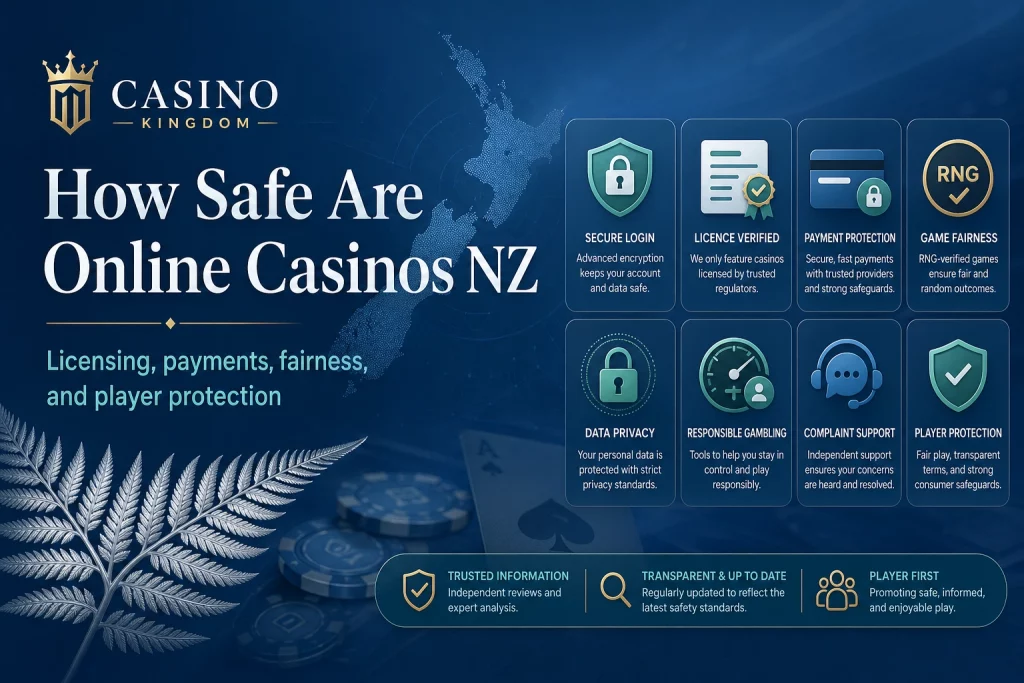
This matters because a New Zealand player cannot simply assume that an online casino is covered by domestic New Zealand protections. If a site is offshore, the relevant regulator may be outside New Zealand. That regulator’s standards, complaint process and enforcement power become part of the safety picture.
For Casino Kingdom readers, I would explain it like this: the first safety check is not the homepage design, the game selection or the welcome offer. The first safety check is legal and regulatory status. A polished website can still be weak if its licensing, ownership and dispute process are unclear.
| Safety Area | What I Would Check | Why It Matters | Risk Signal |
| Licensing | Jurisdiction, licence number, operator name and regulator visibility | Shows which rules apply and who can investigate complaints | Licence details are hidden, vague or impossible to verify |
| Payments | Deposit rules, withdrawal timeframes, fees and verification requirements | Payment transparency reduces disputes and surprise restrictions | Withdrawal terms are unclear or change after winning |
| Game fairness | RNG testing, RTP information and provider reputation | Fairness controls help confirm games are not manually manipulated | No testing references or missing RTP details |
| Account security | Password protection, verification flow and secure account management | Protects identity, funds and personal data | Weak verification, unclear data policies or poor login protection |
| Responsible gambling | Deposit limits, time-outs, self-exclusion and support information | Helps users stop or reduce access when gambling becomes risky | Limits are hard to find or support links are buried |
What I Would Check Before Trusting an Online Casino
If I were assessing an online casino for NZ readers, I would start before the Login area. Account access is not the first safety test. The first safety test is whether the site gives enough information to evaluate it before creating an account or depositing money.
I would look for the operator name, licence information, terms and conditions, privacy policy, payment terms, responsible gambling page and complaint route. If those details are missing or written vaguely, that is a problem. Safety depends on transparency.
The next thing I would check is whether the casino separates promotional content from safety information. A site that pushes offers aggressively but hides responsible gambling tools is not balanced. A Bonus may look attractive, but safety depends on whether the terms are clear: wagering requirements, eligible games, maximum bet rules, expiry time, withdrawal restrictions and identity checks.
I would also be cautious at the Sign up stage. A safe registration process should explain identity checks, age restrictions, data use and responsible gambling tools. Registration should not feel like a rushed path to depositing. A site that pressures immediate payment before giving clear account information deserves scrutiny.
Payment Safety and Withdrawal Reliability
Payment safety is one of the areas where online casino risk becomes visible. A safe site should explain how deposits work, which payment methods are accepted, how long withdrawals normally take, what verification is required, whether fees apply, and what can delay payment.
I would not judge payment safety only by deposit speed. Fast deposits are common. Withdrawals are more important. A casino can feel smooth at the deposit stage but become difficult when money has to leave the account. That is why withdrawal terms need to be read before depositing.
Verification is not automatically a red flag. In regulated gambling environments, identity checks can be required to prevent fraud, underage gambling and financial crime. The problem is not verification itself. The problem is unclear, inconsistent or late-stage verification that appears only after a withdrawal request.
For Casino Kingdom readers, the safer rule is simple: if payment rules are unclear before depositing, do not treat the site as fully safe. Payment clarity should exist before money enters the account.
Game Fairness and RNG Testing
Online casino safety also depends on whether games are independently tested and whether game information is transparent. Legitimate casino games usually rely on random number generation, game certificates, provider testing and RTP information. These controls do not guarantee wins. They only help confirm that outcomes follow the tested game rules.
A common mistake is thinking that a safe casino means a player is more likely to win. That is wrong. Even fair games are designed with a mathematical house edge. Safety means the game should operate as described, not that it becomes profitable for the player.
This matters especially with Slots, because they are fast, visually engaging and often volatile. A slot can be technically fair and still risky for the player if sessions are long, deposits repeat, or losses are chased. Fairness and harm reduction are related, but they are not the same thing.
The wider Games lobby should also be assessed carefully. A large library is not a safety guarantee. I would rather see clear provider names, RTP information, game rules and responsible gambling controls than a huge lobby with little transparency.
How Safe Are Online Casinos NZ: Main Safety Factors
Account Security and Data Protection
A safe online casino account should protect personal data, payment details and identity documents. This matters because gambling accounts often contain sensitive information: name, date of birth, address, payment method, transaction history and verification documents.
A site should explain how data is stored, why verification documents are requested, and how account access is protected. Strong passwords, secure browsing, clear privacy policies and responsible account management all matter.
I would also check whether the casino offers practical account protections: password reset security, login monitoring, withdrawal verification and support for account closure. These details show whether the site treats the account as a financial-risk environment rather than a simple entertainment profile.
If a casino treats account creation casually but requests sensitive documents later without clear explanation, I would see that as a risk signal. Verification should be understandable, not surprising.
Responsible Gambling Tools Are Part of Safety
A casino cannot be considered genuinely safe if its responsible gambling tools are weak. Safety is not only about encryption and payments. It is also about what happens when gambling becomes difficult to control.
The Ministry of Health explains that gambling harm can affect individuals, whānau and communities, and its gambling statistics work includes evidence on prevalence, behaviour and service use. A responsible online casino page should reflect this by making limits, time-outs, self-exclusion and support information easy to find.
A safe casino should provide clear account tools: deposit limits, session reminders, time-outs, self-exclusion, marketing removal and links to support. These tools should be visible before harm becomes severe, not hidden after several help pages.
The App environment deserves extra attention. Mobile gambling can make access too easy because the account sits next to everyday tools. If a player uses a casino app, safety depends on notification control, payment friction, account limits and the ability to remove access quickly.
Complaint Handling and Dispute Resolution
Complaint handling is another safety test. A casino should explain how players can raise disputes, how long responses take, what evidence is needed, and whether an external dispute body or regulator is available. If complaint information is vague, the player may have few options when something goes wrong.
I would review the FAQ section for this reason. A good FAQ should not only explain promotions and account use. It should explain verification, withdrawals, responsible gambling, complaints, limits, self-exclusion and account closure.
The Links area should also be used responsibly. It should point users toward official resources, responsible gambling support, regulatory information and account protection guidance. If a site only links deeper into promotional or game content, that is not enough for a safety-focused user.
Licensing, Offshore Risk and Real Player Protection
When I evaluate online casino safety for New Zealand players, I separate three different ideas: technical access, legal clarity and player protection. A website may be technically accessible from New Zealand. That does not automatically mean it is locally licensed, locally regulated or protected by New Zealand consumer-facing gambling systems. This distinction is important because many players judge safety by whether the site loads, whether the games open and whether deposits work. That is not enough.
For Casino Kingdom, I would explain the issue directly. A casino can look polished, offer familiar providers, display modern payment options and still leave the player with weak protection if licensing, ownership, complaints and responsible gambling tools are unclear. Safety is not the same as convenience. A smooth interface can reduce friction, but it does not prove accountability.
Why Licensing Jurisdiction Matters
A licence tells the player which regulator sets the rules, what standards the operator must follow, and where complaints may go if the casino fails to act properly. I would not treat all licences as identical. Some regulators have stronger requirements, clearer dispute systems, better complaint channels and more visible enforcement than others.
A safety-focused player should check the licence before depositing. The licence should be named clearly, and the operator should provide enough information to verify it. If the licence number is missing, the regulator is vague, or the operator name does not match the terms, I would treat that as a warning sign.
Licensing also affects responsible gambling obligations. Some regulators require limits, self-exclusion, identity checks, game testing, payment controls and complaint procedures. Others may be less strict. If a player cannot tell which rules apply, they cannot properly assess the risk.
The safest approach is to read the licence details together with the terms and conditions. A licence badge on its own is not enough. I would check whether the regulator, company name, registered address, dispute process and responsible gambling rules align across the site.
| Licensing Check | What I Would Look For | Why It Matters | Warning Signal |
| Regulator name | Clear licensing authority and jurisdiction | Shows which legal framework applies | Only a vague “licensed casino” claim appears |
| Operator identity | Company name, registered address and terms alignment | Shows who is responsible for the account relationship | Different company names appear across pages |
| Licence verification | Licence number, regulator link or searchable registry reference | Allows the player to confirm the licence is real | No way to verify the claim independently |
| Complaint route | Internal complaint process and external escalation option | Protects the player if a withdrawal or account issue arises | Complaint instructions are vague or missing |
| Responsible gambling duties | Limits, time-outs, exclusion tools and support information | Shows whether the licence connects to harm-reduction tools | Support tools are hidden or weakly explained |
Offshore Online Casinos and NZ Player Risk
Many online casino sites accessible to New Zealand users operate offshore. That does not automatically mean every such site is fraudulent, but it does change the player-protection picture. If the casino is not locally licensed in New Zealand, a player may need to rely on the offshore operator’s licensing jurisdiction, internal complaints process and payment rules.
The main risk is not only whether the games work. The main risk is what happens when something goes wrong. If a withdrawal is delayed, if verification is disputed, if a bonus term is interpreted against the player, or if an account is closed with funds pending, the available complaint route matters.
I would also check whether the casino clearly accepts players from New Zealand under its terms. Some sites may be accessible but restrict certain jurisdictions. A player should not assume that access means eligibility. If the terms are unclear on country eligibility, that is a practical risk.
For Casino Kingdom readers, I would frame offshore risk carefully: technical access is not the same as regulatory certainty. A player should check jurisdiction rules, terms, payments and dispute routes before creating an account or depositing.
Identity Checks and Verification
Identity verification is often misunderstood. Some players see it as an inconvenience or a red flag, but legitimate gambling operators often require age checks, identity checks and anti-fraud review. Verification can be part of safety. It helps prevent underage gambling, account misuse, bonus abuse, fraud and financial crime.
The problem is not verification itself. The problem is unclear verification. A safe online casino should explain what documents may be required, when they may be requested, how long review usually takes, and how data is protected. If a casino waits until withdrawal to introduce unexpected rules, the player may feel trapped.
I would check the verification rules before depositing. If the site says withdrawals can be delayed until identity checks are completed, I want to know that early. If proof of address, payment ownership or source-of-funds checks may be required, that should be stated clearly.
A safe player should also keep account details accurate. Incorrect name, address, date of birth or payment ownership can cause withdrawal delays. If the account must match the payment method, that should be followed from the start.
Payment Terms Are a Safety Test
Payment terms reveal a lot about a casino’s reliability. I would check minimum withdrawals, maximum withdrawals, processing times, pending periods, fees, document requirements, restricted payment methods and rules around bonus funds. These details matter more than the headline claim “fast withdrawals.”
A site may advertise quick payouts but still apply long verification windows, weekend delays, manual review, or payment-method restrictions. That is not automatically unfair, but it must be clear before the player deposits.
I would also review whether the casino allows withdrawals back to the same payment method used for deposits. Some payment methods may support deposits but not withdrawals. If that is the case, the player should know in advance.
Another key issue is bonus-linked withdrawal restrictions. If the player accepts a promotion, winnings may be tied to wagering requirements, maximum bet rules, maximum win limits or game restrictions. A payment problem may actually be a bonus-term problem. That is why payment safety and promotional transparency must be reviewed together.
How Safety Controls Affect the Player Journey
Legal Access, Technical Access and Real Protection
I would separate three questions. Can the website be opened from New Zealand? That is technical access. Does the site legally and clearly accept New Zealand users under its terms? That is eligibility. What happens if the user needs protection, support or dispute resolution? That is real player protection.
Many players stop at the first question. If the website opens, they assume access is acceptable. That is not careful enough. Terms, licensing and payment eligibility matter more than whether the homepage loads.
Real protection includes clear limits, account closure, exclusion tools, withdrawal rules, data handling and complaint escalation. If those parts are weak, the user may have little practical protection even if the games function normally.
For Casino Kingdom, this distinction should be central. A safety page should not encourage players to treat technical access as proof of safety. It should teach them to check the full operating structure.
Why Responsible Gambling Tools Are Not Optional
Responsible gambling tools are part of basic safety, not decorative compliance. Deposit limits, session limits, cooling-off periods, self-exclusion, marketing removal and support links should be visible and functional. If a casino makes these tools hard to find, that is a negative safety signal.
I would especially check whether limits can be reduced immediately and whether increases require a delay. Immediate increases can be risky because they allow emotional decisions to take effect too quickly. A delay protects the player from impulsive escalation.
Self-exclusion should be clear. A player should know how to request it, what it does, how long it lasts, whether marketing stops, and whether written confirmation is provided. If self-exclusion is buried behind vague support language, the casino is weaker from a safety perspective.
Support information should also include external resources. A site should not keep every struggling player inside its own environment. When gambling becomes difficult to control, independent support may be safer than another account tool.
Complaint Handling and Evidence
A player should keep evidence when dealing with online casinos. This includes screenshots of terms, promotional rules, chat transcripts, payment confirmations, withdrawal requests, identity verification submissions and self-exclusion requests. Evidence matters because casino disputes often depend on timing and written terms.
If a player accepts a promotion, they should save the bonus terms active at that time. If a withdrawal is requested, they should save the confirmation and any communication. If a support agent gives instructions, those should be recorded.
A safe casino should make this less necessary by being transparent. But even with a transparent site, documentation protects the player.
If a casino refuses to explain decisions clearly, delays responses repeatedly, or gives conflicting information, I would treat that as a serious risk signal.
Game Fairness, Data Security and Early Warning Signs
After licensing and payments, I would move to the next safety layer: what happens inside the product itself. A casino may have clean branding, quick registration and a modern payment page, but safety also depends on whether games are tested, account data is protected, support is responsive, and risky behaviour is not encouraged through design.
For New Zealand players, this distinction is important because online casinos can feel familiar very quickly. A polished lobby, simple layout and fast-loading games can create trust before the player has checked the underlying protections. I would not treat visual quality as proof of safety. A good interface is useful, but it does not replace licensing, transparent terms, tested games and visible help tools.
Game Fairness Is Not the Same as Winning More Often
When I review game fairness, I first separate fairness from profitability. A fair casino game can still be mathematically unfavourable to the player. Fairness means the game operates according to its stated rules, not that the player is likely to win over time.
For online casinos, fairness usually depends on random number generation, provider oversight, game certification, RTP disclosure and independent testing. A trustworthy casino should name its game providers and make game information reasonably available. If provider names are hidden or RTP information is impossible to find, I would treat that as a transparency problem.
This matters because many players misunderstand short-term results. A losing streak does not automatically mean a game is unfair. A win does not automatically mean the site is safe. The better question is whether the game is from a recognised provider, whether the rules are visible, whether RTP is published, and whether the operator has a credible licensing structure.
I would also check whether the casino explains bonus restrictions around game categories. Some games may contribute differently to wagering, and some may be excluded entirely. If those details are unclear, a player can misunderstand the real cost of playing.
| Safety Check | What I Would Review | Why It Matters | Warning Sign |
| Game providers | Named studios, clear game rules and visible game information | Provider transparency supports trust in game operation | Anonymous games or missing provider details |
| RTP information | Return-to-player details in game info or help sections | Helps users understand mathematical expectations | RTP is hidden or replaced with vague “high win” language |
| Bonus contribution | Which games count toward wagering and at what percentage | Prevents confusion during bonus play | Restrictions are unclear until withdrawal |
| Session speed | How quickly rounds repeat and whether autoplay or quick play is available | Fast play can increase risk even with small stakes | No reminders, no session controls and aggressive fast-play design |
| Responsible design | Limits, reality checks, time-outs and help links near gameplay areas | Safety tools should be reachable during real use | Tools are buried far away from the game lobby |
Why Fast Games Need More Caution
Online casino safety is not only about whether games are fair. It is also about how games behave during real sessions. Fast games can compress decisions. The faster a player can repeat a wager, the easier it is to lose track of time, total spend and emotional state.
This is why I would be cautious with fast slot formats, instant games, crash-style mechanics and rapid table-game variants. A player may think the stake is small, but the total session exposure can grow quickly when rounds repeat without natural pauses.
Safe design should give the player enough interruption points. Session reminders, balance visibility, limit tools and cool-off options all matter. If the interface is built to keep the player moving without reflection, that weakens safety.
I would also watch how the site reacts after a loss. Does it push another deposit? Does it highlight promotions aggressively? Does it make account limits easy to reach? These design details matter because they affect behaviour.
Data Security and Account Protection
A safe online casino must protect personal and payment information. Gambling accounts usually contain sensitive data: identity details, date of birth, residential address, payment records, withdrawal information, support conversations and verification documents.
I would check the privacy policy, account security process and document-handling explanation before uploading anything sensitive. The site should explain why documents are requested, how they are reviewed, how long they may be stored and how personal information is protected.
Strong passwords are also part of player safety. I would not reuse a password from email, banking or other casino sites. If two-factor authentication is available, I would use it. If it is not available, I would at least treat account monitoring and password hygiene seriously.
A site that handles payments but gives little detail about privacy or account protection is weaker from a safety point of view. Data safety is not a secondary detail. It is part of the total risk assessment.
Mobile Casino Risks
Mobile gambling changes the safety picture because access becomes constant. A player can open the account from bed, during a commute, after work, during stress, or late at night. That does not make mobile gambling automatically unsafe, but it means the player needs stronger boundaries.
I would treat app notifications as a serious risk point. If a casino sends promotional alerts, free spin reminders, cashback messages or balance prompts, those can trigger unplanned sessions. A safer setup uses notification control, no saved payment details, session reminders and clear limits.
Mobile design should also make safety tools easy to reach. If limits, time-outs and self-exclusion are hard to find on a phone screen, the mobile product is weaker. A safe mobile experience should not only make games easier to play. It should also make breaks easier to take.
For New Zealand players, I would also recommend separating gambling from everyday phone routines. If the casino account is one tap away from banking or messaging apps, gambling can become too automatic.
User Reviews and Complaint Patterns
User reviews can be useful, but I would read them carefully. One angry review does not prove that a casino is unsafe. One positive review does not prove that it is trustworthy. The real value is in patterns.
If many users mention delayed withdrawals, unclear bonus terms, repeated verification problems, blocked accounts without explanation, unresponsive support or unresolved complaints, I would take that seriously. Recurring patterns can reveal operational weakness.
At the same time, reviews should be checked against the terms. Sometimes users misunderstand wagering requirements or verification rules. That does not automatically make the casino unsafe. The key question is whether the casino explains the rules clearly and applies them consistently.
I would also prefer reviews that include dates, specific issues and outcomes. Vague praise or vague anger is less useful than repeated, specific evidence.
Early Warning Signs of an Unsafe Online Casino
Some warning signs are visible before depositing. If the casino hides licence information, uses unclear terms, makes withdrawal rules hard to find, pushes large offers without explaining conditions, or avoids naming the operator, I would stop.
Other warning signs appear after account creation. These include support agents giving conflicting answers, verification rules changing suddenly, withdrawal options disappearing, limits being hard to set, or promotional messages continuing after a self-exclusion or marketing-removal request.
A player should not ignore these signs because the games look good. Safety is operational. A site can look premium and still be risky if its processes are weak.
A responsible player should also stop if they feel pressured. If the site design makes it hard to leave, hard to withdraw, hard to set limits or hard to contact support, that is not a good safety signal.
How Casino Kingdom Should Explain Safety
For Casino Kingdom, I would avoid saying that online casinos are “safe” in a blanket way. The page should explain conditions. A casino is safer when it has visible licensing, transparent terms, tested games, secure account systems, clear payments, responsible gambling tools and responsive support.
The page should also explain that fairness does not remove gambling risk. A certified game can still produce losses. A licensed site can still be risky for a player who chases losses or uses essential money. A polished mobile app can still encourage harmful access if limits are weak.
This balanced framing is important. It gives readers useful criteria without creating false confidence.
Complete Online Casino Safety Checklist for NZ Players
If I had to answer “how safe are online casinos NZ?” in one practical sentence, I would say this: an online casino is only as safe as its weakest operational layer. A site can have a professional design and a large game library, but if licensing is unclear, withdrawals are vague, support is slow, data protection is weak or responsible gambling tools are hidden, I would not call it safe.
For Casino Kingdom readers, the goal should not be blind trust or automatic rejection. The goal should be structured evaluation. Before account creation, before depositing and before accepting promotions, the player should know what protections exist and what risks remain.
My Online Casino Safety Checklist
I would use this checklist before depositing at any online casino. If several points are weak, I would stop and avoid using the site. Safety should be visible before money enters the account, not explained only after a problem appears.
| Safety Check | What I Would Confirm | Safe Signal | Unsafe Signal |
| Licence and operator | Regulator, licence number, company name and terms alignment | Information is clear, consistent and verifiable | Licence claims are vague or operator identity is hidden |
| Payment terms | Withdrawal timeframes, fees, limits and verification rules | Rules are visible before deposit | Withdrawal rules are unclear or only appear after winning |
| Game fairness | Recognised providers, RTP information and game rules | Game details are available and understandable | Provider names or fairness information are missing |
| Account security | Password safety, privacy policy, document handling and data protection | Data use and verification are clearly explained | Sensitive documents are requested without clear policy |
| Responsible gambling tools | Limits, time-outs, self-exclusion, support links and marketing removal | Tools are easy to find and use | Tools are buried, vague or difficult to activate |
| Complaint handling | Internal complaint route and external escalation path where available | Process, timelines and contact points are clear | Complaints are handled only through vague support chat |
When I Would Not Use an Online Casino
I would avoid an online casino if the licence is unclear, the operator name is hidden, withdrawal terms are vague, support gives conflicting answers, bonus rules are difficult to understand, or responsible gambling tools are hard to find. Any one of these issues may be manageable on its own, but several together create serious risk.
I would also avoid the site if it creates pressure before I have enough information. If the homepage pushes large offers but does not clearly show terms, payment rules or safety tools, that is not a balanced presentation. A safe user journey should make information available before persuasion.
Another reason to stop is personal risk. Even a better-operated casino may not be safe for someone who is chasing losses, using essential money, hiding gambling or unable to stop at planned limits. Platform safety and personal safety are not the same thing. A site may be operationally acceptable while gambling itself is unsafe for that person.
The strongest decision is sometimes not to play. If gambling feels financially or emotionally pressured, the safest option is to stop access and use support.
Final Risk Interpretation Rules
I would use several rules when judging online casino safety in New Zealand.
First, technical access is not proof of safety. A website loading from New Zealand does not mean the site is locally licensed, legally clear or backed by strong local protections.
Second, licensing needs verification. A badge or footer line is not enough. The regulator, operator and complaint process should be clear.
Third, fast deposits do not prove payment reliability. Withdrawals, verification and dispute handling reveal more about the casino’s real operation.
Fourth, fair games still carry loss risk. RNG testing and RTP information do not remove the house edge or the risk of harmful sessions.
Fifth, responsible gambling tools are core safety features. If limits, self-exclusion and support are hard to find, the site is weaker even if the game library is strong.
How Casino Kingdom Should Present This Page
A Casino Kingdom page about online casino safety should not create false certainty. It should explain that safety has layers: regulation, operator transparency, payment terms, game fairness, security, responsible gambling tools and support access.
The page should also separate informational guidance from promotional content. A reader asking “how safe are online casinos NZ?” is likely looking for risk evaluation, not a push toward deposits. The page should give them criteria, warning signs and next steps.
I would also include clear guidance on what to do if gambling feels difficult to control. The safety question is not only whether a casino is reliable. It is also whether the player can use it without harm. If the answer is no, account tools and external support should come before any more gambling.
Casino Kingdom should make responsible gambling tools visible across the user journey: account pages, payment sections, terms pages, promotion areas and help content. Safety should not be isolated in one footer link.
Practical Guidance for NZ Players
Before using any online casino, I would read the licence section, payment terms, bonus rules, privacy policy and responsible gambling page. If those pages are unclear, I would not deposit. If support cannot answer basic questions before deposit, I would not trust it after a dispute.
I would also test my own risk level before playing. Am I gambling with spare money only? Am I calm? Can I stop after the planned session? Am I trying to recover losses? Am I hiding this activity? If any answer points toward risk, the safer choice is not to gamble.
Players should also pay attention to the frequency and communication of system updates. Regular updates to game libraries, payment systems, and security protocols indicate active maintenance and risk management. Conversely, platforms that rarely update or provide minimal change logs may be at higher operational risk, especially if technical issues or regulatory adjustments occur. Monitoring update transparency can therefore serve as an early signal of platform reliability.
Finally, a comprehensive evaluation includes user feedback trends. While individual complaints may not indicate systemic issues, recurring patterns—such as delayed withdrawals, unclear bonus terms, or repeated verification errors—can highlight structural weaknesses. Combining personal experience with expert evaluation ensures that players approach Casino Kingdom with informed expectations, balancing entertainment value with operational confidence.
Final Guidance: How Safe Are Online Casinos NZ?
Online casinos in New Zealand should be evaluated carefully because access, legality and protection are not the same thing. Some sites may be technically available but still weak in regulation, transparency or player support. A safer casino experience depends on clear licensing, honest terms, tested games, secure accounts, reliable payments, visible limits and real complaint handling.
For Casino Kingdom readers, the best approach is cautious and evidence-based. Check before signing up. Read before depositing. Verify before trusting. Set limits before playing. Avoid chasing losses. Use support if gambling becomes stressful or difficult to stop.
The final answer is conditional: online casinos are safer when they are transparent, regulated, technically secure, fair in their terms and serious about harm prevention. They are unsafe when they hide ownership, obscure withdrawals, pressure deposits, weaken support tools or make the player feel trapped inside the account.
The player’s own situation matters too. If gambling is no longer controlled, the safest casino is no casino at all.






Comments