
Offline Casinos in New Zealand
Market Overview and What Makes Them Different
Offline casinos in New Zealand operate in a very specific environment. The Department of Internal Affairs is the public authority responsible for monitoring casino compliance under the Gambling Act 2003, along with casino licence conditions, minimum operating standards, and game rules. That matters because New Zealand’s land-based casino sector is not a loose collection of private venues running on their own internal logic. It sits inside a clear domestic regulatory structure with direct state oversight.
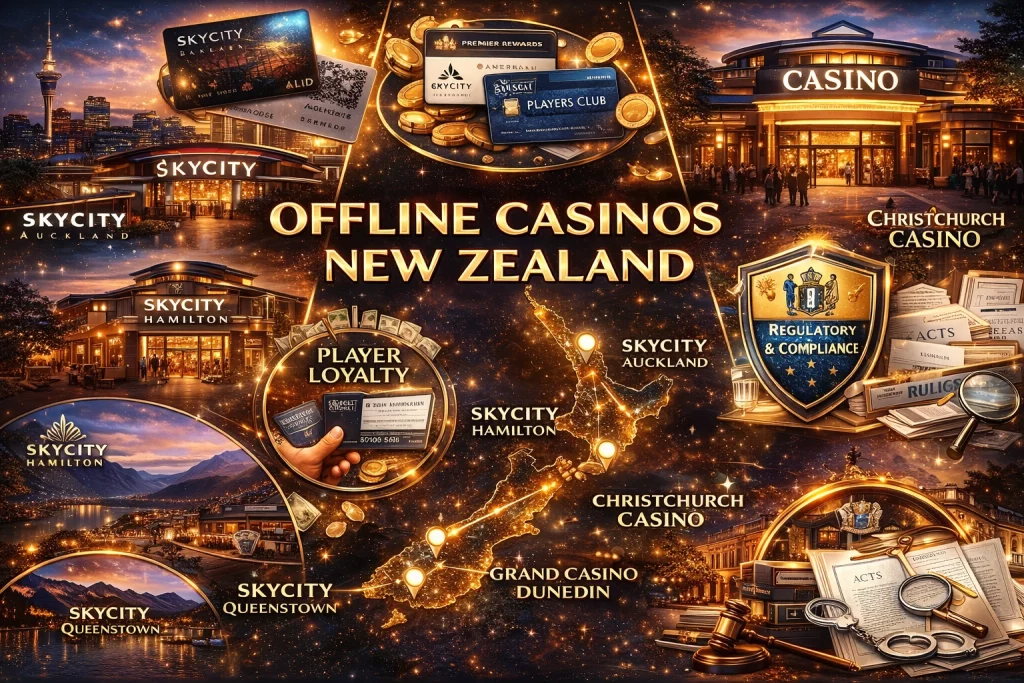
From a visitor perspective, New Zealand’s offline casino market is relatively compact but still varied. The best-known names include SkyCity Auckland, SkyCity Hamilton, SkyCity Queenstown, Christchurch Casino, and Grand Casino Dunedin, each positioned differently in terms of scale, city role, and hospitality mix. SkyCity Auckland is framed as a major CBD entertainment complex with hotels, restaurants, bars, a theatre, and casino space; SkyCity Hamilton combines a casino with dining and bowling; Christchurch Casino presents itself as a city entertainment destination with table games, machines, and restaurants; and Grand Casino Dunedin operates from a heritage hotel building in central Dunedin.
The most useful way to understand New Zealand’s land-based casinos is not as copies of giant Las Vegas-style resorts. They are better understood as city-based entertainment venues where gambling is combined with dining, bars, events, and, in some cases, hotels or tourism infrastructure. That structure gives the market a different personality. The venues are usually more integrated into ordinary urban life than destination mega-resorts, which makes them easier to visit casually but also more dependent on local reputation, repeat custom, and practical usability.
What Defines an Offline Casino Experience in New Zealand
The offline casino experience in New Zealand begins well before the first machine or table. It starts with entry rules, age restrictions, dress expectations, and how the property positions itself socially. For example, SkyCity Hamilton states that entry to gaming areas is restricted to those aged 20 or older, while Christchurch Casino’s FAQ says the same and adds a smart-and-neat presentation requirement. These details matter because they show that New Zealand casinos are not simply open leisure halls. They are managed adult venues with controlled access and a stronger operational framework than many casual nightlife settings.
This is also where the offline equivalent of Sign up begins to make sense. In a physical New Zealand casino, the first barrier is not digital onboarding but whether the visitor can enter, meet age requirements, and, in some cases, integrate into the venue’s player ecosystem. Several SkyCity venues have shifted toward mandatory carded play, which means gambling is increasingly tied to player-card access rather than pure anonymous walk-in play. That changes the tone of the offline experience significantly.
The Main Types of Land-Based Casino Venues
There are three broad models visible across the New Zealand market.
The first is the integrated urban entertainment complex. SkyCity Auckland is the clearest example. The official site describes a CBD precinct with 14 bars and restaurants, three hotels, the Sky Tower, theatre, and casino all working together. This model is strongest when the casino is only one part of a larger night-out or destination-stay experience.
The second is the city entertainment casino. Christchurch Casino and SkyCity Hamilton fit this model more closely. They are substantial venues with real gaming floors, food-and-drink support, and repeat local traffic, but they are not trying to function like giant tourism precincts. They are more city-scaled and more directly tied to regular local nightlife patterns. Christchurch Casino promotes 32 table games and 450+ gaming machines, while SkyCity Hamilton advertises over 330 gaming machines and 23 table games.
The third is the boutique tourist-market casino. SkyCity Queenstown fits here. It operates in Queenstown’s CBD and publicly advertises over 80 gaming machines and 8 table games. Compared with Auckland or Christchurch, that is a smaller footprint, but it is enough to function as a serious gambling option inside a high-tourism destination where hospitality and location matter as much as floor size.
Why Scale Matters, but Not in the Same Way Everywhere
Scale affects offline casino value, but not always in the most obvious way. A venue with more machines and tables usually supports longer visits, more varied play styles, and a broader customer mix. SkyCity Auckland’s official casino positioning is built around over 2,100 gaming machines and 150 table games, which makes it the largest and most resort-like offline casino environment in the country. Christchurch Casino, with 450+ machines and 32 table games, and SkyCity Hamilton, with 330+ machines and 23 table games, sit in a smaller but still substantial category. Grand Casino Dunedin is more compact again, with over 150 electronic gaming machines and a classic table mix including Blackjack, Roulette, Baccarat, and Caribbean Stud Poker.
But scale alone does not decide quality. A large property works best when its floor size matches its hospitality and visitor-flow model. Auckland’s massive footprint works because it sits inside a full entertainment precinct. Dunedin’s smaller footprint works because it is positioned as a central-city heritage venue with a more compact but still complete casino experience. In other words, New Zealand’s offline casinos should be judged by fit, not just by size.
Snapshot of Major Offline Casinos in New Zealand
| Venue | Official Positioning | Gaming Scale Mentioned Publicly | Practical Character |
|---|---|---|---|
| SkyCity Auckland | CBD entertainment complex with hotels, bars, restaurants, theatre, and casino | Over 2,100 gaming machines and 150 table games | Largest, most integrated urban casino destination |
| Christchurch Casino | Christchurch entertainment destination with gaming, bars, restaurants, and live events | 32 table games and 450+ gaming machines | Large city casino with nightlife support |
| SkyCity Hamilton | Hamilton CBD entertainment venue with casino, dining, and bowling | Over 330 gaming machines and 23 table games | City-scaled casino with wider entertainment mix |
| Grand Casino Dunedin | Central Dunedin heritage venue with gaming and dining | Over 150 electronic gaming machines plus classic table games | Compact, heritage-style city casino |
| SkyCity Queenstown | Queenstown CBD casino and entertainment venue | Over 80 gaming machines and 8 table games | Boutique tourist-market casino |
Why Loyalty and Controlled Play Matter More Now
One of the biggest shifts in New Zealand’s land-based casino experience is the move toward more structured player tracking. SkyCity Hamilton’s official join page says carded play has been introduced at all SkyCity New Zealand casinos, and SkyCity Queenstown explicitly states that a SHOW by SkyCity card or valid Premier Rewards card is required to play any casino games. This changes the traditional idea of offline casino spontaneity. Gambling in these venues is increasingly integrated into player-card systems rather than purely cash-and-anonymity models.
That has practical consequences. It makes the offline equivalent of Login more relevant than many visitors might expect, even in a physical venue. The player is no longer only entering a room; they are entering a controlled gambling ecosystem with identity, loyalty, and safer-play logic built into the floor. Some visitors will see that as a strength. Others will see it as friction. Either way, it is central to how modern New Zealand casino visits now work.
Why Hospitality Is So Important in the New Zealand Model
A defining feature of New Zealand’s offline casinos is that very few of them try to survive as pure gambling floors. Hospitality is not decorative. It is structural. SkyCity Auckland emphasizes 14 bars and restaurants and three hotels; SkyCity Hamilton promotes dining, bars, and Bowl and Social; Christchurch Casino integrates bars, restaurants, and live entertainment; Grand Casino Dunedin pairs gaming with dining inside a heritage hotel building. These details are not side notes. They are the reason many of these venues work as repeat destinations instead of one-dimensional gambling spaces.
This broader leisure positioning also shapes the mood of the venues. A casino attached to food, drink, sport viewing, or accommodation tends to attract a wider crowd than one that relies only on people arriving solely to gamble. That usually makes the atmosphere less one-note and gives the property more resilience as a real-world entertainment venue. It is one of the reasons offline casinos in New Zealand often feel more city-integrated than isolated or purely transactional.
Market-Level Diagram
At the market-overview stage, offline casinos in New Zealand look less like giant standalone gambling resorts and more like regulated urban entertainment venues with casino floors at their core. The sector is tightly overseen by the Department of Internal Affairs, and the major venues differentiate themselves through scale, city role, tourism value, and how well they combine gambling with hospitality. The most important practical pattern is clear: if you want to understand land-based casinos in New Zealand, you have to look at the full venue ecosystem, not just the tables and machines.
Main Venue Categories Across New Zealand
Once the national picture is clear, the next useful step is to separate New Zealand’s offline casinos by type rather than by brand alone. In practical terms, the market falls into three broad categories.
The first category is the large integrated city casino. SkyCity Auckland is the clearest example. Officially, it positions itself as a full-scale entertainment venue with over 2,100 gaming machines, 150 table games, live entertainment, food and drink, and a carded-play system built into the floor. That is the closest thing in New Zealand to a full urban casino precinct rather than a standalone gaming room.
The second category is the mid-scale city casino. Christchurch Casino and SkyCity Hamilton fit here well. Christchurch Casino publicly advertises 32 table games, 450+ gaming machines, three restaurants and bars, live events, and daily opening hours that stretch into late evening or early morning depending on the day. SkyCity Hamilton publicly states it has over 330 gaming machines and 23 table games, plus live entertainment, food, and bar offerings. These properties are substantial enough to feel serious, but they are still more compact and legible than Auckland’s flagship venue.
The third category is the boutique or tourist-oriented casino. SkyCity Queenstown is the clearest case. Its official site says it has over 80 gaming machines and 8 table games, with carded play required and a smaller CBD footprint. It still functions as a real casino, but on a different scale and with a more destination-tourism profile than the larger city venues. Grand Casino Dunedin also belongs in the more compact category: a recent official article states it operated 10 gaming tables and 150 electronic gaming machines in the post-Covid period.
Why Floor Size Changes the Experience
The easiest way to misunderstand offline casinos is to think that scale only means “more is better.” Scale matters, but mainly because it changes the rhythm of a visit.
A very large casino like SkyCity Auckland can support different traffic types at the same time without feeling empty. Machine players, table players, poker traffic, tourists, and nightlife guests can all overlap without the floor becoming too one-dimensional. That is one of the practical benefits of having over 2,100 machines and 150 tables. The room has enough depth to feel active in several directions at once.
Mid-scale venues such as Christchurch Casino and SkyCity Hamilton offer a different kind of strength. They are large enough to support variety, but compact enough to feel more immediately readable. A visitor can understand the room faster. That often makes them easier for regular local use because they feel less sprawling while still offering enough game density to avoid repetition. Christchurch’s 32-table and 450+ machine profile, and Hamilton’s 23-table and 330+ machine profile, place them very clearly in that “serious but manageable” middle band.
Smaller properties like SkyCity Queenstown and Grand Casino Dunedin work differently again. Their value depends less on floor size and more on fit. Queenstown benefits from tourism and location; Dunedin benefits from heritage atmosphere and central placement. In those venues, the casino is part of a broader city experience rather than the largest gambling room in the country.
Table Games Versus Machine Floors
The machine-to-table balance is one of the most important ways to read a land-based casino. A room with many machines but too few live tables tends to feel passive. A room with serious table presence usually feels more complete, even if not every visitor uses the tables.
SkyCity Auckland’s official numbers suggest the strongest table presence nationally, with 150 table games alongside the giant machine floor. That gives it the broadest floor identity and makes it the venue most capable of supporting different session styles simultaneously. Christchurch Casino’s official positioning around 32 tables and 450+ machines shows a more concentrated but still balanced model. Hamilton’s 23 tables and 330+ machines create a similar pattern on a slightly smaller scale. Queenstown and Dunedin, by contrast, lean more naturally toward compact, selective table environments rather than mass live-table scale.
This balance matters because it affects who the venue is really for. Larger table counts usually mean the casino expects repeat serious gamblers as well as casual machine users. Smaller table counts often signal that the venue’s role is broader than gambling alone, with tourism, bars, or local leisure use carrying more of the property identity.
The Role of Carded Play and Controlled Access
One of the strongest market-wide themes in New Zealand land-based casinos is the move toward carded play. SkyCity Auckland, Hamilton, and Queenstown all publicly state that players must have a SHOW by SkyCity card or valid Premier Rewards card to play any casino games. That means these casinos are no longer operating as fully anonymous walk-in gambling floors. The gambling experience is increasingly integrated into tracked player systems and safer-gaming infrastructure.
That has two effects. First, it changes the tone of the venue. A carded-play casino feels more institutional and more supervised. Second, it makes loyalty, tiering, and customer management more important because the player is no longer only entering a room; they are entering a monitored gaming ecosystem.
In practical terms, this is one of the biggest differences between older casino expectations and the current New Zealand model. The modern venue is not just about tables and machines. It is also about identity-linked access, host responsibility, and structured membership logic.
How Hospitality Changes the Meaning of the Casino
Another major difference between venues is how much the wider hospitality layer matters. A casino with hotels, extensive dining, and event infrastructure feels different from one where the gaming floor does most of the work by itself.
SkyCity Auckland is strongest in this respect because it combines casino scale with hotels, tower tourism, and a broad food-and-beverage precinct. Christchurch Casino also leans into nightlife through bars, restaurants, live music, and sports viewing. Hamilton adds food, bars, and entertainment support to its casino floor. Queenstown benefits from tourist-market location even on a smaller gaming footprint. Grand Casino Dunedin’s strength is not giant hospitality scale, but distinctive venue character in a heritage setting.
This is where land-based casino reviews become more than gambling reviews. A New Zealand casino often succeeds or fails partly because of how naturally it fits into a wider social evening. That is especially true for venues with bars, events, and dining strong enough to attract people who were not planning a gambling-led visit in the first place.
Comparative Venue Snapshot
| Venue Category | Representative Property | Official Scale | Main Practical Strength |
|---|---|---|---|
| Integrated flagship city casino | SkyCity Auckland | Over 2,100 machines, 150 tables | Largest floor and strongest overall precinct depth |
| Mid-scale city casino | Christchurch Casino | 32 tables, 450+ machines | Strong city-nightlife and casino balance |
| Mid-scale city casino | SkyCity Hamilton | Over 330 machines, 23 tables | Manageable scale with real floor depth |
| Boutique tourist-market casino | SkyCity Queenstown | Over 80 machines, 8 tables | Fits tourism-led short-stay market well |
| Compact heritage casino | Grand Casino Dunedin | 150 machines, 10 tables | Distinctive city-centre character and manageable footprint |
Where the Broadest Gambling Choice Sits
If the question is simply where a visitor will find the broadest gambling choice in one venue, the answer is SkyCity Auckland. Its machine and table counts are far beyond the others in the current official material, and that makes it the clearest choice for players who prioritise variety and scale above everything else.
If the question is where the best balance sits between floor depth and manageable venue size, Christchurch Casino and SkyCity Hamilton both make strong cases. Christchurch looks slightly more nightlife-weighted; Hamilton looks more compact and structured. Queenstown and Dunedin fit visitors who value location and venue character more than maximum gambling breadth.
Loyalty Systems, Carded Play, and the Offline–Digital Overlap
One of the clearest ways New Zealand’s offline casinos have changed is through loyalty systems and carded-play requirements. At SkyCity properties, carded play is now a core operating model rather than an optional extra. SkyCity Hamilton’s official SHOW by SkyCity pages state that carded play is live and that customers need a SHOW by SkyCity card or a valid Premier Rewards card to play, and the FAQ explains that this rollout is tied to host responsibility and preventing financial crime. SkyCity Auckland and SkyCity Queenstown also publicly state that carded play is required to play casino games.
That matters because it changes the meaning of an offline casino visit. In older casino culture, the venue was mainly a physical room you entered. In the current New Zealand model, especially at SkyCity venues, it is increasingly a tracked gaming environment where the customer is linked to a card, a reward structure, and a host-responsibility framework. In practice, the offline equivalent of Login is no longer just walking through the doors. It is entering a monitored player ecosystem that sits behind the tables and machines.
Why Loyalty Matters in Land-Based Casinos
Loyalty systems are not a cosmetic layer in these venues. They shape how value circulates through the property. Christchurch Casino’s Players Club is free to join and allows members to earn and redeem rewards on gaming and dining, while SkyCity’s SHOW by SkyCity programme is built around earning rewards across participating casino and hospitality outlets. In both cases, the goal is the same: turn occasional visitors into repeat customers who interact with the venue as a full ecosystem rather than a one-off gambling stop.
This is also the closest land-based equivalent to an online Bonus structure, even though the mechanics are different. Instead of deposit offers, the offline venues use points, member offers, casino dollars, and tiered benefits to keep the relationship active over time. Christchurch Casino explicitly says Players Club members can collect rewards on gaming, food, and beverages and can upgrade from Bronze to Silver and Gold. That makes the loyalty system a serious part of the venue’s operating logic, not a side incentive.
Christchurch Casino as the Best Example of a Mid-Scale Loyalty Model
Christchurch Casino is a useful example because its Players Club sits at the center of the venue’s repeat-visit strategy. The official site describes it as a free-to-join gaming club where members earn and redeem rewards when they game and dine, and the benefits page highlights points on gaming, food, and beverages along with tier movement. The casino’s gaming page also frames Players Club and host responsibility side by side, which suggests that the venue treats repeat-play tracking and safer-play structure as part of one wider operating system.
That pairing matters because it shows a land-based venue trying to balance customer retention with visible control. Offline casinos are no longer just rooms full of machines and tables. They are becoming membership-based hospitality environments where the player card does several jobs at once: it enables earning, helps shape repeat visitation, and supports regulatory or host-responsibility aims. Christchurch Casino’s own public material makes that logic very visible.
The Role of Support and Written Guidance
A sign of a stronger offline casino ecosystem is whether the support structure around membership and safer play is easy to find. Christchurch Casino’s public-facing material is strong here: its site has practical Players Club guidance, benefits pages, host-responsibility information, support contact details, and operational FAQs. The FAQ page also includes parking information and directs people with concerns about a friend or family member toward host-responsibility policies and support services. That makes the venue easier to navigate because the information architecture is not hidden behind generic legal language.
This is where the keyword FAQ actually matters in a practical sense. In an offline casino review, a good FAQ is not filler. It is a signal that the operator expects real questions about membership, entry, support, and problem play — and is prepared to answer them clearly. Christchurch Casino does this more explicitly than many venues, while SkyCity tends to distribute similar information through SHOW by SkyCity pages and venue-specific support sections.
The Digital Layer: Why an Offline Casino Still Needs an App
One of the biggest shifts in land-based gambling is that the physical venue is no longer the whole customer experience. Christchurch Casino’s official Players Club companion App lets members check balances, stay up to date with offers, and play mini-games for daily prizes. SkyCity’s wider reward ecosystem also has digital account access through SHOW by SkyCity and related reward portals, including online sign-in and balance-checking functions across participating properties.
From a review standpoint, this is important because it shows that offline casinos in New Zealand are no longer purely offline. The gambling floor remains physical, but the loyalty relationship extends into the customer’s daily digital routine. That makes the venue feel more modern and more persistent. It also means the distinction between offline and online is no longer as simple as it once was. The venue may be land-based, but the customer relationship increasingly continues between visits.
Why Formal Support Links Matter
Another useful signal of quality is whether the venue gives people direct paths to the information and services they actually need. Christchurch Casino’s host-responsibility section provides direct contact information for people experiencing gambling or alcohol difficulties, while SkyCity’s host-responsibility page explains its programme and the kinds of initiatives required by law to support safe and responsible gaming. In other words, the official support Links are not decorative. They are part of how the venue communicates seriousness and accountability.
That matters in a land-based review because physical casinos operate in more socially visible environments than online products. A venue in a city centre, attached to bars or hotels, needs to make customer-care pathways visible if it wants to feel credible. New Zealand’s stronger operators do this because they understand that trust is built not only through gaming scale, but also through how clearly the support system is exposed to the public.
Loyalty and Support Snapshot
| Venue / System | Official Public Signal | Why It Matters | Practical Reading |
|---|---|---|---|
| SHOW by SkyCity | Required for play at SkyCity casinos and linked to host responsibility | Shows carded play is central, not optional | Offline casino access is increasingly tracked |
| Christchurch Players Club | Free-to-join rewards club with points on gaming, food, and beverages | Builds repeat visitation and trackable value | Strong mid-scale loyalty model |
| Christchurch companion app | Balance checks, daily prize mini-games, offer updates | Extends the venue beyond the building itself | Offline experience now has a digital tail |
| Host-responsibility support | Direct contact details, policy pages, and structured support information | Strengthens public trust and operational clarity | Better venues make support visible |
The New Zealand offline casino model looks much more system-driven than many players expect. Loyalty programmes, carded play, digital support layers, and visible host-responsibility structures are now central to how the main venues operate. That does not remove the importance of the gaming floor, but it does show that modern land-based casinos in New Zealand are increasingly built around tracked customer ecosystems rather than pure anonymous walk-in play.
Regulation, Public Trust, and How to Judge Offline Casinos in New Zealand
The final way to assess offline casinos in New Zealand is not by machine count alone. Scale matters, but regulation and public accountability matter just as much. The Department of Internal Affairs is responsible for monitoring compliance with the Gambling Act 2003, casino licence conditions, minimum operating standards, and game rules. It also makes clear that casino gambling inspectors investigate complaints, monitor conduct, and oversee integrity issues in New Zealand casinos.
That framework is important because it means New Zealand’s land-based casinos do not operate in a vague private space. They sit inside a highly visible domestic compliance structure. For players, that has two practical consequences. First, the venues tend to feel more controlled than old-style anonymous gambling halls. Second, the trust question becomes more nuanced. A large casino with good hospitality can still face serious scrutiny if its operational controls are weak.
This is one reason the offline market feels more institutional than many visitors expect. Entry rules, age restrictions, carded play, host-responsibility messaging, and visible support services are not side details. They are part of what defines the modern casino visit in New Zealand.
Why Host Responsibility Is Central to the Offline Experience
Across the market, one of the clearest shifts is that land-based casino gambling is no longer framed only as entertainment. It is increasingly framed as entertainment inside a host-responsibility system. SkyCity Auckland is a good example because its official casino page says players must have a SHOW by SkyCity card or valid Premier Rewards card to play any casino games, and it explicitly links carded play to “an even safer gaming experience.” The same page also states that players can sign up online or inside the casino, and that valid photo ID and residential details are required.
That tells you a lot about where the market has moved. The physical casino floor still matters, but it now sits inside a more monitored player ecosystem. For some visitors, this improves trust because the venue feels structured and accountable. For others, it reduces the spontaneous, anonymous feel older casino culture once had. Either way, it is one of the defining features of offline casinos in New Zealand today.
Public Trust Is Strongest When Venue Strength and Compliance Align
The strongest offline casino venues in New Zealand usually share the same visible qualities:
- clear rules at entry
- obvious host-responsibility messaging
- a loyalty or card system that links customers to safer-play controls
- enough scale or hospitality depth to feel like a real destination
- public accountability when things go wrong
That last point matters more than marketing ever will. A casino can look polished, modern, and convenient, but long-term trust depends on whether the operator holds up under scrutiny. In New Zealand, that scrutiny is real. The DIA publicly investigates, prosecutes, and reports on casino compliance matters, and the wider regulatory structure includes both the Department of Internal Affairs and the Gambling Commission.
So the right way to judge an offline casino is not just, “Does it look big?” or “Does it have good restaurants?” It is, “Does the venue combine scale, usability, and visible control in a way that still feels credible when examined closely?”
Market-Level Comparison
| Assessment Area | What Strong Offline Casinos Show | Why It Matters | Practical Reading |
|---|---|---|---|
| Regulatory structure | Visible operation inside DIA and Gambling Act oversight | Improves public accountability | New Zealand casinos are tightly supervised |
| Host responsibility | Entry rules, carded play, safer-gambling tools, support pathways | Shapes modern venue trust | Control is now part of the product |
| Gaming scale | Enough machines/tables to support repeat visits | Determines floor depth and variety | Scale matters, but only when it fits the venue model |
| Hospitality integration | Bars, dining, events, hotels, or tourism links | Broadens the property beyond gambling alone | Best venues work as full entertainment spaces |
Final Overall Verdict on Offline Casinos in New Zealand
Offline casinos in New Zealand are best understood as regulated entertainment venues rather than pure gambling halls. The strongest properties combine several elements well: a credible gaming floor, visible host responsibility, integrated hospitality, and a structure that makes sense in a city or tourism setting. At the same time, the market is clearly moving away from anonymous casino culture and toward carded, monitored, loyalty-linked play.
That means the best offline casino for a player depends on what they value most. If they want the broadest floor and the strongest integrated entertainment precinct, the large flagship venues stand out. If they want a more compact city casino with easier physical readability, mid-scale properties may feel better. If they want a tourism-led stop with a smaller floor but a stronger destination setting, the boutique venues make more sense.
The key point is that New Zealand’s land-based casinos should not be judged only by glamour or game count. They should be judged by fit: how well the venue’s gaming scale, hospitality, support structure, and compliance culture work together in practice. When those elements align, the casino feels strong. When they do not, even a large venue can feel less trustworthy than it first appears.






Comments