
Problem Gambling Statistics NZ
I treat problem gambling statistics in New Zealand as more than numbers. They show where gambling harm appears, how it affects people around the player, and why support tools should not be hidden behind generic “play responsibly” messages. For Casino Kingdom, a page about gambling statistics should not be written like a promotional article. It should work as a public-health style guide that helps readers understand risk before gambling behaviour becomes harder to control.
The most important point is that gambling harm in New Zealand is not limited to people who gamble heavily every day. Harm can affect the person gambling, but it can also affect whānau, partners, children, flatmates, workplaces and communities. The Ministry of Health describes gambling harm as a significant health issue in New Zealand and says it can negatively affect individuals, whānau and communities.
The latest Ministry of Health gambling statistics page identifies the New Zealand Gambling Survey 2023/24 as part of the Gambling Harm research programme, collecting data on gambling activities, risks, impacts of harm and help-seeking among people aged 15 and over. That scope matters. It means the statistics are not only about how many people gamble. They are also about how gambling affects households, how risk develops, and whether people seek help.
Why Problem Gambling Statistics Matter
When I look at problem gambling statistics, I do not read them as abstract data. I read them as warning signals. If a country tracks gambling harm, intervention services, expenditure, risk categories and household-level impact, that tells us something important: gambling harm is measurable, recurring, and serious enough to require structured public monitoring.
For Casino Kingdom, this matters because players need to understand that gambling risk does not begin only after a major loss. It can begin with smaller patterns: repeated deposits, emotional play, chasing losses, hidden spending, or sessions that last longer than planned. Statistics help make those patterns visible.
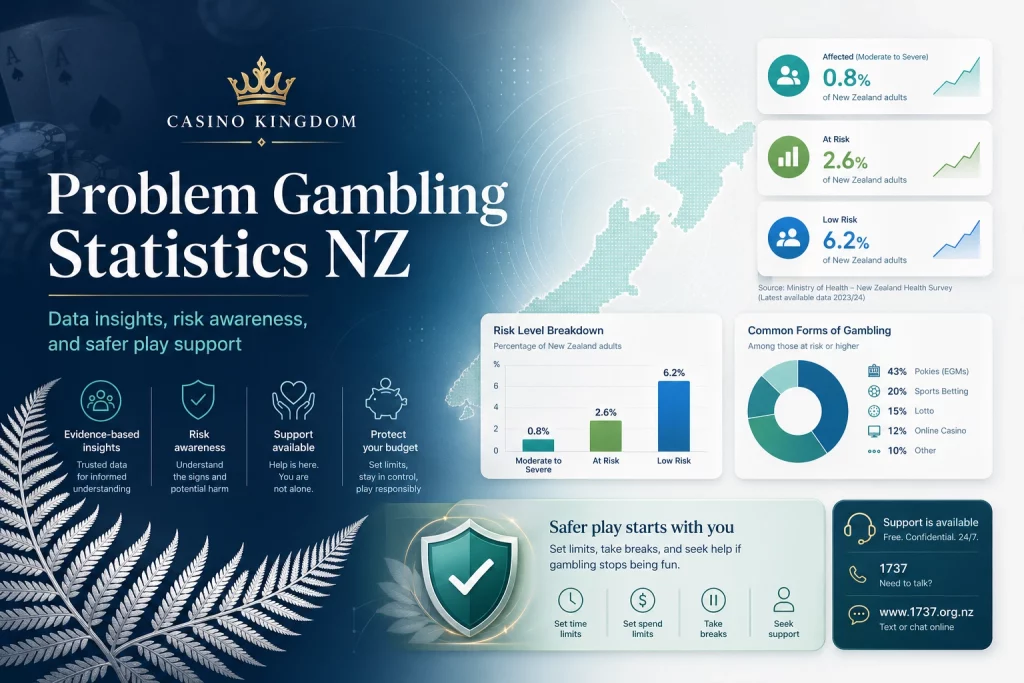
New Zealand’s Ministry of Health states that about 381,000 adults experienced at least one form of household-level gambling harm in their wider families or households, based on the New Zealand Gambling Survey data explorer. That number is important because it shows that harm is not isolated to the person placing bets. Gambling can affect people who are financially, emotionally or socially connected to the player.
The Department of Internal Affairs also publishes gambling expenditure data for the four main types of gambling activity: TAB racing and sports betting, NZ Lotteries products, gaming machines outside casinos, and casino gambling. Expenditure data is not the same as harm data, but it helps show where money is being lost across regulated gambling channels.
| Statistic Area | What It Measures | Why It Matters for NZ Players | Responsible Interpretation |
| Gambling participation | How many people report gambling activity within a survey period | Shows how common gambling exposure is across the population | Participation alone does not prove harm, but it creates the base where harm can occur |
| Risk of gambling harm | How many people report low, moderate or high-risk gambling indicators | Helps identify when gambling is becoming harder to control | Risk categories should be treated as early warning signals, not labels of failure |
| Household-level harm | How gambling affects people in wider families or households | Shows that harm can extend beyond the individual player | Support should be available for whānau and affected others, not only account holders |
| Help-seeking | How people use helplines, counselling or intervention services | Shows whether people are reaching support when harm appears | Low help-seeking can mean barriers such as shame, access problems or lack of awareness |
| Gambling expenditure | Net amount lost by people gambling across regulated sectors | Shows the financial scale of gambling activity | Expenditure should not be read as entertainment spend only; some of it may be linked to harm |
How I Would Read NZ Gambling Harm Data
I would avoid reading a single gambling statistic in isolation. One number can mislead if it is separated from context. For example, gambling expenditure tells us how much money is lost across gambling categories, but it does not tell us exactly who experienced harm. A risk-prevalence figure can show population-level exposure, but it does not fully describe the emotional, family or financial consequences behind that risk.
This is why I would combine several types of data: survey findings, expenditure data, intervention-service data, and household-harm reporting. Together, these create a clearer picture. They show how common gambling is, where money is lost, where risk appears, and how harm reaches people around the player.
The New Zealand Gambling Survey 2023/24 is especially relevant because it was designed to collect population-level data on participation, risk, impact and help-seeking among people aged 15 and over. For a Casino Kingdom page, that makes it more useful than isolated anecdotes or forum comments.
A responsible statistics page should also explain uncertainty. Gambling harm can be underreported because people may feel shame, may not recognise harm early, or may not want to discuss money problems. Some harm also appears indirectly, through family stress or household conflict, rather than through a direct gambling-harm admission.
Problem Gambling Is Not Only About Frequency
One mistake I often see is assuming that problem gambling always means gambling every day. Frequency matters, but it is not the only signal. A person can gamble occasionally and still experience harm if the sessions are intense, secretive, emotionally driven or financially damaging.
A player who gambles once a month but loses essential money, lies about the activity, or tries to recover losses through another deposit is already in risky territory. A player who gambles more often but stays within strict entertainment limits may show a different risk profile. The behaviour around gambling is as important as the number of sessions.
This is why a player should not use average statistics to excuse personal risk. If national data says only a smaller share of people fall into moderate or high-risk categories, that does not mean an individual pattern is safe. Personal warning signs matter more than averages.
For Casino Kingdom users, the Login stage should be treated as a checkpoint. If a player reaches the account while already feeling pressure, shame, urgency or a need to win back money, the safer action is not to continue. The safer action is to pause and use account controls or support.
Gambling Expenditure and Why Money Data Needs Context
The Department of Internal Affairs describes gambling expenditure statistics as the amount lost by gamblers, effectively operator profits, across the main regulated gambling activity types. This framing is important. Expenditure is not the total amount wagered; it is the net amount lost.
A 2025 Ministry of Health-linked economic and social costing report cites total regulated gambling expenditure in New Zealand for 2023/24 as $2.792 billion, including $1.037 billion on Class 4 pokies, $792 million on Lotto NZ, $371 million on TAB NZ and $592 million on casinos. Those figures show the scale of gambling losses across regulated channels.
But I would be careful with interpretation. High expenditure does not automatically mean every participant is harmed. At the same time, it would be irresponsible to treat the number as ordinary leisure spending without considering the harm context. Some spending may come from controlled entertainment budgets. Some may come from people experiencing risky or harmful gambling patterns.
For an online casino information page, the lesson is practical: players should track their own net loss, not only deposits or wins. A player may remember occasional withdrawals but forget repeated deposits. A personal gambling record should include total deposits, total withdrawals, net spend, session length and emotional state.
Problem Gambling Risk Signals in NZ Context
Why Bonus Pressure Can Distort Personal Statistics
A player’s own gambling statistics can become distorted when promotions are involved. A Bonus may make a session feel cheaper or less risky, but it can also extend gambling time, increase deposits or create wagering pressure. If the promotion leads to behaviour the player would not otherwise choose, it has affected control.
When reviewing personal gambling data, I would separate ordinary deposits from bonus-driven deposits. Did the player deposit because they had planned to gamble, or because an offer appeared? Did wagering requirements extend the session? Did the player continue after the entertainment budget was gone because bonus progress was unfinished?
These questions matter because gambling harm often hides behind justification. The player may tell themselves the promotion made the session rational, but the actual behaviour may show escalation: more time, more deposits and less willingness to stop.
For a Casino Kingdom statistics page, I would explain this clearly. Promotional activity should not be counted only as “extra value.” It should also be reviewed as a possible risk driver.
Prevalence, Household Harm and Help-Seeking Patterns
When I read problem gambling statistics for New Zealand, I focus on what they reveal about hidden harm. The visible part is gambling activity: deposits, bets, venue visits, gaming machine use, lotteries, casino play or sports betting. The less visible part is the pressure around that activity: whether people chase losses, hide spending, borrow money, argue with whānau, lose sleep, or avoid asking for help.
For Casino Kingdom, this distinction matters. A player may still look controlled from the outside while risk is already increasing. They may log in normally, place smaller bets, or use ordinary account tools, but behind that behaviour there may be stress, secrecy or repeated attempts to recover losses. Statistics help us understand that gambling harm often exists below the surface before it becomes obvious.
Prevalence Is Only One Part of the Story
Prevalence statistics usually try to show how many people fall into different risk or harm categories. That is useful, but it should not be read too narrowly. A person does not need to match a severe category before taking action. Low-risk or moderate-risk signals can still deserve a pause, especially if the pattern is changing.
I would not use national prevalence rates to reassure a player too quickly. If someone says, “Most people are not problem gamblers, so I am probably fine,” that is the wrong lesson. The better lesson is: gambling harm exists, it is monitored, and personal warning signs matter.
A player’s own behaviour is the most important evidence. If gambling creates debt pressure, secrecy, emotional dependence or repeated chasing, the person should respond to that pattern directly. National statistics provide context, but they do not override personal risk.
For Casino Kingdom users, this is why account tools should not only appear after major problems. Limits, time-outs, support links and self-exclusion should be easy to find early. A player who notices smaller warning signs should not have to wait until the situation becomes severe.
| Statistical Theme | What It Can Show | What It Cannot Fully Show | Player-Level Lesson |
| Participation | How many people report gambling within a period | Whether each person gambled safely or under pressure | Do not assume common activity means low personal risk |
| Risk category | How many people show low, moderate or higher-risk indicators | The full emotional and family impact behind the score | Act early when warning signs appear |
| Household harm | How gambling affects people around the gambler | Every private conflict, argument or hidden financial impact | Whānau impact should be taken seriously |
| Help-seeking | How many people contact services or use support pathways | How many people need help but never ask for it | Low help-seeking does not mean low harm |
| Expenditure | How much money is lost across gambling categories | Which losses were affordable and which created harm | Track personal net loss, not just occasional wins |
Household Harm Changes the Way We Read the Data
One of the most important parts of New Zealand gambling harm data is the focus on household and wider family impact. Gambling harm can affect people who never place a bet. Partners may face financial uncertainty. Parents may become worried about debt or secrecy. Children may experience stress in the home. Friends or flatmates may notice mood changes, borrowing or avoidance.
That is why I would not write a Casino Kingdom statistics page only for the player. I would also write it for people around the player. If someone is worried about another person’s gambling, statistics can help them understand that their concern is valid.
Household harm also changes how we think about “controlled” gambling. A player may insist that the losses are personal, but if the behaviour affects shared money, trust, time, mood or household stability, the harm is no longer private. The support response should include whānau where appropriate.
This is why problem gambling pages should include support options for affected others. A partner or family member should not have to wait until the player agrees there is a problem before asking for guidance.
Help-Seeking Statistics and the Problem of Silence
Help-seeking data is important, but it can be difficult to interpret. If a small number of people contact support services, that does not automatically mean only a small number need help. Shame, lack of awareness, cultural barriers, fear of judgement and uncertainty about what counts as “serious enough” can all prevent people from reaching out.
From a practical point of view, I would assume that some gambling harm is hidden. People may not report it, may not discuss it with family, and may not contact services until later. This is why early support messaging matters.
For Casino Kingdom, the site should not frame help as something only for the worst cases. The safer message is: if gambling feels difficult to stop, support is already relevant. If gambling is hidden, support is relevant. If the player is chasing losses, support is relevant. If whānau are worried, support is relevant.
The FAQ section should also reflect this. It should answer questions such as: when should I contact support, how do I set limits, how do I self-exclude, how do I remove marketing, and what should I do if I keep depositing after losses?
Why Account Creation Can Become a Risk Signal
Statistics about gambling participation can show population patterns, but personal risk often appears through account behaviour. One sign I would watch closely is repeated account creation. If a person has already tried to stop gambling but then looks for another site, another promotion, or another account, that is not neutral browsing.
The Sign up stage can become part of a harm pattern. Someone may create a new account after a time-out, after self-exclusion, after losing access to a previous platform, or after deciding to stop. In that case, the issue is not curiosity. It is access-seeking.
For Casino Kingdom, this matters because responsible content should not present registration as harmless in every context. If the reader is already worried about gambling, the safer advice may be to avoid opening new accounts and contact support instead.
A responsible statistics page should therefore connect population data to behaviour. The question is not only how many people gamble. The question is what happens when gambling access expands and self-control contracts.
Promotions and Statistical Blind Spots
Promotions can also create statistical blind spots. A player may not remember bonus-driven deposits as “real” spending because the promotion made the session feel discounted. But from a harm perspective, the behaviour still matters. Money was deposited. Time was spent. Wagering may have continued longer than planned. Emotional pressure may have increased.
The same applies to cashback. A player may feel that a cashback offer reduces the harm of losses, but if it encourages further gambling, it can extend the risk pattern. A promotion that keeps someone engaged after they wanted to stop is not simply a benefit.
I would therefore encourage Casino Kingdom players to track promotional play separately. How often did an offer trigger a deposit? Did it increase session length? Did it delay stopping? Did the player accept the promotion after deciding not to gamble?
These personal statistics are more useful than promotional language. They show whether the offer supported controlled entertainment or weakened control.
How NZ Players Can Use Statistics Personally
National statistics are useful, but personal tracking is where safe behaviour becomes real. I would recommend tracking five things: deposits, withdrawals, net loss, session time and emotional state. If possible, I would also track whether the session was planned or triggered by stress, promotion or chasing.
A player should not track only wins. Wins are memorable, but repeated losses are often less visible. Net position matters more than isolated positive moments. A person may remember a large withdrawal and forget the many deposits that came before and after it.
This personal data can show whether gambling is still entertainment. If monthly losses are larger than expected, if session time keeps increasing, or if the player repeatedly gambles after stress, the pattern is changing.
The safest response is to act on the pattern early. Lower limits, take a time-out, remove payment access, or use support before the numbers become harder to manage.
Gambling Data and Player Protection Tools
How Statistics Should Shape Casino Kingdom Content
Problem gambling statistics should influence how Casino Kingdom presents safer gambling information. A responsible page should not only say “play within your means.” It should explain what risk looks like in real behaviour: chasing, hidden spending, long sessions, repeated deposits, and reluctance to stop.
Support information should be visible near account tools, payment areas, promotions and help pages. If data shows that gambling harm can affect households, then support content should mention whānau and affected others. If help-seeking can be limited by shame, then language should be non-judgmental and direct.
Statistics should also shape internal navigation. A page about risk should not aggressively push users toward gambling products. It should allow readers to move toward support, limits, self-exclusion and official resources.
For Casino Kingdom, that is the responsible use of data: not to create fear, and not to minimise harm, but to help players recognise patterns earlier.
Demographic Impact, Online Access and High-Risk Gambling Patterns
Problem gambling statistics become more useful when they are connected to real behaviour. A national figure can show scale, but it does not automatically explain what happens inside a player’s day. I would look at the point where statistics meet daily patterns: who is exposed, what products are used, how quickly money can be spent, how often sessions repeat, and whether people around the player are affected.
For Casino Kingdom, this matters because online gambling changes access. A player no longer needs to travel to a venue, handle cash, or leave a visible public space. The account can be reached quietly from a phone, laptop or tablet. That convenience can support controlled entertainment for some people, but it can also make harmful behaviour easier to hide.
Demographics Should Be Read Carefully
When gambling data is broken down by age, ethnicity, gender, location or income group, I would avoid using it to stereotype. Statistics can show where harm is more concentrated, but they should not be used to label communities. The responsible interpretation is that different groups may face different exposure patterns, access issues, cultural barriers, financial pressures or support needs.
For example, if data shows higher harm in certain communities, the response should be better support visibility, culturally appropriate help, language access, whānau-aware services and earlier prevention. It should not become blame.
This is especially important in New Zealand because gambling harm can affect individuals, whānau and communities differently. A support pathway that works for one person may not be enough for another. Some people may prefer private counselling. Others may need whānau involvement. Others may need culturally specific support or language-accessible services.
A Casino Kingdom statistics page should therefore frame demographic data as a support-design issue. The question is not “which group has a problem?” The better question is “which support and protection tools need to be easier to reach?”
| Impact Area | What Statistics May Reveal | Responsible Interpretation | Casino Kingdom Page Response |
| Age groups | Different participation and risk patterns by life stage | Younger and older players may need different support messaging | Use clear, accessible language and avoid assuming one player profile |
| Whānau impact | Harm can affect people beyond the individual gambler | Support should include family and affected others | Include guidance for partners, friends and whānau members |
| Income pressure | Gambling losses may affect households differently depending on financial stability | The same loss amount can create different levels of harm | Emphasise spare-money-only gambling and payment barriers |
| Cultural access | Some people may face barriers to asking for help | Support should be confidential, non-judgmental and culturally aware | List external support options and avoid shame-based language |
| Online access | Digital gambling may be easier to hide and repeat | Account tools must be visible before harm escalates | Place limits, time-outs, self-exclusion and help links near account areas |
Online Access Can Hide Escalation
One reason online gambling deserves special attention is that escalation can happen privately. A person can deposit repeatedly without anyone nearby seeing cash change hands. They can play late at night. They can delete emails. They can switch between devices. They can open gambling content during ordinary phone use.
That does not mean every online player is at high risk. It means the platform should support visible control. Transaction history, deposit limits, session reminders, time-outs, account closure and self-exclusion should be clear and easy to use. If these tools are hidden, the player may only look for them after harm has already escalated.
For a Casino Kingdom player, the personal statistic I would watch is not only total spend. I would watch access frequency. How often does the person open the account? How often do they check promotions? How often do they browse games without a clear plan? These actions may happen before gambling loss, but they still show the cycle forming.
The App environment can intensify this because the account sits beside everyday tools. If gambling access becomes just another tap on the phone, it can feel less serious than it is. That is why mobile notifications, saved payment details and app shortcuts should be treated as risk points.
Game Speed and Product Design
Statistics about harm should also make us think about product design. Faster games create faster decisions. A player can place many bets in a short time, especially when game rounds are short and the next round begins immediately.
This is why game speed matters. A low stake can still become costly when repeated many times. A player may say, “I only bet small,” but the session total can tell a different story. Personal tracking should include number of rounds, session duration and total net loss.
For Casino Kingdom, this is especially relevant when discussing Slots, instant-play formats or rapid game lobbies. These products are not automatically harmful, but they require stronger boundaries because they reduce natural pauses.
The safer interpretation of product data is not to tell players that one category is always safe or unsafe. It is to explain which formats need stricter controls. Fast games need time limits. Volatile games need loss limits. Mobile games need access friction. Promotions need budget discipline.
Why Long Sessions Deserve Attention
Long sessions can be a risk signal even when the amount lost is not immediately dramatic. Time spent gambling can affect sleep, mood, work, study, family time and emotional regulation. It can also make the player more likely to continue after losses because they feel invested in the session.
A long session may also create time distortion. The person may not realise how many rounds have passed or how much money has moved through the account. This is why session reminders and time limits matter.
For Casino Kingdom, I would recommend presenting session length as a core safety metric. It should sit beside money controls, not below them. A player who stays within budget but spends hours gambling may still need a break.
The safest session review asks: Did I stop on time? Did I feel calm? Did I keep switching games? Did I play longer because I was trying to recover money? Did I continue after I stopped enjoying it? If the answer is yes, the session should be treated as risky regardless of final balance.
Why Community Impact Should Guide Support Design
Problem gambling statistics in New Zealand often highlight that harm can extend beyond the player. That should shape support design. A gambling information page should not only speak to the account holder. It should also speak to the person who is worried about someone else.
A partner may search the page after seeing bank transactions. A parent may search after noticing secrecy. A friend may search after hearing repeated borrowing requests. These readers need clear language too.
The page should explain that affected others can seek support. They do not need to wait for the player to admit everything. They can ask for guidance on boundaries, communication and financial safety.
For Casino Kingdom, this means the responsible gambling area should mention whānau support directly. It should not reduce gambling harm to an individual budgeting issue.
How Statistics Should Influence Account Tools
Statistics should lead to better account design. If data shows that harm includes financial stress, account tools should include visible deposit limits and spending history. If data shows that harm affects families, support pages should include affected-others resources. If help-seeking is low, support routes should be more visible and less judgmental.
A player should not need to search several pages to find exclusion tools. A self-exclusion link should be clear. Marketing removal should be simple. Deposit and session controls should be easy to understand. Transaction history should not be confusing.
The Links section should also be used responsibly. A statistics page should guide users toward official gambling harm resources, support organizations and account protection tools, not only toward more promotional or game-related content.
When statistics are used well, they improve safety architecture. They make the website more transparent, not more persuasive.
How I Would Explain Statistics to a Player
If I were explaining this page to a Casino Kingdom player, I would say: national statistics are not there to scare you, and they are not there to reassure you blindly. They are there to help you compare your behaviour with known harm signals.
If you are gambling with spare money, stopping on time, avoiding chasing, staying open with whānau and treating losses as entertainment cost, your risk pattern is different from someone who hides gambling, borrows money or keeps returning after losses. But if your behaviour starts shifting toward the second pattern, act early.
Statistics help define the warning signs. Personal behaviour confirms whether those signs are present.
The responsible action is not to wait until the data describes you perfectly. It is to respond when your own pattern starts to change.
Statistics-Based Safer Gambling Checklist for Casino Kingdom Players
Problem gambling statistics are useful only when they lead to practical decisions. A player does not need to memorise every national figure to benefit from the data. The stronger approach is to translate the statistics into personal checks: how often gambling happens, how much money is lost, whether sessions are getting longer, whether losses are being chased, whether whānau are affected, and whether support is being avoided.
For Casino Kingdom players in New Zealand, the point of a statistics page is not to create fear. It is to make risk visible. Gambling harm often becomes harder to manage when the person explains away small warning signs. Statistics show that harm is real, measurable and not limited to one type of player. Personal tracking then shows whether those warning signs are appearing in an individual pattern.
How I Would Use Statistics Personally
If I were using Casino Kingdom, I would not compare myself only to national averages. I would use statistics as a prompt to review my own behaviour. The question is not “Am I like the average player?” The better question is “Am I showing any of the behaviours linked with gambling harm?”
The first personal statistic I would track is net loss. Deposits alone can be misleading. Withdrawals alone can also be misleading. Net loss gives a clearer picture because it shows the real cost over time. If a player remembers one good withdrawal but ignores several smaller deposits, the personal picture becomes distorted.
The second statistic is session length. A player may stay within budget but spend too much time gambling. Long sessions can affect mood, sleep, work, study and relationships. They can also increase the chance of chasing because the player becomes more emotionally invested in the result.
The third statistic is emotional state. This is not usually shown in account history, but it matters. Was the session calm or tense? Was it planned or triggered by stress? Did the player feel able to stop? Did they hide the activity? These are behavioural indicators that can reveal risk before the financial damage becomes severe.
| Personal Statistic | What to Track | Warning Signal | Safer Response |
| Net loss | Total deposits minus withdrawals over a week or month | The real loss is higher than expected or difficult to accept | Lower limits, pause gambling or use support |
| Session length | How long each gambling session lasts | Sessions regularly exceed the planned time | Use timers, session limits or a time-out |
| Deposit frequency | How often money is added to the account | Repeated top-ups after losses | Set deposit caps and remove saved payment methods |
| Trigger pattern | Stress, payday, boredom, late-night use or promotions | Gambling happens after the same emotional or financial trigger | Block the trigger route and use a replacement routine |
| Secrecy | Whether gambling is hidden from others | Deleting messages, hiding transactions or avoiding questions | Tell one trusted person or contact a gambling support service |
Statistics Should Not Be Used to Minimise Harm
One mistake I would avoid is using statistics to minimise personal risk. A player might see that only a portion of the population is classified as higher risk and decide that their own gambling is probably fine. That is not how risk should be read.
National statistics describe groups. Personal harm happens in individual patterns. If someone is chasing losses, borrowing money, hiding gambling, breaking limits or gambling with essential funds, those behaviours matter more than any reassuring average.
The same applies to expenditure data. Some gambling losses may come from controlled entertainment spending, while some may come from harmful patterns. The national number cannot tell a player whether their own spending is safe. The personal record can.
For Casino Kingdom users, the safest approach is to treat national statistics as context and personal warning signs as action triggers. If the warning signs appear, act. Do not wait for the pattern to become severe enough to match a label.
When Personal Statistics Show Escalation
Escalation often appears gradually. The deposit amount may rise. The number of sessions may increase. The player may start gambling later at night. They may begin checking the account more often. They may start accepting promotions they would normally ignore. They may tell themselves that one more session is justified because the last one ended badly.
These changes are important because they show movement. A player does not need to reach a crisis before responding. If the pattern is moving in the wrong direction, the correct response is to reduce access.
The first step could be lower limits. If that does not work, use a time-out. If the person keeps returning despite limits, self-exclusion is more appropriate. If gambling has become secretive or financially stressful, external support should be used early.
A statistics-based approach is useful because it removes some of the emotion. Instead of asking, “Am I a problem gambler?” the player can ask, “Are my numbers and behaviours getting worse?” That question is easier to answer honestly.
What Casino Kingdom Should Show Clearly
A responsible Casino Kingdom page should help users see their own behaviour. It should make deposit history, withdrawal history, bonus activity, limit settings and responsible gambling tools easy to find. If a player has to search hard for these details, self-review becomes weaker.
The site should also explain the difference between gross activity and net loss. A player may wager large amounts while only depositing smaller amounts, but the amount actually lost is what affects their personal finances. At the same time, high wagering volume can still indicate long sessions or repeated engagement.
Marketing history also matters. If a player repeatedly returns after promotional messages, that should be recognised as a behavioural signal. Promotional contact should be easy to reduce or stop.
A strong responsible gambling section should also include support resources for affected others. If whānau or friends are worried, they should be able to find guidance without needing access to the player’s account.
How to Respond to High-Risk Personal Patterns
If personal tracking shows high-risk patterns, I would not recommend minor adjustments only. The response should match the severity of the behaviour.
If the problem is occasional overspending, lower deposit limits may help. If the problem is long sessions, time limits and session reminders may help. If the problem is repeated chasing, stronger barriers are needed. If the problem is secrecy or essential money being used, the person should stop gambling and seek support.
A useful escalation rule is simple:
If one limit fails once, review it.
If the same limit fails twice, strengthen it.
If gambling continues through stronger limits, use time-out or self-exclusion.
If gambling becomes hidden, debt-linked or emotionally urgent, contact support.
This rule avoids waiting too long. It treats repeated risk as a signal for stronger protection.
How Statistics Connect to Whānau Impact
Problem gambling statistics in New Zealand repeatedly point to harm beyond the individual. That should influence how players think about their own behaviour. If gambling affects household money, trust, mood, time or communication, it is no longer private entertainment.
A player may believe they are only risking their own money, but that is not always true. Shared bills, family savings, emotional availability and trust can all be affected. Even when money is not shared directly, secrecy can still harm relationships.
For this reason, I would include whānau impact in personal tracking. Has gambling caused arguments? Has someone asked questions about money? Has the player avoided conversations? Has gambling affected family time or sleep? These are not side issues. They are part of the harm picture.
If whānau impact appears, support should involve more than account tools. Counselling, helpline contact, financial boundaries and family guidance may be needed.
Final Interpretation Rules for NZ Gambling Statistics
When using problem gambling statistics, I would follow several rules. First, never treat national averages as personal protection. Second, track net loss, not only wins. Third, treat repeated deposits as a warning sign. Fourth, take household harm seriously. Fifth, use support before the situation becomes severe.
I would also treat underreporting as possible. Some people do not ask for help because of shame or uncertainty. That means help-seeking data may not show the full level of need. A player should not assume that silence means safety.
Statistics should create clarity. They should show that gambling harm has patterns, and those patterns can be interrupted. The earlier the interruption happens, the easier it is to protect money, relationships and wellbeing.
Final Guidance for Casino Kingdom Players in New Zealand
Problem gambling statistics NZ pages should not only present numbers. They should help players understand behaviour. For Casino Kingdom, the responsible message is clear: track your own gambling honestly, respond early to warning signs, and use support tools before harm becomes harder to control.
The most important personal indicators are not complicated. Watch net loss, deposit frequency, session length, chasing behaviour, secrecy, emotional gambling and whānau impact. If those indicators move in the wrong direction, gambling should be paused and stronger barriers should be used.
Gambling should not become a way to recover losses, manage stress, hide financial pressure or escape difficult emotions. If that pattern appears, the safest response is not another strategy or another promotion. It is support, reduced access, and a clear break from gambling.
Statistics give the context. Personal behaviour gives the answer. If the personal pattern shows harm, act on it immediately. That is the practical value of problem gambling statistics for Casino Kingdom players in New Zealand.






Comments