SSL Encryption Casinos NZ
Why Secure Casino Access Matters
SSL encryption is one of the first technical trust signals I check when reviewing online casinos for New Zealand players. It is not the most visible part of a casino website, and most players do not think about it unless something goes wrong. The design may look modern, the lobby may load quickly, and the promotions may look attractive, but if the casino does not protect player data properly, the whole platform becomes questionable.
For Casino Kingdom, SSL encryption is not treated as a decorative security badge. It is part of the basic safety structure that should protect account access, registration forms, payment pages, verification uploads, and communication between the player and the casino server. When a player opens a casino website, enters personal details, creates an account, or uses the cashier, that information needs to move through an encrypted connection. Without that layer, sensitive data becomes easier to intercept or misuse.
In practical terms, NZ players usually recognise SSL encryption through HTTPS in the browser address bar and a secure padlock icon. However, I do not treat the padlock as a complete guarantee. A proper casino review needs to look deeper. The secure connection should remain active across the whole player journey, not only on the homepage. It should be present during Login, account creation, deposit steps, withdrawals, identity verification, live chat, and mobile browsing.
A casino can advertise security, but the real test is whether the platform behaves securely during normal use. I check whether the browser shows warnings, whether the HTTPS connection breaks on payment pages, whether forms load through protected URLs, and whether external payment windows feel consistent with the casino’s security structure. If the site redirects the player through unclear domains or displays mixed-content warnings, that immediately weakens trust.
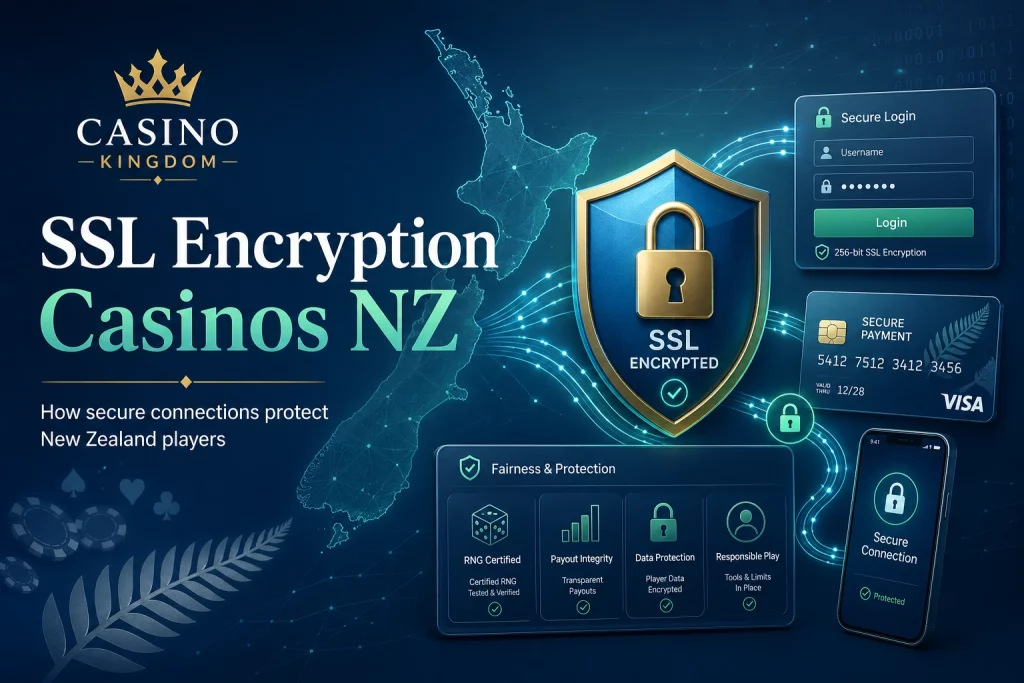
For New Zealand players, this matters because online casino activity usually involves more than casual browsing. A player may submit their name, date of birth, email address, residential details, payment information, and sometimes verification documents. SSL encryption helps protect this information while it travels between the player’s device and the casino system. It does not decide whether a casino is licensed, fair, or well-managed, but it forms one of the minimum technical conditions for safe use.
What SSL Encryption Actually Protects
SSL encryption protects data in transit. That means it helps secure information while it is being sent from the player’s browser or mobile device to the casino server. In modern technical language, most platforms use TLS rather than old SSL, but casino pages often still use the phrase “SSL encryption” because players understand it more easily.
The most important point is simple: encryption does not make a bad casino good, but a serious casino should not operate without it. It is the basic layer that protects the communication channel. If a player enters a password, uploads documents, or confirms a payment instruction, that data should not move across an open, exposed connection.
I normally check SSL encryption before judging promotions or game selection. A casino may offer a strong Bonus, but that promotion has little value if the account environment feels technically weak. Security comes before offers. If the platform cannot protect basic player data, the bonus terms, free spins, and loyalty perks become irrelevant.
The strongest casino platforms keep encryption active across the complete session. There should be no unsecured registration page, no unprotected cashier form, and no payment window that feels detached from the rest of the platform. Consistency is the key. NZ players should not need technical knowledge to stay protected; the site should be built so secure access is the default condition.
| Security Area | What SSL Encryption Should Protect | Why It Matters for NZ Players |
|---|---|---|
| Account Login | Email, username, password, session token | Prevents exposed account credentials during access |
| Registration | Name, date of birth, address, contact details | Protects personal information during account creation |
| Cashier Page | Deposit and withdrawal instructions | Reduces risk when handling payment activity |
| Verification Uploads | ID documents and proof of address | Protects sensitive identity data during transfer |
| Mobile Access | Session data, device connection, account actions | Supports safer use on phones and tablets |
How I Review SSL Security on Casino Kingdom
When I review SSL encryption for Casino Kingdom, I do not stop at checking whether the homepage uses HTTPS. That is only the first layer. A casino can display HTTPS on the front page and still have weaker security behaviour elsewhere. The better approach is to follow the player journey step by step.
The first check is account entry. A safe casino should allow players to sign in through a secure form, without browser warnings or suspicious redirects. The second check is registration. If a player decides to Sign up, the form should load securely from the start and remain protected until account creation is complete. I also look at whether the casino asks for unnecessary data too early, because secure transmission is important, but data minimisation also matters.
The third check is the cashier. Deposit and withdrawal pages should feel technically stable and clearly connected to the casino account. If external processors are involved, the transition should still feel professional, encrypted, and transparent. Players should not be sent to strange pages with unclear branding or browser warnings.
The fourth check is mobile access. Many NZ players use casinos from phones rather than desktop computers, so SSL encryption must work properly on smaller screens as well. A secure desktop site is not enough if the mobile version behaves inconsistently. This also applies to browser-based mobile play and any casino App experience promoted by the brand.
Finally, I check session behaviour. A secure casino should not randomly log players out during basic activity, expose account information in URLs, or allow sensitive pages to remain visible after logout. SSL encryption protects the data channel, but the casino still needs sensible session management to support real account safety.
Why SSL Alone Is Not Enough
SSL encryption is essential, but it is not the full definition of casino safety. Some unsafe websites can still use HTTPS. A padlock means the connection is encrypted; it does not prove that the operator is honest, licensed, financially stable, or fair to players. This is why Casino Kingdom treats SSL encryption as one part of a larger review framework.
A serious NZ casino review should also consider licensing information, game provider credibility, payment reliability, responsible gambling tools, complaint handling, identity verification standards, and transparent terms. SSL is the foundation, not the complete building.
This distinction is important because players sometimes overtrust surface-level signals. A polished website with HTTPS can still have poor withdrawal behaviour, unclear bonus rules, weak support, or aggressive promotional design. Strong encryption protects data movement, but it does not protect players from confusing terms or irresponsible platform design.
For that reason, I place SSL encryption at the beginning of the review process. If the platform fails there, I do not move forward with confidence. If it passes, I continue testing the rest of the experience: account setup, navigation, casino lobby structure, payment flow, responsible gambling controls, and support clarity.
SSL encryption is not exciting, but it is necessary. For NZ casino players, it helps create the technical conditions for safer account use. It protects sensitive information during transmission and gives players a basic level of confidence before they interact with deeper parts of the casino.
Where SSL Encryption Matters Most in NZ Casino Use
SSL encryption becomes most important when the player moves from simple browsing into account activity. Reading a casino page is one thing. Entering personal data, opening the cashier, checking payment history, or saving account preferences is different. That is the point where the casino stops being only a website and becomes a system that holds private player information.
For New Zealand players, this distinction is important because offshore casino platforms often combine several services inside one account environment. The same profile may connect to game providers, payment processors, verification tools, support chat, bonus tracking, and responsible gambling settings. A weak connection in any of these areas can reduce confidence in the whole platform.
When I assess SSL encryption on Casino Kingdom, I look at the casino as a chain of protected actions. A secure homepage is useful, but it is not enough. The player journey should remain encrypted from the first visit to the final account action. The safest platforms do not make the player think about security at every step because protection is already built into the structure.
Secure Browsing Before Account Creation
Before registration, the casino should already use HTTPS. This matters because players often browse promotions, terms, payment pages, and game categories before deciding whether to create an account. Even at this early stage, the platform may collect basic technical data through cookies, location prompts, device recognition, or session identifiers.
A secure browsing environment also tells me something about the operator’s technical standards. If a casino cannot maintain a clean HTTPS connection on public pages, I become cautious about trusting deeper account areas. Public browsing pages should load without browser warnings, broken padlocks, mixed content, or suspicious pop-ups.
The game lobby is one of the areas I check carefully. When players browse Slots, they may move between the casino interface and embedded provider systems. The page should remain stable and protected. If game thumbnails, launch windows, or provider frames create browser warnings, the platform needs closer inspection. A strong casino should not expose players to unstable technical behaviour simply because they are moving through the game catalogue.
A well-secured casino also avoids forcing unnecessary account actions too early. Players should be able to inspect basic information, read payment rules, and review terms without being pushed through unclear redirects. Secure browsing is not only about encryption. It is also about predictable site behaviour.
SSL and Casino Payment Pages
Payment pages are where SSL encryption becomes non-negotiable. Any casino that accepts deposits or processes withdrawals must protect the cashier area properly. This includes deposit selection, payment details, withdrawal requests, transaction history, and confirmation pages.
For NZ players, the cashier often involves third-party payment providers. That does not automatically create a problem. Many legitimate casinos use external payment systems. The issue is how the transition is handled. A secure casino should move the player from the casino account to the payment processor through a protected, clearly branded, professional flow. The player should not feel lost between random domains.
The payment page should not ask for sensitive information through unsecured forms. It should not display browser warnings. It should not break the secure connection after the player selects a payment method. The confirmation stage should also remain protected because it may include transaction references, account balances, payment amounts, or withdrawal instructions.
I also check whether the casino separates deposit safety from withdrawal transparency. SSL encryption protects the technical transfer of payment data, but it does not guarantee that withdrawals will be fast or fair. A casino can have a secure cashier and still apply slow reviews, unclear limits, or difficult verification rules. That is why I treat SSL encryption as a technical requirement, not as proof of overall payment quality.
SSL and Game Launching
Game launching is another area where secure access matters. Modern casinos usually rely on external studios to provide casino games. When a player opens live tables, crash games, jackpot titles, or standard casino Games, the platform may communicate with provider servers in the background. This should happen without weakening the secure session.
The player should not need to understand technical routing. The casino should handle it cleanly. A secure game launch should feel smooth: the game opens, the balance loads, the session remains active, and no browser warning appears. If a game opens through an unsecured frame or redirects to a questionable address, I mark that as a risk point.
SSL encryption also matters when a player uses demo modes. Even if no money is being wagered, the browser may still exchange session data with the casino or provider. If the player is logged in, demo activity can still be connected to an account environment. Secure transmission should remain active across both real-money and demo play.
For NZ players, this becomes especially relevant when switching between desktop and mobile. A casino may behave correctly on a laptop but less consistently on a phone browser. I check whether games open through secure URLs, whether the session survives screen changes, and whether the casino avoids strange mobile redirects.
SSL and Identity Verification
Identity verification is one of the most sensitive parts of casino use. A player may need to upload a passport, driver licence, proof of address, bank statement, or payment confirmation. This information is far more sensitive than a basic email address. If the casino does not protect document upload pages properly, I treat that as a major security weakness.
A secure verification page should load through HTTPS, show clear upload instructions, explain why documents are required, and avoid unnecessary third-party confusion. The casino should also make it clear whether documents are uploaded directly to the operator or through a verification partner.
SSL encryption helps protect files while they are transmitted, but responsible handling does not stop there. The casino should also apply secure document storage, restricted access, and sensible retention policies. Players normally cannot see the back-end controls, so the visible upload process needs to be professional and transparent.
I also prefer casinos that request verification at logical points. If a casino asks for sensitive documents without context or before explaining its process, that feels poor from a user-experience standpoint. Security is partly technical, but it is also procedural. A platform should protect data and explain why it needs that data.
| Casino Area | SSL Security Expectation | Review Signal |
|---|---|---|
| Game Lobby | Encrypted browsing across categories and provider previews | Stable HTTPS with no mixed-content alerts |
| Cashier | Protected deposit and withdrawal pages | No browser warnings during payment flow |
| Game Launch | Secure connection between casino and provider systems | Games open without suspicious redirects |
| Verification | Encrypted document upload and identity checks | Clear process with secure upload page |
| Support Chat | Protected conversation and account-related assistance | No insecure embedded chat window |
Main Casino Areas Where SSL Protection Matters
Why Browser Warnings Should Not Be Ignored
Browser warnings are not cosmetic interruptions. If a browser warns that a connection is not private, that a certificate is invalid, or that a page contains insecure content, players should not continue with account activity. The safest response is to stop, close the page, and avoid entering personal or payment details until the issue is resolved.
Sometimes a warning can be caused by a temporary configuration error. That may be true, but players should not take the risk on behalf of the casino. A serious operator should maintain its certificate, domain configuration, and page resources properly. Security maintenance is part of running a casino platform.
Mixed content is another issue. This happens when a secure HTTPS page loads some elements through unsecured HTTP. It may involve images, scripts, frames, or other resources. In some cases, mixed content can be minor. In other cases, it can create real exposure. Either way, it tells me the casino’s technical setup deserves scrutiny.
For Casino Kingdom, a clean SSL review means the player can move through the casino without seeing these warnings. The browser should not become the player’s security analyst. The casino should already be built to avoid that problem.
SSL and Responsible Account Control
SSL encryption also supports responsible account control. Players may use account limits, self-exclusion tools, cooling-off settings, or communication preferences. These features involve personal account decisions and should be protected during use.
If a player changes a deposit limit, submits a responsible gambling request, or contacts support about account restriction, that interaction should happen securely. This is not only a technical matter. It affects trust. Players need confidence that sensitive account requests are handled through a protected channel.
This is one reason Casino Kingdom does not separate technical safety from responsible gambling quality. A casino can display responsible gambling links, but if the account tools are difficult to access or poorly secured, the practical value is weaker. Security should support the player’s ability to control the account, not only the casino’s ability to process deposits.
How SSL Supports Trust Without Replacing Review Work
The main value of SSL encryption is that it creates a safer technical environment for the player journey. It protects data while it moves through the connection. It helps secure account entry, payments, identity checks, game launching, and support communication. For NZ players, that is essential.
However, SSL encryption does not replace full review work. I still need to examine licensing claims, payment rules, bonus restrictions, withdrawal behaviour, support response quality, game provider credibility, and responsible gambling access. A secure connection makes review possible; it does not complete the review by itself.
That is the correct way to understand SSL encryption casinos NZ. It is a baseline requirement. If a casino fails this baseline, I do not trust the deeper experience. If it passes, I continue testing the platform with more detailed checks.
How NZ Players Can Check SSL Encryption Before Trusting a Casino
SSL encryption should not be treated as something only developers understand. A player does not need to inspect server configuration or read certificate chains in technical detail to notice basic security signals. Most practical checks are visible directly in the browser. The goal is not to become a cybersecurity expert, but to recognise whether a casino is maintaining the minimum conditions for secure account use.
For Casino Kingdom, this player-side check is important because security claims can be easy to write and harder to prove. Many casinos use phrases such as “bank-level security,” “advanced encryption,” or “safe gaming environment.” Those phrases sound reassuring, but they are not enough. A proper review looks at how the casino behaves during real interaction.
The simplest rule is this: before entering any personal information, payment details, or account credentials, the casino page should use HTTPS and show no browser warning. If the browser warns that the connection is not private, the player should not continue. If the padlock is missing on an account page, that is also a problem. If the site redirects through strange domains during account creation or payment, the player should pause and inspect the situation more carefully.
Checking the Browser Address Bar
The address bar is the first place to check. A secure casino page should begin with HTTPS rather than HTTP. Most modern browsers also display a padlock icon or a connection settings symbol. Clicking that area usually gives basic certificate information, including whether the connection is secure.
This check should be repeated across different parts of the casino, not only on the homepage. I check the homepage, registration page, account area, cashier, support pages, and help centre. If the secure connection appears on one page but disappears on another, that inconsistency matters.
The account area is especially important. If a casino has a customer support section or FAQ, it may include links to payment rules, verification requirements, bonus terms, and responsible gambling tools. Those pages may not always collect data directly, but they shape player decisions. A serious casino should keep the full user environment clean, stable, and secure.
A clean browser connection does not prove everything, but it creates the minimum technical confidence needed to continue. If that first check fails, I do not recommend moving into account activity.
Looking for Certificate Problems
A security certificate confirms that the browser is communicating with the domain it expects and that the connection can be encrypted. When a certificate is expired, invalid, misconfigured, or issued to the wrong domain, browsers usually display warnings.
NZ players should not ignore these warnings. Even if the casino says the issue is temporary, the safest action is to avoid entering data until the connection is corrected. A legitimate casino should maintain its certificates properly. Security maintenance is not optional; it is part of operating a platform that handles account balances and personal information.
Certificate problems may appear in different ways. The browser may say the connection is not private. It may mention an expired certificate. It may block access entirely. It may show a red warning page. These signals are stronger than ordinary inconvenience. They suggest that the secure connection cannot be trusted at that moment.
When I review a casino, I also check whether warnings appear only in certain areas. Sometimes the homepage is secure, but a payment page or embedded frame triggers an issue. That still matters. The player journey is only as strong as its weakest sensitive point.
Watching for Mixed Content
Mixed content happens when a secure HTTPS page loads some resources through unsecured HTTP. These resources can include images, scripts, frames, tracking tools, or embedded elements. Some forms of mixed content are blocked automatically by browsers, while others may only create warning signs.
For casino use, mixed content should be treated seriously because online casinos rely on many embedded systems. Game providers, payment tools, chat widgets, analytics scripts, and promotional banners can all interact with the page. If these elements are not loaded securely, the page may not provide the clean security environment players expect.
A player may notice mixed content through a broken padlock, browser warning, missing page elements, or unusual behaviour when opening games or payment windows. Not every visual problem is a security problem, but repeated instability around secure pages is a negative signal.
Casino Kingdom’s review logic is simple here. If a casino handles money and personal data, it should not expect players to tolerate messy technical implementation. The site should feel stable and protected across the full session.
| Player Check | What to Look For | Safe Interpretation | Warning Sign |
|---|---|---|---|
| Homepage URL | HTTPS in the address bar | The public site uses encrypted access | HTTP only or browser warning |
| Account Pages | Secure connection after entering account area | Account activity remains protected | Padlock disappears after login |
| Cashier Flow | Secure payment and withdrawal pages | Payment actions use protected forms | Unclear redirects or insecure payment page |
| Certificate Status | No expired or invalid certificate warning | Browser trusts the connection | Connection not private warning |
| Embedded Features | Games, chat, and help pages load cleanly | No mixed-content behaviour appears | Broken frames, warnings, or blocked scripts |
SSL Claims Versus Real Security Behaviour
One of the most common mistakes players make is trusting casino security language without checking actual behaviour. A website may mention “SSL encryption” in the footer, but that does not prove the whole account journey is protected properly. The player should judge what the browser shows and how the platform behaves.
Real SSL protection should be boring. There should be no drama, no warning pages, no unstable redirects, and no visible technical confusion. The secure connection should simply remain active while the player browses, registers, deposits, withdraws, verifies identity, or contacts support.
Empty security language usually feels different. The casino may use broad claims without clear details. It may display generic icons that do not connect to any real policy page. It may claim “safe payments” while the cashier redirects awkwardly. It may promote encrypted access but fail to keep the secure connection consistent across mobile pages.
Casino Kingdom treats these differences carefully. Security is not judged by slogans alone. It is judged by consistency, visibility, and practical account behaviour.
SSL Trust Signals NZ Players Should Prioritise
Secure Casino Navigation and Internal Links
Secure navigation is another part of the SSL review. A casino should not move players through confusing pathways when they are trying to access account information, support, payments, or responsible gambling tools. The safest sites keep their internal structure predictable.
This matters because casino websites often include many internal pages: promotions, terms, payment instructions, verification rules, responsible gambling controls, game categories, support articles, and account settings. If these pages are connected through clean internal Links, players can review important information without being pushed through risky or unclear redirects.
A secure casino structure should keep players inside recognisable, protected pages. External links should be clear. Payment partners should be identifiable. Support tools should not open suspicious windows. Responsible gambling pages should be easy to reach without hunting through the footer.
For Casino Kingdom, secure navigation is part of user protection. A casino can technically use SSL but still create a poor trust environment if the player journey feels fragmented. Good security design should reduce uncertainty, not add more of it.
SSL on Mobile Devices
Mobile access deserves separate attention because many NZ players use casino sites from smartphones. A casino may look secure on desktop but behave differently on mobile if the mobile version is outdated, poorly configured, or loaded through a separate subdomain.
The same SSL checks apply on mobile. The page should use HTTPS. The browser should show no warning. Account pages should remain secure. Payment windows should open cleanly. Game launches should not trigger suspicious redirects. Support chat should not break the protected session.
Players should also be careful with public Wi-Fi. SSL encryption helps protect data in transit, but it does not make every network safe. When dealing with casino accounts, deposits, withdrawals, or document uploads, private and trusted connections are preferable. A secure casino connection is important, but the player’s own device and network conditions also matter.
I also recommend avoiding saved passwords on shared devices. SSL protects transmission, but it cannot protect an account if another person can access the device. Casino safety depends on both platform security and player-side habits.
Practical Red Flags NZ Players Should Notice
Several SSL-related warning signs should make players stop before continuing. The first is a browser warning that the connection is not private. The second is an account or payment page loading through HTTP. The third is a broken padlock or warning symbol near the address bar. The fourth is a payment redirect that looks unrelated to the casino or its known payment provider. The fifth is inconsistent behaviour between desktop and mobile.
Another red flag is poor explanation. If a casino claims strong encryption but provides no clear security or privacy information, that weakens confidence. Players do not need a technical white paper, but the site should explain how it handles data, payments, verification, and account protection in plain language.
Unusual pop-ups also deserve attention. A legitimate casino may use promotional banners, but security-sensitive actions should not be buried behind aggressive pop-ups or unclear overlays. If a player cannot easily tell where data is being entered, the experience is not good enough.
The safest approach is conservative. If the page feels technically unstable, do not enter sensitive information. A trustworthy casino should make secure use straightforward.
Why Casino Kingdom Treats SSL as a Starting Point
SSL encryption is best understood as the starting point of a safe casino review. It answers one narrow but important question: is the connection protected while information moves between the player and the casino? If the answer is no, deeper review becomes unnecessary because the platform has failed a basic technical standard.
If the answer is yes, the review continues. That is where Casino Kingdom examines payment transparency, licensing information, game provider standards, responsible gambling tools, terms clarity, support quality, and account controls. SSL does not replace these checks. It supports them.
For NZ players, this approach is useful because it avoids both extremes. It does not ignore security, but it also does not pretend that a padlock proves everything. A safe casino experience depends on several layers working together. SSL encryption is the first visible layer, and it should be present before a player trusts the rest of the platform.
Casino Kingdom SSL Review Framework for NZ Players
SSL encryption should be assessed as part of a wider casino safety framework. By itself, it only confirms that information can travel through an encrypted connection. That is useful, but it does not answer every question that matters to New Zealand players. A complete review should look at how the casino combines technical protection with payment transparency, account control, game fairness, and responsible gambling access.
For Casino Kingdom, the SSL review is the first technical filter. If a casino fails basic encryption checks, I would not move forward with deeper confidence. If the casino passes those checks, the next step is to see whether the rest of the platform behaves with the same level of discipline. A safe casino should not treat security as one isolated feature. It should build protection into the full user journey.
That means the registration process should be secure, the cashier should be stable, verification pages should be clear, support channels should be protected, and account tools should remain easy to access. The best casino platforms make this feel natural. The player should not have to fight the website to understand whether their information is safe.
SSL as the First Layer of Casino Safety
The first layer is technical access. A casino should load through HTTPS, keep the secure connection active, and avoid browser warnings. This is the most basic requirement. It tells the player that the site has at least implemented encrypted communication between the browser and the server.
The second layer is account protection. Once a player enters the account area, the casino should protect credentials, session data, personal information, and account settings. It should not expose sensitive data in URLs, leave account pages available after logout, or create unstable session behaviour.
The third layer is payment security. Deposits and withdrawals require stronger trust because financial information is involved. SSL encryption should protect payment actions, but the casino also needs clear payment rules, transparent limits, realistic processing times, and professional handling of verification requests.
The fourth layer is operational trust. This includes licensing information, provider credibility, terms clarity, customer support, complaint routes, and responsible gambling controls. SSL encryption supports these areas, but it cannot replace them. A casino may use encryption and still have poor rules. That is why technical security and user protection need to be reviewed together.
What a Secure NZ Casino Experience Should Feel Like
A secure casino experience should feel calm and predictable. The player should be able to move from the homepage to registration, account settings, game categories, payment pages, and support without seeing browser warnings or strange redirects. There should be no moment where the player wonders whether they are still inside the correct platform.
This is especially important for NZ players who use offshore casino sites. Many platforms serve several countries from the same technical infrastructure. That can be acceptable if the site is well built, but it also means the player should pay attention to consistency. The casino should not feel patched together from unrelated pages.
A secure casino also explains itself. Players should be able to find privacy information, payment rules, verification requirements, and responsible gambling tools without difficulty. Security should not be hidden behind vague statements. If a casino says it protects player data, it should also show practical signs of that protection through clean page behaviour and clear policy pages.
The strongest platforms create a sense of continuity. The same secure structure appears on desktop and mobile. The cashier behaves consistently. Game launches do not break the session. Support tools remain accessible. Responsible gambling settings are not buried. This is the type of environment Casino Kingdom looks for when evaluating SSL encryption casinos NZ.
Final SSL Review
| Review Layer | What Casino Kingdom Checks | Positive Signal | Risk Signal |
|---|---|---|---|
| Connection Security | HTTPS, valid certificate, no browser warnings | Secure connection across all main pages | Invalid certificate, HTTP pages, broken padlock |
| Account Safety | Secure sign-in, session stability, protected account pages | Stable account access without exposed data | Unexpected logouts, exposed details, unstable redirects |
| Payment Protection | Encrypted cashier, clear payment partner flow, secure confirmations | Professional deposit and withdrawal process | Unclear payment pages or insecure forms |
| Verification Process | Secure document upload and clear identity-check instructions | Protected upload page with transparent requirements | Confusing requests or insecure upload path |
| Mobile Security | HTTPS consistency on phone browsers and mobile layouts | Same secure behaviour as desktop | Different mobile domain with weaker security behaviour |
| Platform Trust | Security policies, responsible gambling tools, support access | Clear information and easy account-control access | Generic security claims without practical support |
Practical Recommendations for NZ Players
Before using any online casino, NZ players should complete a basic SSL check. Open the casino homepage and confirm that the page uses HTTPS. Then check the registration page, account area, cashier, help pages, and any verification upload section. The secure connection should remain active throughout the full process.
Players should avoid entering personal information if the browser shows a connection warning. This includes warnings about expired certificates, unsafe connections, or suspicious redirects. Even if the casino looks familiar, the safest response is to stop and return only when the issue is resolved.
It is also sensible to avoid casino account activity on public Wi-Fi. SSL encryption helps protect data in transit, but shared networks can still create avoidable risks. For deposits, withdrawals, account changes, and document uploads, a private connection is the safer option.
Players should also keep their own account security in order. A strong password, private email access, updated browser, and secure device all matter. SSL encryption protects communication between the device and the casino, but it cannot compensate for a compromised device or a reused weak password.
How SSL Connects to Payment Confidence
Payment confidence depends on more than encryption, but SSL encryption is still essential. A player should never deposit through an unsecured page. The cashier should load cleanly, display payment options clearly, and confirm transactions through protected pages.
A professional casino should also explain minimum deposits, withdrawal limits, processing times, fees, verification requirements, and possible payment restrictions. Encryption protects the technical transfer of payment data, while transparent rules protect the player from confusion.
For Casino Kingdom, I separate these two issues during review. A casino can have secure payment pages but still offer poor withdrawal terms. It can also advertise fast withdrawals while creating unclear verification delays. SSL encryption is necessary, but payment trust also depends on how the casino handles real player requests.
The best casino experience combines both. The technical page is secure, the payment rules are clear, the verification process is reasonable, and the withdrawal path is predictable. That is the standard NZ players should expect.
How SSL Supports Responsible Gambling Tools
Responsible gambling tools often involve sensitive account actions. Players may set deposit limits, activate time-outs, request self-exclusion, restrict communication, or contact support about account control. These actions should happen through secure pages.
This is one reason SSL encryption matters beyond payments. It helps protect private account decisions. A player who adjusts limits or asks for gambling support should not have to worry about whether that request is being transmitted safely.
A responsible casino should make these tools visible and protected. It should not hide them behind confusing navigation. It should not make the player contact support repeatedly just to find basic account controls. Security and responsible gambling should work together.
Casino Kingdom reviews this area carefully because responsible gambling is not only a legal or ethical topic. It is also a practical usability issue. If a player cannot securely access account controls, the platform is weaker from a player-protection standpoint.
Final Perspective on SSL Encryption Casinos NZ
SSL encryption is not a luxury feature for online casinos. It is a minimum requirement. NZ players should expect encrypted access across the homepage, account pages, cashier, verification process, support tools, and mobile experience. If a casino fails to provide that consistency, it should not be treated as a trustworthy platform.
At the same time, players should avoid overvaluing the padlock icon. HTTPS means the connection is encrypted; it does not prove that the casino is fair, well licensed, fast with withdrawals, or responsible in how it treats users. It is one technical signal inside a broader trust assessment.
The Casino Kingdom approach is therefore layered. First, check whether the casino provides secure encrypted access. Then examine the account journey, payment transparency, game environment, support quality, responsible gambling tools, and policy clarity. A good casino should pass all of these checks, not only one.
For NZ players, the safest habit is to treat SSL encryption as the starting line. If the connection is not secure, stop immediately. If the connection is secure, continue reviewing the casino with the same level of caution. Secure access makes a safer casino experience possible, but the full judgement comes from how the whole platform behaves.






Comments