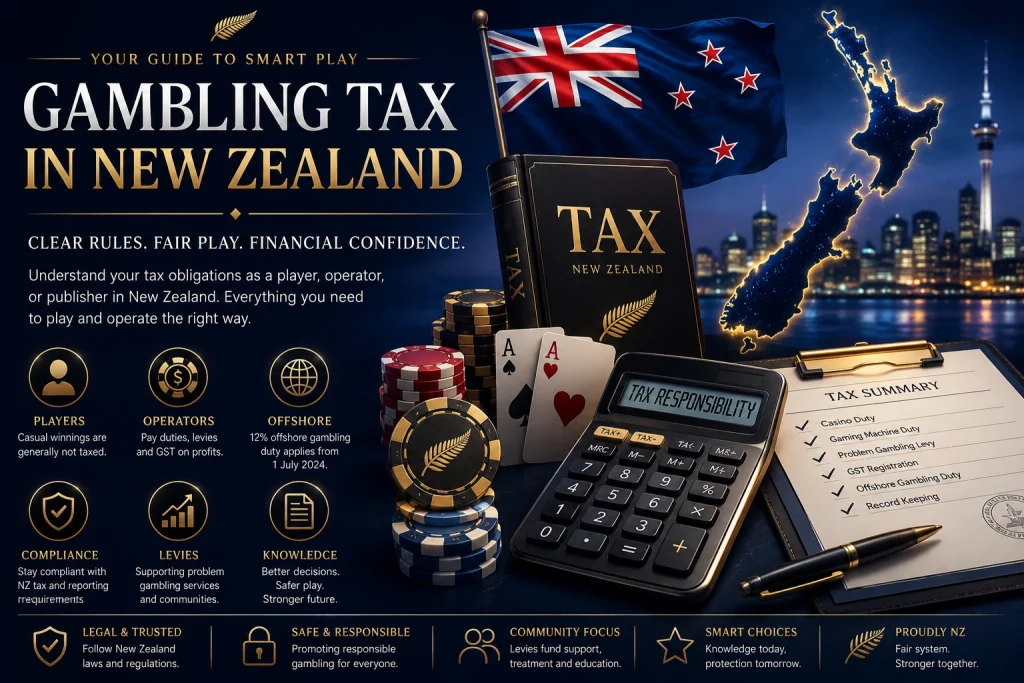
Gambling Tax in New Zealand
How Gambling Tax Works in New Zealand
Gambling tax in New Zealand is not one single tax paid in the same way by every person or every operator. The tax position depends on who receives the money, what type of gambling activity is involved, whether the activity is casual or business-like, and whether the tax applies to a player, an operator, a gaming-machine society, a lottery provider, a casino operator, or an offshore online gambling supplier.
For ordinary players, the main rule is relatively simple: one-off gambling winnings are usually not treated as taxable income. Inland Revenue explains that if someone wins a raffle, Lotto, prize money in a draw, or prize money through TAB racing, those winnings are generally not taxable. However, if prize money is won as part of someone’s taxable activity, it is generally taxable and must be included as business income or as a schedular payment.
This distinction is important because New Zealand tax law looks at the nature of the activity. A casual player who wins once is in a different position from someone whose activity is organised, regular, business-like, or connected with taxable work. A single Lotto prize, raffle win, pokie win, or racing prize is usually not income for tax purposes. A professional or business-related activity may be different.
For Casino Kingdom readers, the core point is this: gambling tax in New Zealand must be separated into two sides. The first side is player winnings. The second side is operator duties and levies. Players usually ask, “Do I pay tax on gambling winnings?” Operators and gambling businesses deal with a different question: “What duties, GST, levies, and filing obligations apply to gambling profits?”
Player Winnings vs Operator Tax
The most common misunderstanding is treating player winnings and operator tax as the same thing. They are not the same. A player may receive a one-off win that is not taxable as income, while the operator may still owe gambling duties, GST, problem gambling levy, or other obligations on gambling profits.
Inland Revenue’s duties section lists several gambling-related duties in New Zealand. Casino operators pay casino duty on gambling profits. Gaming-machine operators pay duties on gaming-machine profits and also pay the problem gambling levy. Lottery duty applies to the nominal value of tickets in a lottery game. Offshore gambling duty applies to qualifying remote gambling services supplied by offshore operators to New Zealand residents.
This means the gambling tax system is mainly designed around the operator side. The person who wins casually is usually not the main tax target. The person or entity conducting gambling activity may have tax and duty obligations because they generate gambling profits, sell lottery tickets, operate machines, run a casino, or supply remote gambling services.
That distinction should stay clear throughout the page. A reader checking a FAQ section may want a quick answer about personal winnings, but a full legal-tax guide needs to explain both the player side and the operator side.
Are Gambling Winnings Taxable for Players in New Zealand?
For most ordinary players, gambling winnings are generally not taxable in New Zealand when they are one-off or casual. Inland Revenue states that raffle winnings, Lotto winnings, prize money in a draw, and TAB racing prize money are generally not taxable.
Work and Income gives similar practical guidance for benefits and support payments. It states that one-off lottery or gambling wins do not need to be declared as income unless the person may get income from them, although some benefit-related situations may require disclosure for assistance such as Accommodation Supplement, Temporary Additional Support, or Special Benefit.
This does not mean every gambling-related amount is always outside tax. The important exception is taxable activity. If someone wins prize money as part of a business, employment, professional competition, or organised income-producing activity, the amount may need to be returned as taxable income. The same principle can apply where the gambling-like activity is not casual entertainment but part of a systematic profit-making operation.
For readers, the practical explanation is straightforward: a casual one-off win is usually not taxed as income, but an organised income-producing activity can be different. The more regular, professional, planned, and business-like the activity becomes, the more carefully the tax position should be checked.
Operator Duties and Gambling Profits
Operators face a different tax environment from players. New Zealand imposes gambling duties on certain gambling operators. The type of duty depends on the gambling category. Casino duty applies to casino operators. Gaming-machine duty applies to gaming-machine operators. Lottery duty applies to lottery games. Offshore gambling duty applies to qualifying offshore remote gambling services supplied to New Zealand residents.
Inland Revenue states that gaming-machine operators need to pay duties on the income brought in by gaming-machine profits and also need to pay the problem gambling levy on all profits made. Inland Revenue also states that the problem gambling levy must be paid on all gambling profits by gambling operators covered by the levy rules, and that current rates apply from 1 July 2025.
The problem gambling levy is important because it shows that gambling taxation in New Zealand is not only about general revenue. Part of the framework is connected with harm-prevention funding and support services. Gambling operators contribute because their activity is associated with social and behavioural risk.
This operator-side structure also explains why a page about gambling tax should not only answer player questions. It should explain how gambling profits are taxed and levied at the business level, because those obligations shape the market and regulatory environment.
Main Types of Gambling Tax and Duties in New Zealand
| Tax or duty area | Who it mainly affects | What it applies to | Reader takeaway |
| Player income tax | Individual players | Usually not applied to one-off casual gambling winnings | Casual winnings are generally not taxable, but taxable activity can be different |
| Casino duty | Casino operators | Casino gambling profits | The operator may owe duty even when player winnings are not taxed as income |
| Gaming-machine duty | Gaming-machine operators | Profits from gaming machines | Class 4-style machine gambling has operator-side duty obligations |
| Problem gambling levy | Covered gambling operators | Gambling profits | The levy supports harm-prevention and treatment funding |
| Lottery duty | Lottery operators | Nominal ticket value in lottery games | Lottery tax treatment is separate from casino or gaming-machine duty |
| Offshore gambling duty | Offshore remote gambling suppliers meeting the rules | Remote gambling services supplied to New Zealand residents | Online gambling tax obligations can apply even when the supplier is outside New Zealand |
| GST obligations | Relevant gambling suppliers and operators | Taxable supplies when thresholds and rules apply | GST can be separate from gambling-specific duties |
Offshore Gambling Duty and Online Gambling
Online gambling creates a separate tax issue because the supplier may be outside New Zealand while the customer is in New Zealand. Inland Revenue explains that offshore gambling duty applies to offshore gambling operators, and an offshore gambling operator must register for, file, and pay GST if they make NZ$60,000 or more of taxable supplies in a 12-month period.
A 2024 Inland Revenue tax policy report states that from 1 July 2024, a 12% offshore gambling duty applies to online gambling provided by offshore operators to New Zealand residents. The report says the duty applies to GST-registered persons located outside New Zealand to the extent they make supplies of remote gambling services to New Zealand residents.
This is a key point for the page because online gambling tax is not limited to companies physically based in New Zealand. If offshore operators supply remote gambling services to New Zealand residents and meet the relevant criteria, New Zealand tax obligations may arise. This is part of the wider move to capture online gambling activity within the tax and regulatory system.
For content sections that mention site navigation such as Login, App, or Links, the tax explanation should remain clear: platform access features do not determine tax status. The tax position depends on the operator, supply type, customer location, GST status, gambling profits, and applicable duty rules.
Online Casino Changes and Future Tax Position
The online casino framework is changing. DIA’s online gambling FAQ discusses regulated online casinos and confirms that expected regulated online casino operators will pay duties on gross gambling revenue, the problem gambling levy, and, where applicable, tax on profits after expenses if they are a registered entity in New Zealand.
This matters because New Zealand’s online casino market is moving from a historically offshore-dominated model toward a licensed regime. As that framework develops, operator-side taxes, duties, levies, and community-return rules may become more visible to readers. The exact obligations should always be checked against current Inland Revenue and DIA guidance because online gambling regulation is actively changing.
For readers, the main distinction remains stable: player winnings and operator taxes are separate. A casual player may not owe income tax on a one-off win, but the operator may still owe gambling duty, GST, problem gambling levy, or future online casino duties.
This is why a tax guide should be careful with terms like Bonus or Sign up. A promotion may affect wagering, account terms, or withdrawal rules, but it does not automatically create a personal income-tax obligation for a casual player. The tax issue depends on the nature of the win and whether the activity is taxable.
Why Gambling Tax Is Often Misunderstood
Gambling tax is often misunderstood because people mix several issues together. They may confuse player winnings with operator profits. They may assume that every win is taxed because wages are taxed. They may assume that no tax exists because casual winnings are usually not taxable. Both assumptions are incomplete.
The New Zealand system is more specific. Casual one-off winnings are generally not taxed as income for players. But gambling operators can owe duties and levies. Offshore remote suppliers may have GST and offshore gambling duty obligations. Professional or business-like prize activity may create taxable income.
This means the right answer depends on the person and the activity. A casual player, a professional competitor, a casino operator, a gaming-machine society, a lottery provider, and an offshore online gambling supplier are all in different tax positions.
When Gambling Winnings Are Usually Not Taxable
For most individual players in New Zealand, ordinary gambling winnings are generally not taxable when they are casual, one-off, or recreational. This can include Lotto prizes, raffle wins, prize draws, racing-related winnings, or ordinary gambling wins that are not connected with a taxable activity.
The reason is that New Zealand tax law generally taxes income, not every amount a person receives. A casual gambling win is usually treated as a windfall rather than income from employment, business, services, or an organised profit-making activity. That distinction is why many ordinary players do not need to include one-off gambling winnings in an income tax return.
However, readers should not turn this into an absolute rule. The tax position can change when the activity becomes systematic, organised, or connected with a taxable source. If gambling activity starts to look less like entertainment and more like a business or professional income stream, the answer may become different.
For Casino Kingdom readers, the practical version is simple: one ordinary win is usually not taxable, but regular profit-seeking activity should be checked more carefully.
Taxable Activity and Professional Gambling
A gambling win may become taxable if it is part of a taxable activity. This can happen when the person is not simply playing casually but is earning prize money or gambling-related returns through a structured, professional, or business-like activity.
The legal assessment depends on facts. Tax authorities usually look at behaviour rather than labels. Calling yourself a casual player does not settle the issue if the activity is organised, regular, planned, and profit-focused. On the other side, having several wins does not automatically turn someone into a taxable gambling business.
Relevant factors may include how often the person gambles, whether they rely on gambling as income, whether they use systems or commercial tools, whether they keep business-like records, whether they receive sponsorship or payments connected with gambling activity, whether they treat the activity as work, and whether the activity is connected with other taxable services.
This matters for people who produce gambling content, compete in paid events, stream casino-style gameplay, receive affiliate income, or earn payments linked to gambling promotion. In those cases, the taxable income may not be the gambling win itself, but the business income around the activity.
Casual Gambling vs Business-Like Activity
The difference between casual gambling and business-like activity is important because tax treatment follows the nature of the activity. A person who buys a Lotto ticket once and wins is in a different position from someone who earns regular taxable income connected with gambling services, promotions, competitions, or professional activity.
Casual gambling usually has no business structure. There is no business plan, no client income, no regular commercial reporting, no service contract, and no predictable income stream. The person may win or lose, but the activity is not organised as a taxable enterprise.
Business-like activity looks different. It may involve systematic participation, structured records, outside payments, agreements, sponsorship, advertising revenue, or content income. If gambling is part of a wider income-producing activity, the tax treatment can change.
For example, if a person receives payment for promoting a gambling brand, that payment may be taxable even if a separate gambling win is not. If a streamer earns advertising revenue while playing casino-style content, the streaming revenue may be taxable. If someone receives a commission for referring users, that commission is not the same as a casual gambling win.
Casual Win vs Taxable Gambling-Related Income
| Situation | Likely tax treatment | Why it matters | Reader takeaway |
| One-off Lotto win | Generally not taxable for ordinary players | Usually treated as a windfall rather than income | Casual prize wins are usually outside income tax |
| Raffle or prize draw win | Generally not taxable if casual and unrelated to business | The win is not normally earned through taxable services | Context decides whether a prize is casual or business-linked |
| Occasional casino win | Usually not taxable if recreational | Entertainment gambling is usually not a taxable activity | A casual win does not automatically create income tax |
| Prize money connected with business activity | May be taxable | The prize is linked to an income-producing activity | Business context can change tax treatment |
| Paid gambling content or streaming revenue | Taxable as content, advertising, sponsorship, or business income | The income comes from services or monetisation, not merely a win | Platform revenue should not be confused with gambling winnings |
| Affiliate commission from gambling referrals | Usually taxable business or self-employed income | Referral income is earned commercially | Commissions are different from casual winnings |
| Professional competition prize | May be taxable if connected with a professional activity | The prize may be part of the person’s taxable work | Professional status matters |
Benefits, Support Payments and Gambling Wins
Tax is not the only financial issue connected with gambling winnings. A one-off gambling win may not be taxable as income, but it may still matter for people who receive certain benefits, support payments, or income-tested assistance.
This distinction is important because tax rules and social support rules are not always identical. A payment can be non-taxable but still relevant to benefit entitlement, asset assessment, or financial disclosure. A person who receives support should check the relevant agency rules before assuming that a gambling win has no consequences.
For example, a large one-off win may not be income tax, but if it increases a person’s cash assets or changes their financial position, it may affect support calculations. This is especially relevant for assistance linked to accommodation costs, hardship support, or income and asset testing.
For Casino Kingdom readers, the useful takeaway is that “not taxable” does not always mean “irrelevant.” A win may be outside income tax but still important for benefit reporting, budgeting, debt repayment, or financial planning.
Gambling Money Flow in New Zealand
Online Winnings and Tax Questions
Online winnings create the same basic player-side question: is the win casual, or is it connected with a taxable activity? The fact that a win happens online does not automatically make it taxable. A recreational online gambling win is not automatically business income simply because the platform is digital.
However, online gambling can create more records than land-based gambling. A platform may store account history, transaction logs, deposits, withdrawals, game rounds, payment records, bonuses, and identity documents. If a tax question arises, those records may help show whether the activity was casual or organised.
Online gambling can also blur into commercial activity more easily. A person may run content, publish guides, post reviews, earn affiliate income, or stream gambling sessions. In that case, the taxable part may be the monetised activity, not necessarily every wager result.
This is why pages about Slots or Games should not imply that all winnings are treated the same in every context. The activity behind the money matters. Recreational play and commercial gambling-related income are different tax situations.
Bonus Money and Tax Treatment
Bonus money can confuse readers because it may look like a win, a reward, a discount, or account credit. In most player contexts, a casino bonus is not automatically taxable income just because it appears in an account. It is usually governed first by platform terms: wagering requirements, expiry rules, eligible games, withdrawal limits, and account restrictions.
The tax position becomes more relevant when bonus value is connected with business activity. For example, if a person receives promotional value, commissions, sponsorships, or commercial compensation from a gambling operator, that may be different from a casual player receiving a standard bonus credit.
This is why a Bonus page should distinguish between promotional terms and tax law. Wagering terms explain whether the user can withdraw money. Tax rules explain whether the amount is income. These are different questions.
For ordinary readers, the better practical approach is to treat bonus money as a terms-and-withdrawal issue unless the bonus is part of a commercial relationship, promotion contract, affiliate arrangement, or professional activity.
Record-Keeping for Gambling-Related Income
Casual players generally do not need business-style records for every ordinary gambling session. However, if gambling activity becomes regular, professional, or connected with business income, records become important. Good records can show what money came from winnings, what money came from sponsorship, what money came from commissions, and what expenses relate to taxable activity.
Useful records may include payment statements, platform account history, invoices, affiliate reports, sponsorship agreements, bank deposits, crypto transaction IDs if relevant, and communication with operators. If a person earns money from gambling content or referrals, they should keep those records like any other self-employed or business income.
For operators, record-keeping is much more formal. Gambling businesses, gaming-machine societies, casino operators, lottery providers, and offshore remote suppliers may have filing, duty, GST, levy, and audit obligations. Their records support tax calculation and regulatory compliance.
For Casino Kingdom readers, the distinction remains consistent: casual play usually creates fewer tax-record issues; commercial gambling-related activity creates stronger record obligations.
Why Source of Money Matters
When assessing tax, the source of money matters. A one-off win has a different source from wages, business income, affiliate commission, sponsorship income, or professional prize money. The label “gambling” does not decide everything.
For example, a person may win money while playing casually. Another person may earn money because they are paid to write about gambling. A third person may receive commission because users register through their content. A fourth person may operate a gambling business. These are all gambling-related in a broad sense, but they are not taxed the same way.
This is one of the most useful ideas for readers. The same industry can create different types of money. Some are casual windfalls. Some are commercial income. Some are operator profits. Some are statutory duties. Some are levies.
The correct tax answer follows the money source, the activity context, and the person receiving it.
Why Operator Duties Are Different from Player Winnings
Gambling tax in New Zealand is easiest to understand when player winnings and operator duties are kept separate. A casual player may receive a one-off win that is generally not taxable as income, while the operator behind the gambling activity may still have formal duty, GST, levy, filing, and reporting obligations.
This distinction is central to casino duty, gaming-machine duty, lottery duty, and offshore gambling duty. These are not usually taxes paid by casual players on individual wins. They are operator-side obligations connected with gambling profits, ticket values, or remote gambling supplies to New Zealand residents.
Inland Revenue groups these obligations under duties and levies. Its gambling-related duty categories include casino operators, gaming-machine duty, lottery duty, offshore gambling duty, problem gambling levy, and totalisator duty. Inland Revenue also confirms that offshore gambling duty applies from 1 July 2024 at a rate of 12% for offshore gambling operators that meet the relevant criteria.
For Casino Kingdom readers, the practical takeaway is simple: a player’s tax question and an operator’s tax question are different. The player asks whether a win is taxable. The operator asks which gambling duties, GST rules, levies, filing dates, and compliance obligations apply.
Casino Duty in New Zealand
Casino duty applies to casino operators rather than ordinary players. It is charged on casino gambling profits, which means it is part of the tax structure applied to the business side of casino gambling. This is different from income tax on a casual player’s win.
Casino duty reflects the fact that licensed casino gambling is a regulated commercial activity. Casino operators do not only need gambling licences and venue approvals; they also need to meet tax and duty obligations connected with gambling revenue. These obligations sit alongside other compliance duties such as record-keeping, responsible-gambling controls, and regulatory reporting.
The important point for readers is that casino duty does not mean every casino win is taxed in the player’s hands. A casino operator may owe duty on gambling profits, while an ordinary player’s casual win may still be generally outside income tax. These two rules can exist at the same time because they apply to different people and different money flows.
This distinction is especially useful when readers compare physical casino gambling with online gambling. A land-based casino operator, a gaming-machine operator, and an offshore online gambling supplier may all face different tax treatments. The player-side question remains separate from the operator-side duty structure.
Gaming-Machine Duty
Gaming-machine duty applies to gaming-machine operators. Inland Revenue states that gaming-machine duty is 20% of gaming-machine profits. It also says that operators who need to pay gaming-machine duty should register through myIR and that the return and payment are due by the 20th of each month after the relevant period.
This duty is important because gaming-machine gambling outside casinos has a specific legal and financial structure in New Zealand. It is not treated as ordinary private entertainment income. Gaming-machine profits are part of a regulated system, with duties, venue rules, authorised-purpose requirements, and problem-gambling levy obligations.
For readers, the main point is that gaming-machine tax is mainly an operator-side issue. A person who plays a machine casually is not normally calculating gaming-machine duty. The operator or society responsible for the machine activity carries that obligation.
This also explains why gambling tax discussions should avoid oversimplified claims. Saying “gambling winnings are not taxed” may be broadly true for many casual players, but it does not mean gambling activity is untaxed. The operator side can still carry significant duties and levies.
Problem Gambling Levy
The problem gambling levy is a major part of New Zealand’s gambling-tax environment. Inland Revenue states that a problem gambling levy must be paid on all gambling profits and that the total payable is worked out automatically when the operator files the return. The current rates apply from 1 July 2025, and the levy is reviewed every three years.
The levy exists because gambling creates harm risks that need public-health funding and support services. Inland Revenue’s 2025 update explains that the new problem gambling levy applies from 1 July 2025 and replaces the old levies, with rates set every three years. It also states that the levy helps provide public health services in the community as part of an integrated problem gambling strategy.
The 2025 regulations set levy rates for the period from 1 July 2025 to 30 June 2028. The published schedule lists sector-specific rates, including casino operator at 0.89% and gaming-machine operator at 1.24%, excluding GST.
| Duty or levy | Main payer | Current key point | Reader takeaway |
| Casino duty | Casino operators | Applies to casino gambling profits | Operator duty is separate from casual player winnings |
| Gaming-machine duty | Gaming-machine operators | IRD states gaming-machine duty is 20% of gaming-machine profits | Machine gambling has specific operator-side duty rules |
| Problem gambling levy | Covered gambling operators | Paid on gambling profits, with rates reviewed every three years | The levy funds harm-prevention and public-health services |
| Lottery duty | Lottery operators | Applies to lottery-game ticket value under the relevant duty framework | Lottery taxation is separate from casino and machine duties |
| Offshore gambling duty | Offshore gambling operators meeting the rules | 12% offshore gambling duty applies from 1 July 2024 | Remote gambling supplied from outside New Zealand can still trigger NZ duty |
| GST registration | Relevant remote gambling suppliers and other taxable suppliers | Offshore operators must register if they make NZ$60,000 or more of taxable supplies in a 12-month period | GST and gambling-specific duty can both matter |
Lottery Duty
Lottery duty is another operator-side duty. It applies to lottery games rather than to every individual winner as personal income tax. The duty is connected with the lottery framework and the nominal value of tickets, which makes it different from casino duty and gaming-machine duty.
This distinction matters because lottery products are often the gambling category readers understand best. A person may know that a Lotto win is generally not taxable as personal income, but that does not mean lottery activity has no tax structure. The operator-side duty system still applies.
Lottery duty also shows why gambling tax depends on product type. A lottery ticket, a casino game, a gaming machine, and an offshore remote gambling service are not taxed in the same way at the operator level. They sit in different duty categories.
For a reader, the useful point is that the tax treatment follows the structure of the gambling product. Personal winnings, operator profits, ticket values, GST, and levies must be separated before the tax answer becomes clear.
Offshore Gambling Duty
Offshore gambling duty is especially important for online gambling. Inland Revenue states that from 1 July 2024, a 12% offshore gambling duty applies to offshore gambling operators. It applies to offshore operators that are based overseas and supply gambling or prize competitions to New Zealand residents who pay to gamble or compete for prizes.
IRD’s offshore gambling duty guidance also states that offshore gambling operators must register for, file, and pay GST if they make NZ$60,000 or more of taxable supplies in a 12-month period. Taxable supplies are calculated as the money received from New Zealand residents minus the prize money paid to them. Offshore operators registered for GST must also register for offshore gambling duty.
This is one of the clearest signs that New Zealand’s tax system now reaches remote gambling supplied from overseas. Online access does not automatically place an operator outside the tax discussion. If the offshore operator supplies remote gambling services to New Zealand residents and meets the relevant criteria, duty and GST obligations can arise.
For Casino Kingdom readers, the key distinction remains: offshore gambling duty is an operator obligation, not a casual-player income-tax rule. It helps explain how online gambling suppliers are brought into New Zealand’s tax framework.
Offshore Gambling Duty and Online Casino Regulation
Offshore gambling duty also connects with the changing online casino environment. The IRD tax policy report explains that the 2024 legislation introduced offshore gambling duty and that it applies from 1 July 2024 to online gambling provided by offshore operators to New Zealand residents.
This policy direction matters because New Zealand has been moving toward tighter online gambling regulation. Tax rules, online casino licensing, GST, and harm-prevention funding are all part of a wider shift. The goal is not only to recognise that online gambling exists, but to bring relevant operators into a clearer legal and fiscal framework.
For readers, this means online gambling should not be described as an untaxed grey area. The legal position can still be complex, especially while online casino licensing develops, but operator-side tax duties already exist in defined areas.
This is why a page about gambling tax should mention online gambling separately. The tax position for a land-based casino operator and an offshore online gambling supplier is not identical, but both may have New Zealand obligations depending on the facts.
GST and Gambling Services
GST can apply separately from gambling-specific duties. Inland Revenue’s offshore gambling guidance states that an offshore gambling operator must register for GST if it makes NZ$60,000 or more of taxable supplies in a 12-month period. The taxable supply calculation is based on money received from New Zealand residents minus prize money paid to them.
This means GST registration can be a gateway into offshore gambling duty. An offshore operator that meets the GST threshold and supplies remote gambling services to New Zealand residents may need to register and comply with the duty rules as well.
For land-based and domestic operators, GST treatment can also interact with gambling operations, depending on the product and business structure. Because GST rules can be technical, a public guide should not try to replace tax advice. It should explain the main distinction: GST is a consumption tax framework, while casino duty, gaming-machine duty, lottery duty, and offshore gambling duty are gambling-specific duty frameworks.
For a reader, the main takeaway is that operator tax obligations may stack. An operator can face GST obligations, gambling duties, levies, filing deadlines, and ordinary business-tax rules depending on its structure.
Why Duties and Levies Affect the Market
Duties and levies affect more than tax collection. They shape how gambling operators price products, report profits, manage compliance, and fund harm-prevention systems. They also show that gambling is treated as a controlled sector rather than an ordinary entertainment product.
Gaming-machine duty, for example, is linked to machine profits. Problem gambling levy is linked to gambling profits and harm funding. Offshore gambling duty is linked to remote gambling supplies from outside New Zealand. These rules make the operator side visible in the tax system.
For players, these duties may not appear as a line item on a personal tax return. But they influence the regulated environment around gambling. They also explain why operators need detailed records, compliance systems, and filing processes.
For Casino Kingdom, this section helps readers understand that gambling tax is not only about whether a player pays tax on a win. The larger tax framework is mainly built around gambling operators and the money they generate.
The Short Answer on Gambling Tax in New Zealand
For most ordinary players in New Zealand, casual gambling winnings are generally not taxable as personal income. This usually includes one-off Lotto wins, raffles, prize draws, TAB racing wins, and ordinary recreational gambling wins. The key idea is that a casual win is normally treated as a windfall rather than income from work, business, or a taxable activity.
That does not mean gambling is untaxed in New Zealand. The tax burden usually sits more heavily on operators. Casino operators, gaming-machine operators, lottery providers, offshore remote gambling suppliers, and other gambling businesses may face duties, GST obligations, problem gambling levy payments, filing rules, and business-tax obligations.
This distinction should stay clear throughout any Gambling tax in New Zealand guide. A player asking whether a single win must be declared is asking a different question from an operator asking whether gaming-machine duty, casino duty, offshore gambling duty, GST, or the problem gambling levy applies.
For Casino Kingdom readers, the most practical answer is this: casual player winnings are usually not taxed, but gambling operators are subject to specific tax and duty rules. If gambling-related money comes from business activity, professional activity, affiliate income, sponsorship, paid content, or regular taxable work, the tax answer may change.
Gambling Tax Responsibility Map NZ
Final Checklist for Players
A player should begin with the nature of the win. Was it a casual one-off win, or was it connected with a regular, organised, commercial, or professional activity? This first question usually decides whether the win looks like a non-taxable windfall or taxable income.
The second question is whether the gambling activity is connected with other income. If a person receives affiliate commissions, sponsorship payments, advertising income, streaming revenue, paid reviews, paid tips, or gambling-related business income, those amounts should not be treated like ordinary casual winnings. They are usually commercial income and should be assessed separately.
The third question is whether benefits or support payments are involved. A gambling win may be outside income tax but still relevant for benefit disclosure, assistance calculations, asset testing, or financial support rules. A person receiving government support should not assume that “not taxable” means “not reportable” in every context.
The fourth question is whether clear records exist. Casual players may not need complex records for every recreational session, but anyone receiving regular gambling-related money should keep documents. Account statements, invoices, platform records, payment reports, affiliate dashboards, bank statements, and correspondence may be useful if the tax position is questioned.
Final Gambling Tax Comparison
| Money type | Who receives it | Likely tax position | Practical takeaway |
| One-off Lotto or raffle win | Ordinary player | Generally not taxable as personal income | Usually treated as a windfall rather than earned income |
| Casual casino or racing win | Ordinary recreational player | Generally not taxable if not connected with taxable activity | Context matters, but ordinary casual wins are usually not taxed |
| Professional prize money | Professional competitor or business participant | May be taxable depending on facts | Business-like or professional activity should be checked carefully |
| Affiliate commission | Publisher, marketer, website owner, influencer | Usually taxable business or self-employed income | Referral money is not the same as a gambling win |
| Streaming or content income | Creator, reviewer, publisher, media operator | Usually taxable income | Income from content monetisation should be recorded |
| Casino gambling profits | Casino operator | Subject to casino duty and other business obligations | Operator duties are separate from player tax |
| Gaming-machine profits | Gaming-machine operator | Subject to gaming-machine duty and problem gambling levy | Machine gambling has specific operator-side duties |
| Offshore remote gambling supplies | Offshore operator supplying NZ residents | May trigger GST and offshore gambling duty obligations | Being offshore does not always remove New Zealand tax duties |
Common Misunderstandings About Gambling Tax in New Zealand
One common misunderstanding is that all gambling winnings are taxable. For ordinary casual players, this is usually not correct. A one-off win is generally not treated as income simply because money was received.
Another misunderstanding is that gambling is not taxed at all. This is also wrong. Operator-side duties, levies, GST rules, and business taxes can apply to gambling businesses. The tax may not sit with the casual player, but it can still apply to the operator.
A third misunderstanding is that online gambling is outside the tax system. Offshore gambling duty and GST rules show that remote gambling supplied by offshore operators to New Zealand residents can still create New Zealand tax obligations. The growth of online gambling has made this area more important.
A fourth misunderstanding is that gambling-related content income is the same as gambling winnings. It is not. Affiliate commission, sponsored content, paid reviews, advertising revenue, content services, and streaming income are commercial income streams. They should be assessed as business or self-employed income.
How Gambling Tax Affects Online Casino Content
Online casino content should explain tax carefully because readers may confuse platform features with tax rules. Account access, payment pages, promotional offers, game libraries, and navigation sections do not decide whether a player owes tax. The tax question depends on the source and character of the money.
For a player, the issue is whether the win is casual or connected with taxable activity. For an operator, the issue is whether gambling profits, ticket values, remote supplies, GST thresholds, or levy rules apply. For a publisher, the issue is whether money is earned through commercial promotion, referrals, or media services.
This is why gambling tax pages should avoid broad claims. “No gambling tax” is too simple. “All gambling winnings are taxable” is also too simple. The correct explanation is conditional: ordinary casual winnings are generally not taxable, while operator duties and commercial gambling-related income can be taxable.
For Casino Kingdom, this distinction builds trust because it answers the reader’s question without hiding the complexity of the wider tax system.
Practical Examples
If a person buys a Lotto ticket and wins a prize, that is generally not taxable as personal income. If a person casually plays at a casino and wins once, that is generally not taxable as personal income. If a person receives a prize as part of a professional activity, the tax answer may change.
If a website owner receives commission for referring players to gambling platforms, that commission is usually business income. If a creator publishes gambling videos and receives advertising revenue, that revenue is usually taxable. If a consultant is paid to write gambling reviews, that payment is professional income.
If a casino operator earns gambling profits, operator-side duty and other business obligations may apply. If a gaming-machine operator earns machine profits, gaming-machine duty and problem gambling levy obligations may apply. If an offshore gambling supplier serves New Zealand residents and meets the rules, offshore gambling duty and GST may apply.
These examples show why tax depends on role. Player, operator, affiliate, publisher, professional competitor, and remote gambling supplier are not the same tax category.
What Records Should Be Kept?
Ordinary recreational players generally do not need to maintain complex business records for casual gambling wins. However, if a win is large, it is still sensible to keep proof of the source, especially for banking, benefit, loan, or financial-planning reasons.
People involved in gambling-related commercial activity should keep stronger records. That includes invoices, bank statements, payment confirmations, affiliate reports, sponsorship contracts, website revenue reports, crypto transaction records where relevant, and correspondence with operators or partners.
Operators need formal records for duty calculations, GST, levy reporting, prize payments, gambling profits, tax returns, and regulatory reviews. These records are not optional because operator-side gambling tax depends on accurate reporting.
For readers, the practical rule is simple: the more commercial the activity becomes, the more important records become.
Final Practical Summary
Gambling tax in New Zealand is role-based. Ordinary players are usually not taxed on casual one-off gambling winnings. Operators may pay gambling duties, GST, levies, and business taxes. Offshore remote gambling suppliers may have GST and offshore gambling duty obligations. Publishers and affiliates may owe tax on commercial income connected with gambling promotion or content.
The key distinction is between windfall and income. A casual gambling win is usually a windfall. Affiliate commission, sponsorship money, paid reviews, professional prize money, or operator profits are different. They are more likely to sit inside the tax system.
For Casino Kingdom readers, the safest conclusion is this: casual winnings are generally not taxable in New Zealand, but gambling-related business income and operator profits can be. If the money comes from organised, professional, commercial, or operator activity, it should be checked carefully.
Final Answer: Gambling Tax in New Zealand
Gambling tax in New Zealand is not paid in one simple way. For most ordinary players, casual gambling winnings are generally not taxable as income. For operators, gambling duties and levies can apply. For offshore remote gambling suppliers, GST and offshore gambling duty may apply. For affiliates, publishers, streamers, and professional participants, gambling-related income may be taxable.
The correct tax answer depends on the source of the money, the role of the person receiving it, and the structure of the activity. That is why the strongest approach is to separate player winnings, operator profits, offshore supplies, and commercial gambling-related income before deciding how tax applies.






Comments