
Is VPN Allowed for Online Gambling NZ?
Understanding the VPN Question in New Zealand Gambling Law
The question “Is VPN allowed for online gambling in New Zealand?” does not have one simple answer, because a VPN can be used for many reasons. A VPN can protect privacy on public Wi-Fi, hide an IP address, route traffic through another country, or make a website think the user is in a different location. In an online gambling context, that last use is the most sensitive one.
New Zealand gambling law focuses on whether the gambling activity is authorised, where the operator is based, whether the operator is licensed under the correct framework, and whether advertising or promotion breaches local rules. The Department of Internal Affairs states that online casino gambling is now regulated by the Online Casino Gambling Act 2026 and that implementation of the new law has started. It also explains that, under the older position, New Zealanders could access offshore casino gambling websites, while online casinos based in New Zealand were illegal.
A VPN does not change the legal nature of the gambling activity. If an online casino product is not authorised for a user, using a VPN does not make it authorised. If an operator’s terms prohibit VPN use, a player may face account restrictions, verification problems, withheld withdrawals, or account closure. If a VPN is used to bypass location restrictions, age checks, self-exclusion, or blocked jurisdictions, the risk becomes much higher.
For Casino Kingdom readers, the clearest starting point is this: a VPN is a technology tool, not a gambling licence. It can change how a user appears online, but it does not change the operator’s legal status, the user’s eligibility, or the rules attached to the platform.
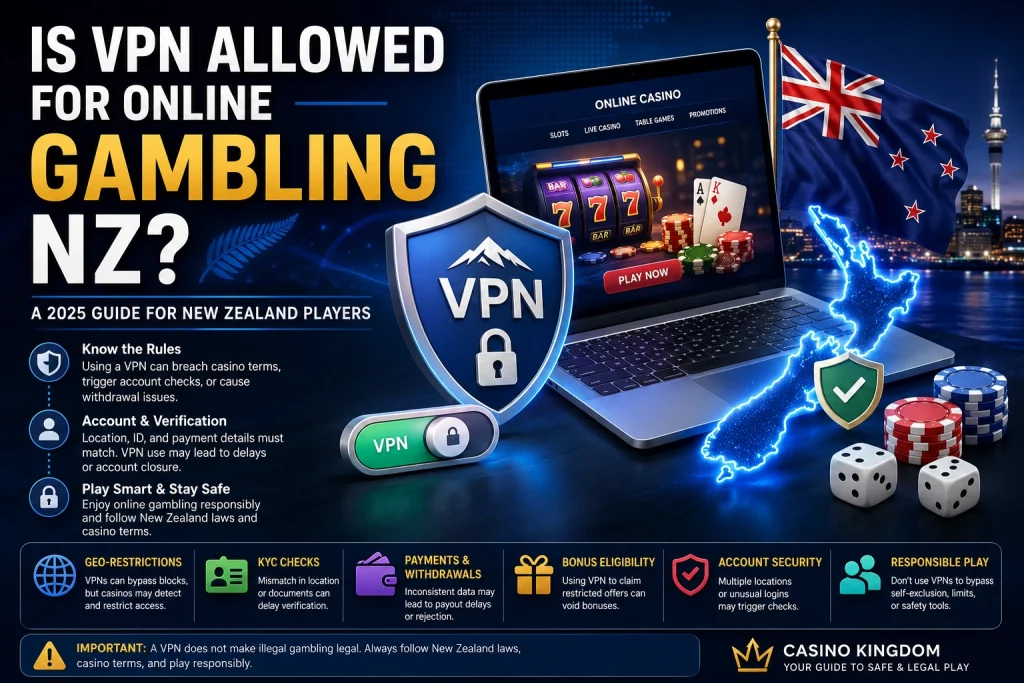
VPN Use Is Not the Same as Legal Permission
Using a VPN is not automatically the same as breaking gambling law. Many people use VPNs for ordinary privacy or cybersecurity reasons. However, in online gambling, the purpose of VPN use matters. If the VPN is used to hide location, access a gambling platform that blocks New Zealand users, evade verification, or bypass platform controls, the situation becomes legally and contractually risky.
The Department of Internal Affairs explains that remote interactive gambling is prohibited under the Gambling Act 2003, with limited exceptions connected to the Lotteries Commission, the Racing Board, and certain sales promotion schemes. This matters because a VPN does not remove the underlying remote-gambling issue. The activity must still be assessed under the correct legal framework.
Online gambling also involves operator rules. A platform may prohibit VPN use in its terms and conditions because it needs to verify jurisdiction, comply with licensing rules, prevent fraud, enforce age controls, and manage restricted territories. Even if a user has no illegal intent, using a VPN may trigger risk systems if the account location, device data, payment details, and identity documents do not match.
This is why a visible Login area or smooth account page does not settle the VPN question. The important issue is whether the operator allows the user, the jurisdiction is accurate, and the platform’s verification rules are being followed.
Why Online Gambling Platforms Restrict VPNs
Online gambling platforms often restrict VPNs because location is part of compliance. Operators may be licensed only in certain markets. They may be required to block users from specific countries. They may need to check whether a user is inside or outside a permitted territory. A VPN can interfere with those checks.
Location controls are not only commercial preferences. They can be connected with gambling law, tax rules, consumer-protection duties, advertising restrictions, anti-money laundering controls, and responsible-gambling systems. If a user appears to be in one country while their documents, payment method, or device history point to another, the operator may treat the account as suspicious.
VPN use can also affect account security. If an account appears to log in from several countries in a short time, the platform may freeze access until the user proves identity. This can delay withdrawals, create verification requests, or lead to a review of account history. In gambling, those reviews can be especially strict because money movement and eligibility are involved.
For a legal-information page, this should be framed clearly: VPN use may be ordinary technology, but VPN use to disguise gambling location creates practical and compliance risk.
Online Casino Regulation and VPN Risk
The new online casino framework in New Zealand makes the VPN issue more important, not less. As online casino gambling moves into a licensing model, operators will need to follow defined rules about who they may serve, how they verify users, how they advertise, and how they manage risk.
This means VPN use may conflict with compliance checks. If a licensed operator must confirm that a user is eligible, it cannot rely only on what the user says. It may need to compare IP address, device data, identity documents, payment details, address records, and account history. A VPN can create inconsistencies between those signals.
The same problem applies to offshore operators. A foreign site may allow or block New Zealand users depending on its own licensing obligations. If the site says New Zealand is restricted, using a VPN to appear elsewhere does not make the user eligible. It simply hides the signal the operator uses to enforce its rules.
New Zealand also restricts advertising overseas gambling. DIA explains that advertising overseas gambling is prohibited under section 16 of the Gambling Act 2003 and defines overseas gambling advertising as communication that publicises or promotes gambling outside New Zealand or is reasonably likely to induce people to gamble outside New Zealand. This is relevant because VPN-focused gambling content can easily cross the line from legal explanation into bypass guidance. A responsible page should explain risk, not tell users how to evade restrictions.
VPN Use in Online Gambling NZ
| VPN use case | What it means | Main risk | Reader takeaway |
| Privacy on public Wi-Fi | A user protects internet traffic while browsing | Lower risk if not used to misrepresent location or eligibility | A VPN itself is not the same as gambling permission |
| Hiding gambling location | A user makes the platform think they are in another country | Account review, blocked access, cancelled withdrawals, terms breach | Location masking can conflict with gambling compliance |
| Bypassing restricted countries | A user tries to access a platform that does not allow their jurisdiction | High risk of account closure and verification failure | VPN access does not create legal eligibility |
| Evading KYC or identity checks | A user uses VPN signals to avoid matching real location and documents | Serious compliance concern and likely account restriction | Gambling platforms usually require accurate identity and location data |
| Accessing blocked gambling content | A user uses VPN routing to view or use content unavailable in their area | May breach operator rules or local restrictions | Availability through VPN does not mean lawful access |
| Consistent VPN use disclosed to platform | A user uses a VPN for security while still providing accurate identity and location | Depends on the operator’s terms and risk systems | Users should rely on platform rules, not assumptions |
VPNs and Account Verification
Account verification is where VPN use often becomes a problem. Online gambling platforms usually check identity, age, address, payment ownership, and sometimes location. If the user’s VPN location does not match their documents, billing data, or payment method, the account may be reviewed.
A platform may request additional documents, proof of address, payment verification, or source-of-funds information. It may also ask why the account was accessed from different locations. This is not unusual in gambling because operators must manage fraud, restricted jurisdictions, underage access, multiple-account abuse, and financial-crime risk.
This is especially relevant around Sign up pages. A simple registration process does not mean verification will remain simple later. Many operators allow account creation first and review identity more carefully before withdrawals. If VPN data creates inconsistencies, the withdrawal stage may become difficult.
For readers, the safest legal interpretation is that gambling accounts should use accurate location and identity information. A VPN should not be used to create a false eligibility picture.
VPNs, Bonuses and Terms Breaches
VPN use can also affect promotional terms. Some gambling offers are limited by country, region, currency, player status, or licence market. If a user appears to be in a permitted location through a VPN but is actually outside it, the operator may treat the offer as invalid.
This can lead to cancelled winnings, voided promotional credits, or account restrictions. The risk is not only legal; it is contractual. Gambling terms often give operators broad power to investigate suspected location masking, duplicate accounts, bonus abuse, or restricted-territory access.
A Bonus section should therefore be read as a terms issue, not only a reward page. If a promotion is available only in certain jurisdictions, VPN use may create a mismatch between what the account appears eligible for and what the user is actually allowed to claim.
For Casino Kingdom readers, the practical takeaway is that VPN-based access can turn a promotion into a dispute. If the platform later identifies location inconsistency, the user may have difficulty proving eligibility.
VPNs and Gambling Apps
VPN use can also interfere with gambling apps. A mobile gambling app may collect signals from IP address, device settings, SIM region, GPS permissions, payment method, and account history. If those signals conflict, the app may block access or trigger verification.
This matters because app-based gambling is often more location-sensitive than ordinary browsing. The platform may need to confirm that the user is in an allowed region every time the app opens. A VPN may hide the IP address, but it may not hide device region, location permissions, or payment-country data.
An App page should therefore not suggest that VPNs are a solution for access problems. If an app is unavailable in a region, that usually reflects operator rules, licensing limits, or platform-store restrictions. Using a VPN to work around those restrictions can create account and compliance risk.
For a legal guide, the correct message is simple: if a gambling app does not allow access from a user’s location, the user should not treat VPN access as confirmation that the service is permitted.
Operator Terms Usually Decide the Practical Outcome
When readers ask whether a VPN is allowed for online gambling in New Zealand, the practical answer often depends on the operator’s terms. Gambling law sets the outer legal framework, but the platform’s own terms decide many day-to-day account outcomes. These terms may prohibit VPNs, proxy servers, location masking, multiple accounts, false registration details, or access from restricted countries.
This is why a player can face consequences even when the VPN itself is not the main legal issue. The operator may treat VPN use as a terms breach if it hides the user’s real location, affects eligibility, triggers fraud controls, or makes it harder to comply with licence duties. In that situation, the platform may suspend the account, request additional documents, reject a promotion, delay a withdrawal, or close the account.
The key point is that online gambling contracts are built around accurate user information. The operator needs to know where the user is located, whether they are eligible, whether the payment method belongs to them, whether they meet age requirements, and whether any legal restrictions apply. A VPN can disrupt those checks.
For Casino Kingdom readers, the safest interpretation is that platform terms should be read before account use, not after a problem appears. If the terms prohibit VPNs or location masking, using one can create account risk even if the user’s intention is only privacy.
Geo-Restrictions and Location Blocking
Geo-restrictions are one of the main reasons gambling platforms monitor VPN use. An operator may block access from certain countries because of licensing limits, legal risk, payment restrictions, sanctions rules, responsible-gambling obligations, or commercial policy. If a user routes traffic through another location to bypass that block, the operator may treat the access as unauthorised.
A geo-block is not just a technical inconvenience. It often reflects the operator’s legal or contractual obligations. If a gambling site does not accept users from New Zealand, a VPN does not change that fact. It only changes how the user appears to the platform. Once the operator reviews documents, payment data, or withdrawal requests, the mismatch can become visible.
Geo-restrictions also matter when a site offers country-specific promotions or product access. Some offers may be available only to users in a particular market. Some games may be blocked in certain territories. Some payment options may be restricted by country. A VPN can make the account look eligible at first, but the platform may later reverse that position.
This is why VPN-based gambling access is unstable. It may work technically at the start, but it can fail at verification, withdrawal, bonus review, or account audit.
KYC Checks and Location Consistency
KYC checks are designed to confirm that the user is who they claim to be. In online gambling, KYC can include identity documents, proof of address, date of birth, payment ownership, source-of-funds information, and sometimes location-related checks. VPN use can create friction when account signals do not match the documents.
For example, a user may register while appearing to be in one country, but their passport, address, phone number, payment card, or bank account may point to another. The platform may then ask for more evidence. If the user cannot explain the mismatch, the account may be frozen or reviewed.
KYC problems often appear at withdrawal stage. A platform may accept deposits and game activity with lighter checks, then apply full verification before releasing funds. This creates a common complaint pattern: access felt easy at the beginning, but the withdrawal became difficult later. VPN use can contribute to that pattern if it made the account appear inconsistent.
For readers, the practical rule is clear: use accurate identity and location information. A gambling account should not be built on a location signal that the user cannot support during verification.
VPNs and Withdrawals
Withdrawals are where VPN use creates the strongest practical risk. If a platform suspects location masking, it may delay the withdrawal while reviewing the account. It may ask for proof of address, identity documents, payment records, bank statements, wallet ownership, or an explanation of login activity.
The operator may also check whether the user accessed games, claimed promotions, or made deposits while appearing to be in a restricted location. If the platform decides that the account breached its terms, it may void bonus winnings, restrict withdrawals, or close the account. The exact outcome depends on the terms and the operator’s licence duties.
This is why VPN use should not be treated as a harmless workaround. It can create a delayed problem. The user may not see the risk during registration or gameplay, but the risk can appear when funds are requested.
A good rule for Casino Kingdom readers is to check withdrawal terms before playing. If the operator prohibits VPNs or requires location consistency, the account should not use VPN routing that conflicts with the user’s real eligibility.
| Account stage | How VPN use can affect it | Possible operator response | Reader takeaway |
| Registration | The user appears to be in a different country from their real address | Account may be flagged for later review | Registration should match real eligibility and location |
| Login activity | Frequent IP changes or unusual countries appear in account history | Security lock, password reset, or identity check | Consistent access patterns reduce account friction |
| Game access | VPN may unlock products blocked for the user’s actual location | Game play may be reviewed or voided if terms are breached | Technical access does not prove product eligibility |
| Promotion use | VPN may make the user appear eligible for restricted offers | Bonus cancellation, winnings review, or account restriction | Promotion eligibility must be based on real location |
| KYC review | Documents and IP location may not match | Extra documents, account hold, or manual investigation | Identity checks can expose location masking |
| Withdrawal request | Operator reviews account history before paying funds | Withdrawal delay, rejected payout, or account closure | VPN risk often appears at the payout stage |
VPN Risk Points in Online Gambling NZ
Offshore Gambling and VPN Confusion
VPN use often appears in discussions about offshore gambling. Some users think a VPN can solve offshore access restrictions by making them appear to be in another country. That view is risky because offshore access, operator permission, and New Zealand legal status are separate questions.
An offshore gambling site may be accessible from New Zealand without being approved under the current New Zealand online casino framework. Another offshore site may block New Zealand users because of its own licence obligations. A VPN may hide the user’s location at first, but it does not change either operator rule or domestic legal context.
This distinction is important for review pages, comparison pages, and legal guides. A page should not frame VPNs as a way to reach offshore gambling products. That kind of framing can cross from explanation into bypass guidance. A stronger legal page explains why VPN access is unreliable and why users should check authorisation instead.
For readers, the useful question is not “can a VPN open the site?” The useful question is “am I allowed to use this service under the operator’s rules and the relevant legal framework?”
VPNs and Payment Method Mismatches
Payment details can also expose VPN inconsistencies. A user may appear to be in one country through a VPN but deposit with a card, bank account, e-wallet, or crypto wallet connected with another region. The operator may treat this as a risk signal.
Traditional payment methods usually carry country indicators. Cards may be issued by a New Zealand bank. Bank transfers may show local account details. E-wallets may have registered addresses. Crypto payments may appear less obvious at first, but platforms can still request ownership proof or source-of-funds information.
If the payment country, account address, and IP location do not align, the operator may conduct a manual review. This is especially likely before withdrawals. The platform needs to know that the user is eligible, the payment method is legitimate, and the account has not breached location rules.
This is another reason why VPN use can create a delayed problem. The user may deposit successfully, but payout review may reveal inconsistencies that were not checked earlier.
VPNs and Responsible Gambling Tools
VPN use can also interfere with responsible-gambling controls. Some tools depend on accurate account identity, jurisdiction, or platform access. If a user is self-excluded, restricted, or blocked in one setting, using a VPN to access another route may undermine the safeguard.
This is one of the most serious concerns. A VPN should not be used to bypass self-exclusion, cooling-off periods, account restrictions, or blocked access. Those controls exist to reduce harm. Avoiding them can increase financial and behavioural risk.
A strong operator should detect unusual access signals and apply protective checks where needed. However, users should not rely on platform detection alone. If a person has set limits or exclusions, the responsible action is to respect those controls.
For Casino Kingdom readers, this point should be explicit: VPNs should not be used to avoid safer-gambling restrictions. The purpose of those restrictions is protection, not inconvenience.
Online Casino Licensing and VPN Use
Online casino licensing is central to the VPN question. A licensed operator must know where it may legally provide services, which users it may accept, which products it may offer, and what safeguards it must apply. A VPN can interfere with these checks because it changes the location signal the platform receives.
In New Zealand, the online casino framework is moving into a regulated licensing model. That means operators will increasingly need to show that they can control access, apply identity checks, monitor accounts, follow advertising rules, and prevent restricted participation. VPN use can create friction with all of those duties.
A user may think a VPN only affects browsing, but a gambling platform reads more than the visible IP address. It may compare IP history, device fingerprints, payment country, registered address, document data, login timing, and account behaviour. If those signals conflict, the platform may treat the account as high risk.
For Casino Kingdom readers, the most important point is that a VPN does not override licence boundaries. If an operator is not allowed to serve a certain user or market, the user’s VPN location does not create permission.
Advertising Limits and VPN-Focused Content
Advertising limits are especially important when discussing VPNs and gambling. A legal-information page can explain why VPN use is risky, how it affects account verification, and why users should not rely on location masking. But content should not present VPNs as a method to access blocked gambling sites.
This distinction matters because New Zealand law restricts advertising overseas gambling. Content that says “use a VPN to access restricted casinos” can create a different legal and ethical problem from content that explains “VPN use may breach platform terms and lead to account review.” The first points users toward bypassing rules. The second explains the risk.
For a New Zealand gambling-law page, the safest editorial structure is educational. The page should define the issue, explain operator rules, describe risk points, and warn readers that technical access does not prove eligibility. It should avoid step-by-step bypass language, VPN provider recommendations, or country-routing suggestions.
This also applies to internal site wording. A legal page can mention FAQ or support sections as places where users may look for platform rules, but it should not direct readers toward methods for avoiding restrictions.
Account Security and VPN Signals
VPNs can trigger security systems because they make account access patterns look unusual. A player may normally log in from New Zealand, then suddenly appear to connect from Europe, Asia, or North America. The platform may interpret that pattern as account takeover risk, especially if it happens before a withdrawal request.
Security systems may respond by freezing access, requiring password reset, requesting two-factor authentication, asking for identity documents, or blocking the session. These actions may feel inconvenient, but they are often designed to protect the account and the operator from fraud.
The problem is stronger when a user switches VPN regions often. Frequent location changes can create an account history that looks inconsistent. If the platform later reviews the account, it may ask why the same user appeared to gamble from several countries within a short period.
For readers, the practical point is that VPN use can create the same signals as suspicious activity. Even when the user does not intend fraud, the platform may still investigate because the data pattern looks abnormal.
App-Based Geolocation and VPN Limits
Mobile gambling apps can be harder to mask than websites because they may rely on several signals at once. A VPN changes IP address, but it may not change GPS permissions, device region, SIM country, app-store region, payment country, or identity documents. If the app compares these signals, VPN use may not work or may trigger account review.
This is especially relevant for users who assume a VPN can “unlock” an app. If an app is unavailable in a region, blocked in an app store, or limited by operator policy, that restriction may reflect licensing or compliance rules. Using a VPN to get around that restriction does not create legal access.
Some apps may also detect VPNs directly. Others may block proxy traffic, reject known data-centre IP addresses, or require location permission during play. If the app cannot verify location, it may prevent the user from accessing the account or specific products.
For Casino Kingdom readers, the correct conclusion is that mobile access should be based on eligibility, not workaround methods. A stable and compliant account should use accurate information across device, payment, and identity records.
Game Restrictions and Product Access
Online gambling platforms may restrict specific games by country or licence market. A user might access the main website, but certain products may still be unavailable. This can happen because game providers, licence terms, local law, or operator policy limit product access.
VPN use can create problems when it appears to unlock restricted games. If a user plays a game that should not have been available in their actual location, the operator may later review the activity. This can affect winnings, bonus progress, or account status.
This is important for pages discussing Slots or other casino-style products. A game appearing on a platform does not mean it is available to every user in every jurisdiction. Product scope depends on licence conditions, provider rules, and regional restrictions.
Readers should not use VPN access as evidence that a game is permitted. If a game is blocked without a VPN, the safer reading is that the operator has a reason for blocking it.
VPN Problems by Platform Area
| Platform area | How VPN use can interfere | Possible result | Reader takeaway |
| Licence market | The user appears to be in a market the operator can serve, while real location differs | Account restriction or service denial after review | Licence boundaries depend on real eligibility, not VPN location |
| Advertising eligibility | The user sees offers or content meant for another country | Promotion may be invalid or later cancelled | Country-specific offers should match actual location |
| Account security | Multiple countries appear in login history | Security lock, extra verification, password reset, or account freeze | VPN patterns can look like suspicious account activity |
| Mobile app | IP address conflicts with GPS, SIM region, app-store country, or payment data | App access blocked or verification requested | A VPN may not override app-based geolocation checks |
| Game library | Restricted games appear available through another IP region | Game activity may be reviewed or winnings questioned | Technical visibility does not prove product permission |
| Support and complaints | The user’s account history shows inconsistent access locations | Dispute becomes harder to resolve | Accurate records support stronger complaint handling |
VPNs and Game Provider Rules
Game providers can also influence access restrictions. Some providers license their products only for certain territories. Others require operators to block games in restricted markets. This means the casino operator may not have full freedom to offer every product to every user.
A VPN can interfere with those provider restrictions. The platform may initially show a game because the user appears to be in an allowed location, but later checks may show that the real user location does not match. This can create disputes around completed play, bonus wagering, or withdrawals.
This matters because users often think only the casino’s terms apply. In reality, online gambling products may involve multiple layers: operator licence, game provider rules, payment rules, local law, and platform terms. A VPN can create conflicts across all of them.
For Casino Kingdom readers, the useful habit is to check availability through the account without masking location. If a product is not available under real account conditions, VPN access should not be treated as a reliable route.
VPNs and Customer Support Problems
VPN use can make support cases more difficult. If a user asks why a withdrawal is delayed, support may review the account and see inconsistent location records. If a user reports missing game access, support may identify a region mismatch. If a user disputes a bonus cancellation, the platform may point to VPN-related eligibility issues.
This can shift the burden onto the user. The user may need to explain why their IP address changed, why they appeared to access the platform from different countries, or why their documents do not match the country shown in account logs. Even if the user used a VPN only for privacy, the explanation may still delay resolution.
The strongest account position is consistent evidence: real address, verified documents, matching payment method, stable login history, and compliance with platform terms. VPN use can weaken that evidence if it creates unexplained inconsistencies.
For readers, the point is not only whether VPN use is detected. The point is what happens when a dispute appears and the platform reviews the full account history.
VPNs and Responsible Gambling Blocks
Responsible gambling blocks are not technical obstacles to bypass. They are protective tools. If a user has self-excluded, set a time-out, reached a limit, or been blocked for safety reasons, a VPN should not be used to work around that control.
Online gambling platforms may use identity, device, payment, and location data to enforce responsible-gambling restrictions. VPN use can interfere with those protections if the user tries to open a new account, access a different regional site, or avoid detection.
This is one of the strongest reasons legal pages should avoid bypass instructions. A person seeking a VPN workaround may not only be trying to access a restricted market; they may also be trying to bypass a safety control. Content should not support that behaviour.
For Casino Kingdom readers, the guidance should be direct: if a gambling restriction exists for safety reasons, respect it. Do not use VPNs, new accounts, or location masking to evade limits or exclusions.
Practical Wording for Legal Pages
A legal page about VPNs should use careful wording. It should say that VPNs can be used for general online privacy, but location masking in gambling can breach platform terms, trigger verification, block withdrawals, or conflict with legal controls. It should not suggest VPNs as a way to open restricted sites or access blocked games.
The page should also make clear that the right answer is found in three places: New Zealand law, the operator’s licence scope, and the operator’s terms. If all three do not support access, a VPN does not solve the problem.
For a site like Casino Kingdom, this approach keeps the content useful. It helps readers understand risk without giving bypass instructions. It also supports a clearer distinction between legal guidance and gambling promotion.
The Short Answer for New Zealand Readers
A VPN is not automatically illegal, but using a VPN for online gambling in New Zealand can create serious legal, contractual, verification, payment, and account-risk issues. The key question is not only whether the VPN works technically. The stronger question is whether the user is eligible under New Zealand law, the operator’s licence, and the platform’s terms.
A VPN does not make a restricted gambling platform available lawfully. It does not turn an offshore operator into a New Zealand-authorised operator. It does not remove age checks, KYC duties, payment controls, responsible-gambling restrictions, or withdrawal-review rules. If a site blocks New Zealand users or restricts certain games, using a VPN to bypass that block can create account consequences.
For Casino Kingdom readers, the most practical answer is this: VPNs may be ordinary privacy tools, but they should not be used to disguise location, bypass geo-restrictions, avoid verification, access blocked products, claim location-restricted offers, or work around responsible-gambling controls.
VPN Gambling Risk Checklist NZ
Final VPN Checklist for Online Gambling NZ
A reader should begin with the operator’s terms. If the terms prohibit VPNs, proxies, location masking, or restricted-territory access, the answer is already clear at account level. Using a VPN may breach the contract even before any legal question becomes relevant.
The second check is jurisdiction. Does the platform allow New Zealand users? Is the operator covered by the current New Zealand online casino framework where required? Does the platform clearly explain who may use the service? If the answer is unclear, a VPN should not be used to create access.
The third check is account consistency. The user’s IP location, address, identity documents, payment method, device profile, and account history should not contradict each other. If they do, the operator may request additional verification or place the account under review.
The fourth check is withdrawal risk. If funds are already inside the account, VPN-related inconsistencies can become more serious. A platform may review the full account history before paying out. If the user accessed restricted products or claimed restricted offers, the withdrawal may be delayed or disputed.
| Checklist area | Question to ask | Why it matters | Risk sign |
| Operator terms | Does the platform allow VPN, proxy, or location-masking use? | Terms can decide account consequences | The terms prohibit VPNs or say access must reflect real location |
| Jurisdiction | Does the operator allow users from New Zealand? | VPN access does not create legal eligibility | The platform blocks New Zealand or does not mention NZ status clearly |
| Licence scope | Does the operator’s licence cover the user and product? | Licence boundaries matter in online gambling | The site uses vague “licensed” language without details |
| Account data | Do IP, documents, address, device, and payment data match? | Inconsistent signals can trigger manual review | The account appears to move between countries without explanation |
| KYC checks | Can the user verify the location and identity used on the account? | Withdrawals often require stronger verification | The user registered through a location they cannot support with documents |
| Promotion eligibility | Was any offer claimed through a VPN location? | Country-restricted offers may be voided | The offer is available only to users in another region |
| Game access | Were any games accessed only because the VPN changed location? | Product access may depend on licence and provider restrictions | The game disappears when VPN is turned off |
| Responsible gambling | Is the VPN being used to bypass limits, blocks, or exclusion? | Safety controls should not be avoided | The user is trying to access gambling after restriction or self-exclusion |
VPNs, Withdrawals and Account Closure
The highest-risk moment is usually withdrawal. Operators often review accounts more closely before releasing funds. This is when they may compare registration data, identity documents, payment ownership, IP history, device records, bonus use, and game access. If a VPN created location inconsistencies, the issue may appear only after the user requests payment.
Possible outcomes include additional KYC, delayed payment, cancelled promotion winnings, restricted product winnings, account suspension, or account closure. The result depends on the operator’s terms, licence duties, product rules, and the seriousness of the inconsistency.
This is why VPN access can be misleading. A user may think the platform allows them because the site opened, the account was created, or the deposit was accepted. But gambling operators often apply the strictest review later. Technical access at the beginning does not guarantee payout eligibility at the end.
A reliable account should be built on accurate information. If the platform does not accept a user’s real location, a VPN should not be treated as a solution.
VPNs and Offshore Casino Claims
Offshore casino claims require extra caution. Some offshore sites may not clearly explain whether New Zealand users are accepted. Others may allow browsing but restrict play. Some may accept deposits but later apply location rules at withdrawal. A VPN can make all of these issues harder to see at the start.
The most important distinction is access versus authorisation. A VPN may create access. It does not create authorisation. It does not change the operator’s licence. It does not change New Zealand law. It does not change the user’s identity, payment country, address, or eligibility.
This is also why a legal page should avoid VPN recommendations. Recommending routes, countries, or VPN setups for gambling access would turn the page into bypass guidance. The better approach is to explain why bypassing restrictions can create account and compliance risk.
For Casino Kingdom readers, the practical rule is simple: if an operator is not available under the user’s real location and account details, VPN access should not be trusted.
VPNs and Responsible Gambling
Responsible gambling restrictions should be treated as firm safeguards. If a person has self-excluded, reached a limit, requested a time-out, or been blocked for safety reasons, using a VPN to access another route undermines the purpose of those controls.
A VPN can also interfere with platform monitoring. If a user appears to access gambling from different countries or accounts, the platform may not apply the same protective signals correctly. That can increase harm risk.
A legal guide should state this plainly: a VPN should not be used to bypass self-exclusion, account closure, deposit limits, time-outs, regional safety blocks, or other responsible-gambling measures. These controls exist to protect the user and should be respected.
If gambling feels difficult to control, the answer is not a VPN workaround. The answer is to stop, use available blocking tools, and contact a recognised support service in New Zealand.
Practical Summary for Casino Kingdom Readers
VPNs can be used for general online privacy, but online gambling creates a different risk environment. A gambling platform must verify who the user is, where they are located, whether they are eligible, whether the product is permitted, whether payments are legitimate, and whether responsible-gambling controls apply.
Using a VPN to change location can interfere with all of those checks. It can make registration look valid when it is not. It can make restricted games appear available. It can make a promotion look claimable when it is not. It can trigger security alerts. It can delay withdrawals. It can weaken a complaint if the account history shows inconsistent access.
The safest position is to use accurate information and follow the operator’s rules. If the platform does not allow New Zealand users, does not allow VPNs, or does not clearly explain its legal status, the user should not rely on technical access.
Final Answer: Is VPN Allowed for Online Gambling NZ?
A VPN may be legal as a general privacy tool, but using it for online gambling in New Zealand can be unsafe when it hides location, bypasses geo-restrictions, avoids verification, accesses blocked games, claims restricted offers, or works around responsible-gambling tools.
The final answer is practical rather than absolute: check New Zealand law, the operator’s licence, and the platform’s terms. If the operator allows VPN use for privacy while still requiring accurate identity and location data, the risk may be lower. If the VPN is used to bypass restrictions, the risk is high.
For Casino Kingdom readers, the best rule is this: do not use a VPN to make a gambling platform think you are somewhere else. In online gambling, accurate location and identity matter because they support licensing, withdrawals, payment checks, account security, and player protection.






Comments