Can NZ Players Play Offshore Casinos Legally?
The question “Can NZ players play offshore casinos legally?” needs a careful answer because New Zealand’s online gambling rules have traditionally separated two issues: where the gambling operator is based and where the player is located. In simple terms, New Zealand has historically restricted online casino operators from running remote interactive casino gambling from inside New Zealand, while New Zealanders have been able to access casino gambling websites operated overseas. The Department of Internal Affairs states this directly: it is legal for New Zealanders to gamble on offshore casino gambling websites, while online casinos based in New Zealand are illegal.
That does not mean every offshore casino is safe, locally approved, or protected by New Zealand law. This distinction is the most important part of the whole topic. “Offshore” means the operator is based outside New Zealand and usually licensed, managed, or regulated under another jurisdiction. A New Zealand player may be able to access such a website, but that access is not the same as using a casino licensed under a New Zealand domestic online casino framework. Legal access and local regulatory protection are different things.
For Casino Kingdom readers, the safest explanation is this: NZ players have not generally been treated as committing an offence simply because they access an offshore casino website, but the offshore operator may not be supervised by New Zealand authorities. If a dispute happens, such as a delayed withdrawal, unclear terms, blocked account, or verification issue, the complaint route may depend on the foreign operator, its overseas licence, and its own internal procedures. That is why this page should not present offshore access as a recommendation. It should explain the law, the limits, and the risk.
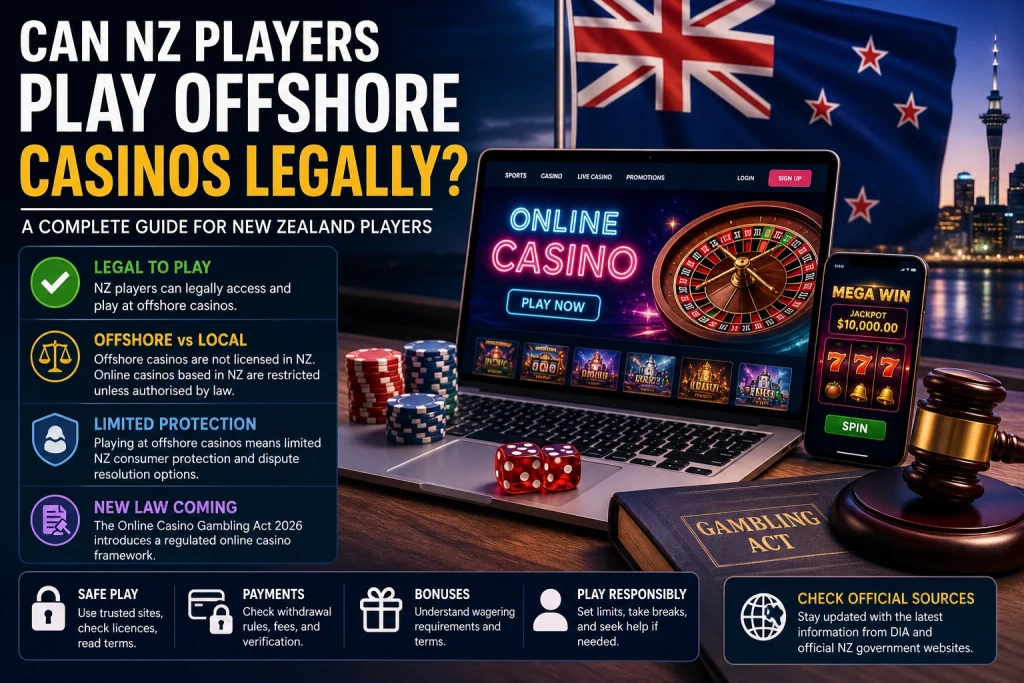
New Zealand’s legal environment is also changing. DIA now explains that online casino gambling is regulated by the Online Casino Gambling Act 2026, and that implementation of the new law has started to create a safe, fair, and well-controlled online gambling environment for New Zealanders. This means older explanations about offshore casinos may be incomplete if they do not mention the new regulatory direction. A modern article must explain both the older offshore-access position and the new licensing framework being introduced.
| Question | Careful NZ-Focused Answer | What It Means for Readers |
|---|---|---|
| Can NZ players access offshore casino websites? | Official DIA guidance states that New Zealanders can legally gamble on offshore casino gambling websites. | Access is possible, but it should not be confused with local NZ licensing. |
| Can online casinos operate from New Zealand? | Online casinos based in New Zealand have historically been illegal unless they fit a lawful framework. | A domestic online casino operator cannot simply offer casino games without legal authorisation. |
| Does offshore access mean the casino is safe? | No. Offshore access does not automatically provide NZ consumer protection. | Disputes may depend on foreign rules, foreign licensing, and the operator’s own policies. |
| Is the NZ framework changing? | Yes. The Online Casino Gambling Act 2026 introduces a regulated online casino framework. | Readers should check current official information rather than relying on older summaries. |
| Should casino marketing be treated as legal proof? | No. Marketing claims are not the same as official legal status. | Readers should separate promotional wording from verified regulation. |
Why Offshore Casinos Are Treated Differently from NZ-Based Operators
The offshore casino question exists because the internet allows players to reach gambling websites across borders. A casino website may be hosted, licensed, and managed outside New Zealand, while still being visible to New Zealand users. That creates a different situation from a company physically operating an online casino business from inside New Zealand. New Zealand law has traditionally focused strongly on controlling domestic gambling supply and remote interactive gambling activity within the country.
This is why the phrase “offshore casino” matters. It does not simply mean “online casino.” It means the operator sits outside the domestic New Zealand framework. The casino may hold a foreign licence, use overseas payment systems, apply its own account rules, and follow another country’s regulatory model. Some foreign jurisdictions have stronger standards than others, so readers should not assume that all offshore platforms are equal.
The legal position can therefore look permissive from the player’s side but weaker from the protection side. If a New Zealand player accesses an overseas casino website, the question is not only “Can this be accessed?” The better question is “Who regulates this operator, and what happens if something goes wrong?” That second question is where offshore gambling becomes more complicated.
For a legal guide, this distinction should be repeated clearly. Offshore access may be legal for New Zealanders, but offshore access does not mean the operator is licensed by New Zealand. It does not mean New Zealand authorities approve every site visible online. It does not mean that a foreign casino’s advertising claims are reliable. It does not mean that the user has the same complaint route they might expect from a locally regulated service.
The Short Answer and the More Useful Answer
The short answer is that New Zealanders can legally gamble on offshore casino gambling websites, according to the current DIA wording. However, the more useful answer is that legal access is only one part of the issue. Offshore casino gambling may involve limited local protection, unclear dispute routes, foreign licensing standards, and terms that are not shaped by New Zealand’s domestic consumer expectations.
That is why Casino Kingdom should frame this page as a legal and safety explanation rather than a gambling encouragement page. Readers searching this topic are usually trying to understand what the law allows, whether offshore access is risky, and how the new NZ framework changes the picture. A strong page should answer those questions directly without making offshore casinos sound risk-free.
The difference between “legal” and “regulated” is central. A person may be legally allowed to access an offshore website, but the operator may still be outside New Zealand’s direct regulatory control. In practice, that can affect identity checks, payments, bonus terms, customer support, privacy, responsible gambling tools, and dispute resolution. A legal article should not hide these limits.
This is also the right place to place internal navigation carefully. A Login page can explain account access and security expectations. A Bonus page should explain promotional restrictions rather than only headline offers. A Sign up page should describe registration and verification in a neutral way. An App page can discuss mobile access and privacy. Slots and Games pages should remain informational. A FAQ page can answer legal questions directly, while Links can point readers toward official guidance and safer gambling resources.
Legal Access vs Local Protection
Why the 2026 Law Changes the Context
The Online Casino Gambling Act 2026 matters because it changes the long-term direction of New Zealand’s online casino market. Instead of leaving online casino gambling mainly in an offshore environment, the new framework is intended to bring parts of the market into a regulated structure. DIA describes the goal as a safe, fair, and well-controlled online gambling environment for New Zealanders.
This does not mean that every offshore website instantly becomes approved. It also does not mean that older risks disappear overnight. Implementation matters. Licensing applications, compliance rules, advertising controls, enforcement powers, and responsible gambling obligations all need to operate in practice before readers can clearly identify which operators are authorised under the new system.
For users, the transition period can be confusing. Older content may say offshore casinos are the only practical option. Newer content may discuss the incoming regulated market. Casino websites may adjust their wording quickly to sound compliant. Because of that, readers should treat official sources as more reliable than promotional claims from casino operators or affiliate websites.
Offshore Casino Risks, Foreign Licences, and NZ Consumer Protection
The legal answer to offshore casino access is only the first layer. The second layer is protection. For New Zealand players, the main issue is not simply whether an offshore casino website can be reached. The more important question is what protection applies if something goes wrong. Offshore operators may be licensed in another country, use foreign complaint systems, apply their own terms, and process payments through international providers. That creates a different risk profile from a casino regulated directly under a New Zealand framework.
A foreign licence can be useful, but it should not be treated as identical to New Zealand regulation. Some offshore regulators require game testing, anti-money-laundering controls, responsible gambling tools, and complaint procedures. Others may apply weaker standards or provide limited practical help to overseas users. This means the phrase “licensed casino” needs detail. Licensed where? By whom? Under what conditions? With what enforcement powers? A serious legal guide should ask those questions before describing an offshore operator as trustworthy.
For Casino Kingdom readers, this matters because casino websites often use regulatory language in a broad way. A site may display a licence logo, a security badge, a responsible gambling icon, and payment symbols, but those visual elements do not automatically prove strong protection. The reader needs to understand whether the licence is current, whether the regulator is credible, whether the operator name matches the licence, and whether complaint routes are realistic for someone based in New Zealand.
Offshore casinos also create practical issues around identity checks and withdrawals. A platform may allow quick registration, but later require identity documents before releasing funds. This is not always suspicious because verification can be part of anti-fraud and anti-money-laundering procedures. The problem appears when the rules are unclear, applied inconsistently, or used only after a player requests a withdrawal. That is why payment and verification terms should be read before any account activity, not after a dispute begins.
| Risk Area | How It Appears at Offshore Casinos | Why NZ Players Should Notice It |
|---|---|---|
| Foreign licence | The casino may be licensed outside New Zealand. | The licence may not provide the same complaint route or enforcement as NZ regulation. |
| Withdrawal checks | Identity verification may happen before payouts are approved. | Delays can occur if document rules are unclear or inconsistently applied. |
| Bonus restrictions | Wagering rules, max bet limits, expiry dates, and game weighting may apply. | Promotional value can be much lower than the headline offer suggests. |
| Complaint handling | Disputes may go through the operator or a foreign regulator. | New Zealand-based support options may be limited. |
| Responsible gambling tools | Limits and self-exclusion may vary by operator. | Player protection may depend on the site’s own standards rather than NZ enforcement. |
Foreign Licensing Is Not the Same as New Zealand Approval
A common mistake is assuming that any licence equals complete safety. Licensing is important, but it only has value when it can be checked and enforced. A proper licence should show the operator’s legal name, the licensing authority, the licence number or registration details, and the permitted gambling activities. If a casino only displays vague language like “fully licensed” without verifiable details, readers should treat that claim carefully.
For NZ players, the strongest licence signal in the future will be whether the operator is authorised under New Zealand’s own regulated framework. Until then, many offshore websites will continue to rely on foreign licences. That can still provide some structure, but it is not local approval. The regulator may be in another jurisdiction, the complaint process may be unfamiliar, and enforcement may not be designed around New Zealand consumer expectations.
This is especially important when a casino uses New Zealand-facing wording. A website might mention NZD payments, Kiwi players, local banking convenience, or New Zealand-friendly service. Those statements can make the operator feel local, but they do not prove local regulation. Marketing localisation is not the same as legal authorisation. A site can target a market commercially while still operating from outside that market’s regulatory system.
A careful page should therefore teach readers to separate “accepts NZ players” from “licensed in New Zealand.” These phrases are not interchangeable. Accepting users describes access. Licensing describes legal authority. Consumer protection describes what happens if the user has a problem. All three points need to be checked separately.
Payment and Withdrawal Issues at Offshore Casinos
Payments are one of the most practical areas where offshore status matters. Deposits are often simple because operators want account funding to be convenient. Withdrawals are usually more controlled because they may involve identity checks, anti-money-laundering review, payment method matching, bonus-term review, and internal fraud monitoring. A player who only looks at deposit speed may misunderstand the real payment experience.
Offshore casinos may also use international payment processors. This can introduce currency conversion, bank restrictions, e-wallet limits, transaction reviews, and extra processing times. Even when a casino advertises fast withdrawals, the actual result may depend on the payment method, verification status, bonus history, account activity, and operator policy. That is why withdrawal terms should be considered more important than deposit claims.
Another issue is document verification. A casino may ask for proof of identity, proof of address, payment method confirmation, or source-of-funds information. These checks can be legitimate under compliance rules. However, a responsible operator should explain them clearly before a user reaches the withdrawal stage. If verification requirements are hidden, vague, or introduced only after a payout request, the user may face unexpected friction.
For legal content, the right message is not that every offshore payment process is unsafe. The better message is that offshore payment protection may be harder to enforce from New Zealand. If a payment dispute appears, the user may need to rely on the casino’s support team, a foreign regulator, or the payment provider’s rules. This makes transparency essential.
Bonus Terms Can Change the Real Value of Offshore Casino Offers
Bonus offers are one of the main ways offshore casinos attract attention. The headline number may look strong, but the real value depends on the terms. Wagering requirements, minimum deposit rules, maximum bet limits, game contribution percentages, withdrawal caps, expiry dates, excluded games, and account verification can all change the outcome. A bonus that looks large on the surface may be restrictive in practice.
This matters legally because bonus advertising can easily become misleading if conditions are not visible. A responsible page should not repeat bonus claims without explaining that terms control the result. Readers should understand that a promotion is not simply “free money.” It is usually a conditional offer with rules that affect whether winnings can be withdrawn.
Offshore casinos may apply bonus rules under foreign standards. That means the presentation of terms, complaint handling, and interpretation of disputed clauses may not match what a New Zealand reader expects. If a casino cancels winnings because of a maximum-bet rule or excluded-game condition, the dispute may depend on the operator’s written terms. If those terms are unclear, the player may have limited local recourse.
A careful Casino Kingdom page should therefore treat bonuses as risk areas, not only as features. The article can explain how bonus terms work, but it should not make promotions sound guaranteed or risk-free. In a legal guide, bonus discussion should always sit inside a broader consumer-protection framework.
Responsible Gambling Tools at Offshore Casinos
Responsible gambling tools are a central part of safety, especially online. Casino websites can be accessed privately and quickly, often from mobile devices. That convenience can increase risk for some users, particularly where there are no strong local controls. Offshore operators may offer deposit limits, time-outs, self-exclusion, reality checks, or account closures, but the strength of those tools can vary.
A reliable operator should make these tools easy to find and easy to activate. Limits should not be buried inside account menus. Self-exclusion should not require repeated persuasion. Support information should be visible before a user is in difficulty. A responsible gambling page should explain real options, not only provide generic slogans.
For NZ readers, this point matters because harm minimisation is a major part of gambling regulation. A casino that offers weak or unclear protection tools may create higher risk even if it has a foreign licence. Responsible gambling is not just a social message. It is part of how a gambling product should be controlled.
A legal article should also avoid language that frames gambling as a way to make money. Offshore casino games are chance-based entertainment products with financial risk. Even regulated games have house edge. No licence or payment method changes that basic structure. Readers should understand that legal access does not make gambling financially safe.
Data Privacy and Account Security
Offshore casino use can also involve privacy questions. Registration may require personal details, identity documents, payment information, device data, and account history. If the operator is outside New Zealand, the data may be processed under foreign privacy laws. This does not automatically mean the data is unsafe, but it does mean the user should read privacy terms carefully.
A secure casino should explain how it protects data, who processes information, why documents are collected, how long records are kept, and when information may be shared with regulators, payment providers, or fraud-prevention services. Vague privacy wording is a warning sign. A legal page should make clear that privacy protection is part of the risk assessment.
Account security also matters. Two-factor authentication, strong password rules, session controls, encrypted payments, and clear login alerts can reduce account risk. If a casino does not provide basic account-security options, users may have weaker protection against unauthorised access. In offshore contexts, recovering an account or challenging suspicious activity may be harder.
For Casino Kingdom, this section adds depth because many legal pages focus only on gambling law and ignore data protection. Offshore casino legality is not only about whether the website can be used. It is also about what happens to personal information, identity documents, and payment records after registration.
Practical Risk Interpretation for NZ Players
The practical interpretation is that NZ players may legally access offshore casino websites, but that legal access comes with important limitations. The biggest limitation is local protection. If a website is not licensed or supervised under a New Zealand framework, then key issues may be handled outside New Zealand. This can affect payments, complaints, data handling, responsible gambling tools, and the interpretation of bonus rules.
Readers should avoid assuming that a foreign licence automatically solves everything. A licence is stronger when it is verifiable, linked to the correct company, current, and backed by a regulator with real enforcement power. A licence is weaker when it appears only as a logo, a vague phrase, or a footer claim without detail.
The same logic applies to payment and bonus claims. Fast deposits, large offers, and wide game libraries may be attractive on a commercial level, but they do not answer the legal and consumer-protection questions. The safer approach is to look at the operator’s structure first, then the features second.
Advertising Rules, Tax Questions, and the New NZ Licensing Framework
The next important issue is advertising. Offshore casino access and offshore casino promotion are not the same thing. A New Zealand reader may legally access an offshore online casino website under current DIA guidance, but that does not mean offshore casino websites can be freely advertised in New Zealand. DIA’s online gambling FAQ explains that offshore online casino gambling has been unregulated and unlicensed in New Zealand, and that advertising offshore casino gambling in New Zealand has been illegal under section 16 of the Gambling Act. It also explains that the new system will make it illegal for unlicensed operators to operate or advertise in New Zealand once the regulatory system is implemented.
This distinction matters for Casino Kingdom because the page should not read like direct advertising for offshore casinos. A legal article can explain the law, risks, and regulatory transition, but it should avoid presenting offshore websites as if they are recommended, approved, or risk-free. The safest editorial approach is to keep the page educational: explain what offshore access means, what local protection may be missing, how the 2026 framework changes the market, and why readers should check official updates before trusting casino claims.
The tax question is also separate from the access question. Some offshore casino operators may have tax-related obligations in New Zealand, but that does not mean DIA can direct users toward those operators before the licensing system is fully operating. DIA’s FAQ notes that some offshore operators may be registered for GST and must pay gambling duty to Inland Revenue, but online casino gambling had been unregulated and unlicensed in New Zealand, so DIA did not hold a public list to channel players toward specific websites.
For readers, the practical meaning is simple: tax registration, offshore access, and gambling safety are different categories. An operator paying a duty or tax does not automatically mean it is locally licensed as an online casino. A website accepting New Zealand users does not automatically mean it is approved by New Zealand regulators. A foreign licence does not automatically mean the same consumer protection applies as it would under a domestic NZ framework.
| Topic | How It Applies to Offshore Casinos | Why It Matters for NZ Readers |
|---|---|---|
| Access | NZ players may access offshore online casino websites under current official wording. | Access should not be confused with local approval or local supervision. |
| Advertising | Advertising offshore online casino gambling in New Zealand has been restricted. | Promotional claims should be treated carefully, especially if they sound like legal approval. |
| Tax and duty | Some offshore operators may have GST or gambling-duty obligations. | Tax registration does not automatically prove player protection or NZ licensing. |
| Licensing transition | The Online Casino Gambling Act 2026 creates a regulated online casino framework. | Readers should distinguish the old offshore model from the incoming licensed system. |
| Consumer safety | Unlicensed offshore websites may offer limited local complaint routes. | Payment, privacy, dispute, and harm-minimisation risks remain important. |
Why Advertising Rules Are Central to Offshore Casino Law
Advertising is one of the most sensitive areas in online gambling law because it shapes user behaviour. A legal explanation is different from a promotional message. A neutral article can say that offshore access exists and explain the risks. A promotional page, by contrast, may push users toward specific gambling services, highlight bonuses, or make access sound simple and harmless. That difference is important in New Zealand because offshore online casino advertising has been restricted.
For Casino Kingdom, this means the wording should be careful. Phrases such as “best offshore casino for NZ players,” “safe guaranteed offshore casino,” or “approved NZ offshore casino” can be problematic if they are not supported by current licensing evidence. A stronger legal page uses more precise language: “offshore casino access,” “foreign-licensed operator,” “not locally licensed,” “regulatory transition,” and “limited local protection.” Those phrases are more accurate and less likely to mislead.
Advertising rules also matter because the new framework is being phased in. DIA explains that the Online Casino Gambling Act will create a safer and fairer online casino gambling market and that implementation is not expected to be fully operational until 2027. This means there is a transition period where readers may see old offshore content, new licensing updates, and casino marketing claims at the same time.
During this transition, legal content should avoid absolute claims. It should not imply that every offshore casino is now regulated by New Zealand. It should not imply that offshore gambling has become risk-free. It should not imply that a foreign licence is the same as a New Zealand licence. Instead, it should explain that New Zealand is building a system where licensed operators will have clearer obligations and unlicensed operators will face stronger restrictions.
The New Zealand Licensing Framework and What It Is Designed to Change
The Online Casino Gambling Act 2026 is important because it creates a new legal route for regulating online casino gambling. DIA states that the Act is designed to create a safer and fairer online casino gambling market. It also notes that many New Zealanders already use overseas gambling websites and that regulation is intended to protect consumers, reduce gambling harm, prevent crime and dishonesty, and ensure operators serving customers in New Zealand follow clear rules.
This is a major shift from the older offshore-access environment. Previously, many NZ users encountered overseas casino websites without those websites being licensed by New Zealand. Under the new direction, the goal is to create a defined structure where approved operators must meet regulatory requirements. That should make it easier to separate licensed operators from unlicensed operators once the system is fully operational.
However, the word “licensed” should still be used carefully. Until licences are actually awarded and public verification routes are available, readers should not assume that every operator claiming to serve New Zealand is authorised. The correct question is not only “Does this casino accept NZ players?” The better question is “Is this operator licensed under the applicable New Zealand framework, and can that licence be verified?”
The new system should also affect advertising. Once the licensing framework is operating, unlicensed operators should not be able to operate or advertise in New Zealand. This matters because a regulated market depends not only on licensing approved operators, but also on controlling the behaviour of unlicensed ones. If unlicensed offshore operators can still promote themselves freely, the consumer-protection value of the framework becomes weaker.
Tax, Offshore Duty, and Why It Does Not Prove Safety
Tax often creates confusion in online casino discussions. Some readers assume that if an offshore operator pays New Zealand tax or duty, then it must be approved or safe. That is not a reliable assumption. Tax compliance and gambling licensing are different legal categories. A business may have financial obligations without being licensed as a gambling operator under a domestic consumer-protection regime.
DIA’s FAQ explains that some offshore online casino operators may be registered for GST and must pay a gambling duty to Inland Revenue. However, it also explains that until the regulatory system is implemented and licences are awarded to operators meeting regulatory requirements, DIA cannot channel players toward specific online casino websites.
For readers, this means tax status should not be used as a shortcut for trust. A casino may have some tax-related connection to New Zealand, but that does not answer the key player-protection questions. Who handles complaints? What happens if a withdrawal is delayed? Which regulator checks game fairness? What responsible gambling tools are enforced? What advertising standards apply? These questions are separate from tax.
A careful Casino Kingdom page should therefore explain tax briefly and cautiously. It should not suggest that tax registration makes a website safer. It should not list operators based on tax assumptions. It should not imply that financial registration equals gambling authorisation. The better approach is to say that tax, licensing, advertising, and safety should be evaluated separately.
Why Legal Content Should Stay Neutral
Because this topic involves gambling, the tone of the page matters. A responsible article should not use urgency, emotional pressure, or promotional exaggeration. It should not make offshore casino use sound like a normal financial opportunity. It should not suggest that gambling is a way to earn money, recover losses, or improve financial security. Online casino games are risk-based entertainment products, not income tools.
Neutral legal content should explain the framework. It can say that New Zealanders may legally access offshore casino websites under current DIA wording. It can say that online casinos based in New Zealand have historically been illegal unless authorised under the new framework. It can say that the Online Casino Gambling Act 2026 introduces regulation. It can also explain that unregulated offshore gambling can carry player-safety risks.
This neutral tone is important for trust. Readers searching for offshore casino legality often want clarity, not pressure. They may be confused by conflicting claims online. Some websites may say offshore casinos are completely legal. Others may say online casinos are illegal. A responsible page should reconcile those claims by explaining the difference between player access, domestic operation, advertising, licensing, and consumer protection.
The page should also avoid sounding like legal advice. The article can explain public information and official guidance, but it should not tell a reader what to do with their money or how to use offshore gambling services. The safest wording is informational: describe the law, describe the risks, describe the transition, and direct readers toward official sources for current updates.
What NZ Players Should Understand During the Transition Period
The transition period is the most confusing stage. New Zealand has moved toward a regulated online casino system, but implementation is phased. DIA states that the new regime is not expected to be fully operational until 2027. That means some parts of the older offshore environment may still be visible while the new licensing system is being built.
During this time, readers should avoid relying on old articles that do not mention the 2026 Act. They should also avoid relying on casino websites that use future-facing language without proof of current authorisation. A casino may prepare for a regulated market, but preparation is not the same as a licence. A website may say it welcomes New Zealand users, but that is not the same as DIA approval.
The safest interpretation is that the legal framework is moving toward stronger control, but readers should wait for verifiable licensing information before treating any operator as locally authorised. This is especially important with offshore casinos because their status can depend on foreign licences, terms, and regulator relationships.
Final Answer, Practical Checklist, and Safer Interpretation for NZ Players
The final answer to “Can NZ players play offshore casinos legally?” is: yes, under current official guidance, New Zealanders can legally gamble on offshore online casino websites, but that answer must be explained with limits. Offshore access does not mean that the operator is licensed in New Zealand. It does not mean the casino is supervised by New Zealand authorities. It does not mean the user has the same complaint route that may exist under a domestic regulatory framework. It also does not mean that every offshore website is safe, transparent, or suitable for use.
This distinction is the main message of the whole page. New Zealand has historically restricted online casinos based inside the country, while offshore casino gambling has existed in a different legal position. That difference created a market where NZ players could access overseas websites, but local oversight remained limited. The Online Casino Gambling Act 2026 changes the future direction by introducing a regulated online casino framework, but the transition should be understood carefully. A future licensing system is not the same as automatic approval for every offshore operator visible online.
For Casino Kingdom readers, the safest interpretation is that legality should be separated from protection. A player may not be breaking the law by accessing an offshore online casino, but the casino itself may still be outside New Zealand’s direct control. If the operator is foreign-licensed, the complaint process may follow foreign rules. If withdrawal terms are unclear, the user may have fewer local options. If advertising claims are exaggerated, the user should not treat them as official legal confirmation.
This page should therefore finish with a balanced conclusion. Offshore casino access can be legal for NZ players, but it remains a risk-based environment. The reader should check operator identity, licensing details, payment rules, bonus terms, responsible gambling tools, privacy policies, and dispute channels before trusting any broad casino claim. In gambling law, the most careful answer is usually the most accurate one.
| Final Point | What It Means | Safe Reader Interpretation |
|---|---|---|
| Offshore access | NZ players may legally access offshore casino gambling websites under current official wording. | Access is not the same as local licensing or local protection. |
| NZ-based operators | Online casinos based in New Zealand have historically been restricted unless authorised by law. | A domestic operator must fit the legal framework before offering casino gambling. |
| Foreign licences | Some offshore casinos operate under licences from other jurisdictions. | A foreign licence may help, but it is not identical to New Zealand regulation. |
| Advertising limits | Advertising offshore casino gambling in New Zealand has been legally sensitive and restricted. | Promotional claims should not be treated as legal proof. |
| 2026 framework | The Online Casino Gambling Act 2026 introduces a new regulated direction. | Readers should follow official updates and verify future licence information. |
How NZ Players Should Read Offshore Casino Claims
The first thing readers should understand is that casino language is often commercial. A website may say it is “NZ-friendly,” “trusted,” “licensed,” “secure,” or “approved for New Zealand players.” These phrases may sound reassuring, but they are not enough by themselves. A serious legal claim needs evidence. The operator should identify the company behind the website, the licensing authority, the licence status, the terms that apply, and the route for complaints.
A casino that accepts New Zealand traffic is not automatically licensed in New Zealand. A casino that supports NZD is not automatically regulated by NZ authorities. A casino that has customer support available during New Zealand hours is not necessarily locally supervised. Localised design and localised marketing can make a foreign website feel familiar, but they do not change the legal structure behind the operator.
The same caution applies to bonus and payment claims. A large welcome offer may be limited by wagering requirements, expiry rules, excluded games, and maximum cashout terms. A fast-withdrawal claim may be limited by identity checks, source-of-funds reviews, payment method restrictions, and internal account checks. These conditions are not always obvious in promotional sections, which is why readers should focus on terms rather than banners.
The safest way to read offshore casino claims is to ask four questions. Who operates the site? Where is it licensed? What happens if there is a dispute? What responsible gambling tools are available? If those questions are difficult to answer, the reader should treat the platform cautiously, regardless of how professional the website looks.
Practical Checklist Before Trusting an Offshore Casino
A practical checklist is useful because it turns a complicated legal topic into a structured review process. The goal is not to encourage gambling. The goal is to help readers avoid confusing access with protection. Offshore casinos can vary widely in quality, transparency, and accountability, so a checklist should focus on evidence rather than impressions.
The first item is operator identity. A reliable casino should clearly name the company that owns or operates the website. If ownership is hidden, vague, or difficult to verify, that is a serious weakness. A user should not have to search deeply to find out who controls their account, funds, personal documents, and payment information.
The second item is licensing. A footer logo is not enough. The licence should be current, linked to the correct operating company, and verifiable through the regulator. If the casino uses broad wording without details, readers should not assume strong oversight. Licensing is only useful when it can be checked.
The third item is payment transparency. Withdrawal limits, verification rules, processing times, accepted methods, fees, and bonus-related restrictions should be clear before account funding. Offshore payment problems are often difficult to resolve locally, so payment rules deserve more attention than promotional design.
The fourth item is responsible gambling protection. A serious casino should provide deposit limits, time-outs, self-exclusion, reality checks, and links to support resources. These tools should be visible and functional. If responsible gambling appears only as a small footer slogan, the operator may not be giving harm minimisation enough weight.
Why the New NZ Framework May Improve the Market
The new regulated framework should improve the market by making online casino status easier to verify. Instead of relying mainly on foreign licences and offshore operator claims, readers should eventually be able to identify which operators are authorised under the New Zealand framework. That should make legal content more precise and reduce confusion around offshore access.
A regulated market can also improve advertising standards. Clearer rules should reduce vague claims, aggressive promotional language, and misleading bonus presentation. Gambling advertising should not create unrealistic expectations or pressure people into risky behaviour. A stronger framework can require operators to present terms more clearly and avoid harmful messaging.
Consumer protection may also improve through better complaint routes and stronger obligations. When operators are licensed under a domestic framework, they can be required to follow specific rules on payments, identity checks, responsible gambling, data protection, and fair dealing. These rules do not remove gambling risk, but they can make the market more accountable.
However, readers should not assume that regulation solves everything. A licensed gambling market still involves financial risk. Casino games still include house edge. Responsible gambling tools still need to be used correctly. Regulation can reduce risk and improve oversight, but it cannot make online casino gambling harmless. That point should remain visible in the final version of the page.
Final Summary for Casino Kingdom Readers
For Casino Kingdom, the most responsible final answer is that NZ players can legally access offshore casino gambling websites under current official wording, but offshore access should be understood as a limited and conditional concept. It does not automatically mean local licensing, local approval, or full New Zealand consumer protection.
The legal position depends on several factors: where the operator is based, whether the casino is licensed, whether it is advertising into New Zealand, whether the new regulatory framework applies, and what protection exists if something goes wrong. A reader who only asks “Can I access the website?” is asking a narrower question than the one that really matters. The stronger question is “What legal and consumer safeguards apply?”
Offshore casinos should therefore be assessed with caution. The reader should look beyond surface-level claims and check licensing, ownership, terms, payments, privacy, responsible gambling tools, and complaint options. If the casino cannot explain these areas clearly, the risk is higher, even if the site is accessible from New Zealand.
This page should close with a practical and restrained conclusion: offshore casino access may be legal for NZ players, but that does not make every offshore casino safe. New Zealand’s 2026 framework is designed to create a clearer regulated market, yet readers should continue to verify information through official sources and avoid relying only on casino marketing.
Closing Answer: Can NZ Players Play Offshore Casinos Legally?
Yes, NZ players can legally play at offshore casino gambling websites according to current official guidance, but the answer must always be qualified. Offshore access is not the same as New Zealand licensing. It is not the same as local regulatory protection. It is not proof that an operator is safe, fair, or accountable. It simply means that the player-access question has been treated differently from the domestic-operation question.
A New Zealand-based online casino operator cannot be understood in the same way as an offshore website. Domestic operation has historically been restricted, while offshore access has existed outside the same direct local control. The Online Casino Gambling Act 2026 changes the future direction by introducing regulation, but readers should wait for verifiable licensing information before treating any operator as locally authorised.
The final message is therefore cautious: offshore casino access can be legal for New Zealand players, but it should never be treated as risk-free. The safest approach is to verify the licence, read the terms, understand payment rules, check responsible gambling tools, and remember that gambling is a financial-risk activity. A legal page should help readers understand those limits, not hide them behind promotional language.






Comments