Is Online Casino Legal in NZ
Is Online Casino Legal in NZ? A Clear Starting Point
The question “Is online casino legal in NZ?” looks simple, but the answer depends on what exactly we are talking about: a casino operating from New Zealand, a player accessing an offshore website, advertising rules, taxation, consumer protection, or the new licensing framework that is being introduced. For Casino Kingdom, this page should explain the topic carefully because New Zealand gambling law has several layers, and many online summaries make it sound more straightforward than it actually is.
At the basic level, New Zealand has historically restricted remote interactive gambling. The Department of Internal Affairs explains that remote interactive gambling is prohibited under the Gambling Act 2003, with limited exceptions connected to Lotto NZ, TAB-related activity, and certain sales promotion schemes. The same official guidance also explains that gambling conducted overseas is not prohibited, except in relation to racing and sports betting. This is why many New Zealand players see offshore casino websites online, even though online casinos based in New Zealand have not been treated as legal domestic operators under the traditional framework.
That distinction is the core of the topic. It is not accurate to say that New Zealand has always had a fully legal local online casino market. It is also too simple to say that every offshore casino interaction is illegal for a New Zealand resident. The more precise explanation is this: New Zealand has restricted the domestic supply of remote interactive gambling, while offshore gambling has existed in a different legal position. That difference affects regulation, consumer protection, dispute handling, advertising, and player safety.
For readers, the most important point is that access does not equal local regulation. A website may be visible from New Zealand, accept NZ users, and display casino-style games, but that does not automatically mean the operator is licensed or supervised by New Zealand authorities. Offshore operators may hold foreign licences, but those licences belong to other jurisdictions. This matters if a customer faces delayed withdrawals, unclear bonus terms, verification disputes, account restrictions, or technical problems. In those cases, New Zealand-based consumer protection may not provide the same type of direct remedy that a domestic regulatory framework would offer.
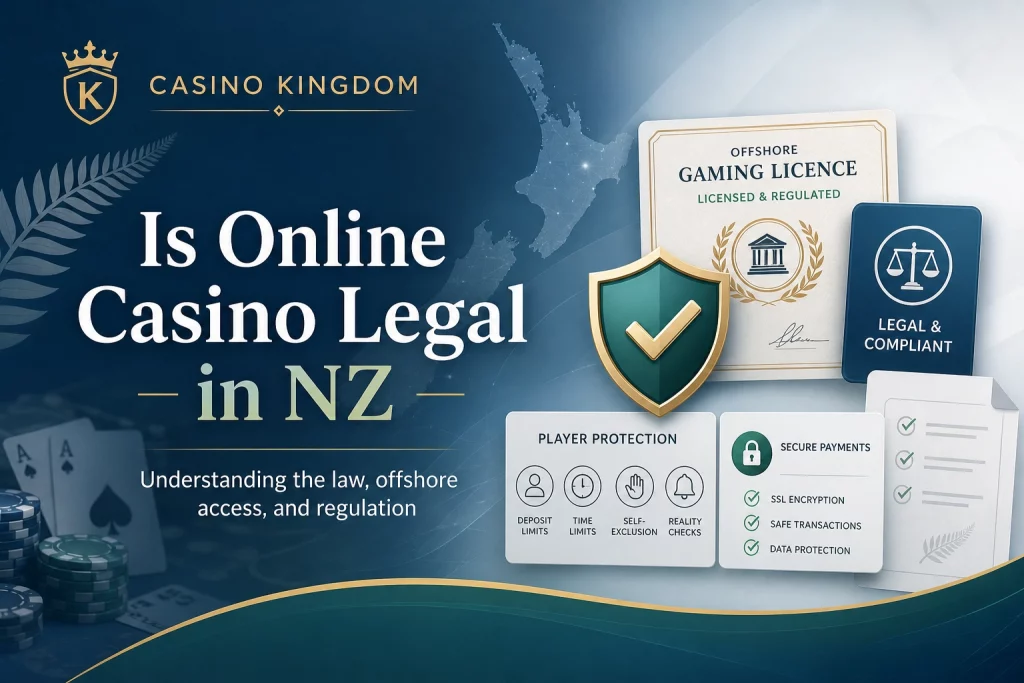
The legal picture is also changing. The Department of Internal Affairs now states that online casino gambling is regulated by the Online Casino Gambling Act 2026, and implementation of the new law has started. This means the older “offshore-only” practical environment is moving toward a controlled licensing model. However, until the licensing system is fully operating, readers should be careful with outdated claims, especially content that presents offshore casino access as if it were the same as full local approval.
| Legal Question | NZ Position | What It Means for Readers |
|---|---|---|
| Can a New Zealand company freely run an online casino? | No, remote interactive gambling has historically been restricted unless a legal exception applies. | A local online casino cannot operate casually without fitting the legal framework. |
| Can NZ residents see offshore casino websites? | Yes, offshore gambling websites have been accessible, and overseas gambling is treated differently. | Access does not mean the site is locally regulated by New Zealand authorities. |
| Are offshore casinos protected by NZ law? | Not in the same way as locally regulated gambling products. | Disputes may depend on the operator, its foreign licence, and its complaint procedures. |
| Is the law changing? | Yes, the Online Casino Gambling Act 2026 introduces a regulated framework. | Older online information may be incomplete or outdated. |
| Should players rely only on casino marketing? | No, advertising and legal status are separate issues. | Official sources and responsible gambling guidance should be checked first. |
Why the NZ Online Casino Question Is Often Misunderstood
The confusion around online casino legality in New Zealand usually comes from mixing three separate ideas: playing, operating, and advertising. A person may ask whether online casino activity is legal, but that question can refer to several different actions. Running an online casino from New Zealand is not the same as visiting an overseas website. Advertising an overseas casino to New Zealanders is not the same as writing an informational article about gambling law. Holding a foreign licence is not the same as being licensed by New Zealand.
This is why an accurate page needs to avoid blunt wording. A phrase like “online casinos are legal in NZ” is too broad. It can make readers think New Zealand already treats all online casinos as locally approved and protected. A phrase like “online casinos are illegal in NZ” can also be misleading if it ignores the offshore distinction explained by the Department of Internal Affairs. The correct position is more balanced: domestic remote interactive gambling has been restricted, offshore gambling has existed outside the same local framework, and New Zealand is now moving toward a more formal online casino licensing system.
For Casino Kingdom, the page should frame this as a legal and consumer-awareness guide, not as a promotional page. The goal is to help readers understand the framework before they interpret casino reviews, bonus pages, payment claims, or app guides. A legal page should explain risk, not hide it behind marketing language. If a site claims fast payments, large promotions, or simple access, those claims still need to be assessed against licensing, terms, identity verification, and dispute-handling standards.
This is also where internal navigation can be used carefully. A Login page can explain account access and security. A Bonus page can explain promotional terms and wagering conditions. A Sign up page can describe registration checks without implying guaranteed approval. An App page can discuss mobile access and privacy. Slots and Games pages can describe game categories in an informational way. A FAQ page can answer legal and safety questions directly, while Links can guide users to broader informational resources and responsible gambling support.
The Difference Between Legal Access and Local Protection
A key mistake in many gambling articles is treating website access as proof of safety. The internet makes offshore casino platforms easy to find, but visibility does not equal local accountability. A website may accept New Zealand traffic, display NZD payment options, and offer familiar game categories, yet still operate from a foreign jurisdiction. If the operator is not licensed under a New Zealand framework, the player’s protection depends heavily on the operator’s own rules and the regulator in the country where the site is licensed.
This difference becomes important when problems occur. For example, if an account is frozen after verification, the user may need to follow the operator’s complaint process. If a withdrawal is delayed, the timeline may depend on offshore payment processors. If a bonus term is unclear, the interpretation may be controlled by the operator’s terms and conditions. If a game result is disputed, the complaint may need to go through a foreign regulator or testing body. None of these scenarios should be presented as simple or guaranteed.
The new regulatory direction in New Zealand aims to address some of these gaps by creating a licensing framework. According to official DIA information, online casino gambling is now regulated by the Online Casino Gambling Act 2026, and implementation work has started. That does not mean every online casino visible in New Zealand is automatically approved. It means the country is moving toward a controlled model where licensing, compliance, harm minimisation, and enforcement will become more structured.
For a reader, the practical takeaway is not “all online casinos are safe” or “all online casinos are forbidden.” The better takeaway is that legal context matters. A responsible user should separate offshore availability from domestic approval, check whether information is current, and avoid relying only on casino advertising. In legal terms, the location of the operator, the type of gambling product, the advertising method, and the applicable licence all matter.
Main Legal Factors Behind Online Casino Status in NZ
Why the 2026 Framework Matters
The 2026 regulatory shift is important because it changes the future direction of online casino gambling in New Zealand. Previously, the practical discussion focused mainly on the gap between prohibited domestic remote interactive gambling and offshore access. The new framework is designed to bring online casino activity into a more controlled legal structure. This should make licensing, compliance expectations, advertising restrictions, and consumer protection more visible over time.
However, a new law does not instantly remove every risk. Implementation matters. Licensing criteria, enforcement powers, technical standards, responsible gambling obligations, and advertising controls all need to be applied in practice. Readers should therefore be cautious with any claim that treats 2026 as a simple switch from “illegal” to “fully safe.” Regulation can improve oversight, but it does not remove the need to read terms, understand risk, and use official sources.
For SEO purposes, this section is useful because it answers the real search intent behind “Is online casino legal in NZ?” People are not only asking about the law. They are also asking whether they can trust what they see online, whether offshore operators are allowed, whether New Zealand has its own licensing system, and whether the rules are changing. A strong page should answer all of those points instead of repeating a one-line legal claim.
Offshore Online Casinos, NZ Players, and the Grey Area
The biggest misunderstanding around online casino legality in New Zealand comes from the offshore market. Many websites that appear in search results are not based in New Zealand, are not operated by a New Zealand casino licence holder, and are not directly supervised under the same local rules that apply to domestic gambling providers. This is why the term “grey area” appears so often in discussions about NZ online casino law.
A grey area does not mean something is automatically safe. It also does not mean the same thing as a fully illegal black market. In New Zealand’s older framework, the key distinction was between providing remote interactive gambling from within New Zealand and accessing gambling services conducted overseas. The Department of Internal Affairs states that remote interactive gambling in New Zealand is prohibited under the Gambling Act 2003, while gambling conducted overseas is not prohibited, apart from betting on racing and sporting events. That difference has shaped the online casino environment for many years.
For a reader, this means the legal question should be framed carefully. A New Zealand resident may encounter offshore casino websites online, but that does not mean those websites are locally approved, locally licensed, or locally protected. Offshore platforms may operate under foreign rules, foreign complaint systems, and foreign business standards. Some may be licensed in recognised jurisdictions; others may provide limited transparency. The practical risk is that a user may assume local protection exists when it does not.
This is also why responsible legal content should avoid treating offshore access as a recommendation. The purpose of this page is to explain the framework, not to encourage gambling. Online casino activity carries financial risk, and legal status is only one part of the issue. The other parts include identity checks, withdrawal policies, dispute procedures, software fairness, data security, advertising rules, responsible gambling tools, and whether the operator falls under a regulator that can realistically enforce standards.
| Offshore Casino Issue | Why It Matters in NZ | Risk for Readers |
|---|---|---|
| Operator location | The casino may be based outside New Zealand. | NZ authorities may not directly supervise the operator. |
| Foreign licence | A licence may come from another jurisdiction. | Rules and complaint procedures may differ from NZ expectations. |
| Payment handling | Deposits and withdrawals may depend on offshore processors. | Delays, checks, or limits may be harder to challenge locally. |
| Bonus terms | Promotional terms may be written under foreign standards. | Wagering rules, withdrawal caps, and exclusions may be strict. |
| Consumer protection | Local remedies may be limited. | Disputes may need to be handled through the operator or foreign regulator. |
Why Offshore Access Is Not the Same as NZ Licensing
A major reason readers search for “Is online casino legal in NZ?” is that they see offshore casino platforms using New Zealand-facing language. A website may mention NZD, New Zealand players, fast withdrawals, mobile access, or casino games that are familiar to local users. However, those signals should not be confused with local licensing. A site can be accessible from New Zealand without being approved under a New Zealand online casino licence.
This distinction becomes especially important in 2026 because the legal environment is changing. The Department of Internal Affairs now states that online casino gambling is regulated by the Online Casino Gambling Act 2026 and that implementation of the new law has started. DIA also states that it is legal for New Zealanders to gamble on offshore casino gambling websites, while online casinos based in New Zealand are illegal. That official wording shows why the topic needs careful explanation rather than a simple slogan.
The practical meaning is that New Zealand is moving from an offshore-dominated environment toward a more controlled licensing model. This does not automatically make every existing offshore website safe or approved. It means regulation is being developed to create a safer, fairer, and more controlled online gambling environment. Until readers can clearly identify which operators are licensed under the new domestic framework, offshore status remains a major consumer-awareness issue.
For Casino Kingdom, the strongest editorial approach is to explain this transition clearly. The page should not pretend that offshore casinos never existed. It should also not present offshore access as equal to full domestic regulation. Instead, the article should explain the difference between availability, legality, licensing, and protection. Those four words are close in everyday language, but they are very different in gambling law.
The Main Risks Linked to Offshore Online Casinos
The first risk is weak dispute control. If a player has a problem with a locally regulated service, there is usually a clearer path through domestic rules, complaint bodies, or regulator guidance. With offshore casinos, the path may be less predictable. The user may need to contact the operator, wait for internal review, escalate to a foreign regulator, or rely on terms written outside New Zealand.
The second risk is unclear promotional language. Online casinos often use bonus wording that looks simple at first glance but becomes complex in the terms. Wagering requirements, maximum bet rules, game weighting, withdrawal limits, expiry dates, excluded games, and verification conditions can all affect whether a promotion has any practical value. A legal page should make clear that promotional claims are not the same as consumer protection.
The third risk is payment friction. Offshore payment systems may involve international processors, currency conversion, bank checks, anti-money-laundering review, or extra identity verification. Even when a website advertises fast withdrawals, the actual result can depend on account status, payment method, document checks, and operator policy. This is why legal and safety content should separate marketing claims from operational reality.
The fourth risk is harm minimisation. New Zealand gambling law has a strong focus on preventing and minimising gambling harm. Offshore websites may offer responsible gambling tools, but the quality, enforcement, and accessibility of those tools can vary. A user should not assume that every platform applies limits, time-outs, self-exclusion, affordability checks, or support referrals in the same way.
Why Advertising Rules Matter
Advertising is one of the most sensitive parts of the online casino legality question. A person reading about the law may only be trying to understand the framework, but operators and affiliates may use similar content to promote gambling products. That is why NZ-focused casino content needs careful wording. There is a difference between explaining the legal position and actively encouraging people to use offshore gambling services.
The Department of Internal Affairs’ prohibited gambling guidance explains that remote interactive gambling conducted in New Zealand is prohibited and that the prohibition includes a New Zealand casino website. It also states that gambling conducted overseas is not prohibited, apart from racing and sporting events. This creates a strict line around domestic operation and a separate issue around how overseas gambling is promoted to New Zealanders.
For Casino Kingdom, this means the page should stay informational. It should answer legal questions, explain risks, and direct readers toward official understanding rather than overstating benefits. Claims such as “legal NZ online casino” or “fully approved for New Zealand players” should be used only when they match the current licensing reality. Before the new regime is fully operational, that kind of wording can easily become misleading.
A safer content structure is to say that New Zealand has historically restricted domestic remote interactive gambling, that offshore gambling has occupied a different legal position, and that the Online Casino Gambling Act 2026 introduces a new regulatory direction. This gives readers a more accurate view and reduces the chance that the page sounds like legal approval for every offshore operator.
How the 2026 Licensing Shift Changes the Conversation
The Online Casino Gambling Act 2026 is important because it moves New Zealand toward a more formal online casino market. Instead of leaving most online casino activity in an offshore environment, the new framework is intended to regulate online casino gambling directly. DIA describes the implementation goal as creating a safe, fair, and well-controlled online gambling environment for New Zealanders.
This changes the conversation from “Can offshore casinos be accessed?” to “Which operators are licensed, supervised, and compliant under New Zealand’s new rules?” That is a much stronger consumer-protection question. Licensing can create clearer obligations around player safety, technical standards, advertising, anti-money-laundering checks, responsible gambling tools, and enforcement. However, those benefits depend on the details of implementation and the conduct of individual operators.
Readers should also understand that regulatory transition periods can be confusing. Old articles may say one thing, new government updates may say another, and casino websites may adjust their wording quickly for commercial reasons. This is why current official sources should be treated as more reliable than outdated casino marketing pages. The law is changing, and the wording used in content should change with it.
From an SEO perspective, this section helps answer a deeper search intent. People are not only asking whether online casino gambling is legal. They are asking whether New Zealand is still in a grey market, whether offshore sites are treated differently, whether new licences are coming, and whether existing casino sites are safe to use. The answer must explain that the legal framework is shifting, but caution remains necessary.
Player Protection Should Come Before Convenience
Online casino pages often focus on convenience: quick registration, mobile access, casino apps, payment speed, and game variety. A legal page should reverse that order. Protection should come before convenience. Before a reader considers any practical feature, they should understand who regulates the operator, what complaint routes exist, how identity checks work, how payments are controlled, and what responsible gambling protections apply.
This is particularly important in New Zealand because the older offshore environment placed much of the burden on the user. A person had to interpret licensing badges, terms and conditions, support quality, payment rules, and withdrawal limits independently. The new regulatory model should reduce some of that uncertainty over time, but it does not remove the need for caution.
A proper Casino Kingdom legal page should therefore avoid language that makes gambling sound frictionless. Friction is sometimes part of protection. Identity checks can prevent fraud. Withdrawal reviews can support anti-money-laundering compliance. Spending limits can reduce harm. Clear advertising limits can prevent misleading claims. The issue is not whether a casino is fast or flashy; the issue is whether it operates within a framework that can be checked and enforced.
In practical terms, the reader should leave this section understanding one core message: offshore access has existed, but offshore access is not the same as local licensing. The 2026 framework is designed to change the market, but until a reader can confirm licensing and protections through official channels, the safest interpretation is cautious and informational.
Licensing, Regulation, Tax, and Player Responsibility
The legal question around online casinos in New Zealand is not only about whether a website can be accessed. A stronger question is whether the operator is licensed, regulated, accountable, and subject to standards that protect users. Licensing is the part of gambling law that turns a general activity into a controlled market. Without licensing, a website may still appear professional, but readers have fewer ways to verify who stands behind it and what obligations the operator must follow.
In New Zealand, the historic framework limited domestic online casino operation, while offshore access existed in a different position. The newer regulatory direction changes the future shape of the market by moving toward direct licensing of online casino gambling. That does not mean every visible website automatically becomes legal, trusted, or locally approved. It means that the country is building a more formal structure where selected operators can be assessed, authorised, monitored, and penalised if they fail to meet standards.
For Casino Kingdom readers, this point should be central. Legal status should never be reduced to a marketing phrase. A casino that says it “accepts New Zealand players” is not necessarily the same as a casino that is legally licensed under a New Zealand framework. A casino that displays payment logos is not necessarily safer than one that explains its licence, responsible gambling tools, complaint process, withdrawal rules, and verification requirements in plain language. The real value of regulation is transparency, not decoration.
A good legal page should therefore teach readers how to think about licensing. It should explain the difference between domestic approval, offshore authorisation, foreign licensing, and unverified claims. It should also explain why regulation matters for payments, disputes, advertising, data protection, game fairness, and harm minimisation. These are not small details. They are the foundation of whether an online gambling environment can be considered controlled.
| Regulatory Element | What It Should Control | Why It Matters for NZ Readers |
|---|---|---|
| Licensing | Who is allowed to offer online casino gambling. | It separates authorised operators from unapproved or unclear platforms. |
| Technical standards | Game fairness, RNG testing, security, and platform reliability. | Readers can better understand whether games are independently checked. |
| Payment rules | Deposits, withdrawals, identity checks, and anti-fraud controls. | It reduces uncertainty around locked accounts, delayed payouts, or unclear limits. |
| Advertising rules | How gambling products may be promoted to the public. | It helps prevent misleading bonus claims or aggressive promotional pressure. |
| Responsible gambling duties | Limits, exclusions, safer gambling tools, and harm-prevention measures. | It shifts the market away from pure promotion and toward user protection. |
Why Licensing Matters More Than Website Appearance
Online casino websites often look polished. They may use professional design, mobile-friendly layouts, live chat widgets, game provider logos, large promotional banners, and security badges. None of those elements should be treated as proof of legal approval. Design can make a platform look credible, but regulation determines whether the operator is accountable.
This distinction matters because gambling websites are built to create confidence quickly. A reader may see a clean homepage, a familiar payment method, a large game library, or a bonus offer and assume that the platform is properly supervised. But trust should not be based on surface signals alone. It should be based on verifiable licensing, clear ownership, transparent terms, responsible gambling tools, and realistic complaint routes.
A New Zealand-focused legal page should make that difference explicit. A casino may be offshore, locally licensed in the future, or operating under a foreign licence. Each category creates a different level of certainty. The safest content approach is to avoid treating all casinos as equal. A regulated operator should be described differently from an offshore website that merely accepts traffic from New Zealand.
The licensing question also affects how other parts of a casino website are interpreted. A payment page means more when the operator has enforceable withdrawal obligations. A bonus page means more when advertising and promotional terms are regulated. A game page means more when game fairness is independently tested. A support page means more when complaints can be escalated outside the operator’s own customer service system.
What a Regulated Online Casino Framework Should Improve
A regulated online casino framework should improve market clarity. Instead of readers guessing whether a website is legitimate, they should be able to check whether the operator holds a valid licence, what entity owns it, what rules apply, and which authority supervises it. That kind of clarity reduces confusion and makes legal content more useful.
It should also improve responsible gambling standards. Online casino products are continuous, private, and available on mobile devices, which can increase risk for some users. A serious regulatory framework should require meaningful safeguards such as deposit limits, reality checks, time-outs, self-exclusion options, visible support information, and restrictions on harmful promotional practices. These tools do not remove risk, but they make the environment more controlled.
Payment transparency is another important area. Many complaints about online casinos involve withdrawals, account verification, bonus restrictions, or delayed processing. A regulated model should create clearer expectations around identity checks, anti-money-laundering review, payout timelines, account closure, and communication. Readers should understand that verification is not automatically a bad sign. It can be part of compliance. The problem appears when rules are unclear, inconsistent, or used unfairly.
A regulated framework should also improve advertising standards. Online gambling promotion can easily become misleading if it focuses only on bonuses, jackpots, or speed. A responsible market needs limits on how products are advertised, especially where vulnerable people could be affected. The language used on casino websites should be clear, balanced, and not built around unrealistic expectations.
How Regulation Reduces Risk Areas
Tax and Gambling Winnings in New Zealand
Tax is another area where online casino content often becomes too broad. In general, casual gambling winnings in New Zealand are not usually treated like ordinary income for recreational players. However, tax treatment can depend on the facts. If a person is gambling as a business or in a systematic professional way, the situation may be different. Because of that, a responsible legal page should avoid giving personal tax advice and should encourage readers to check official tax guidance or speak to a qualified adviser if their situation is complex.
For most ordinary readers, the practical point is that gambling tax is not the same as casino legality. A person may ask whether winnings are taxed and assume that this answers whether the platform is legal. These are separate questions. Tax rules concern income treatment. Gambling law concerns whether an activity is authorised, prohibited, licensed, advertised, or regulated. A page about legality should keep those categories separate.
This is especially important with offshore casinos. If funds move through offshore payment systems, crypto wallets, e-wallets, or bank transfers, the legal, tax, and banking implications may not be identical. A casino website may not explain those issues fully. A payment method may work technically, but that does not automatically mean every financial, tax, or regulatory question is resolved.
Casino Kingdom should therefore present tax information cautiously. The correct editorial tone is informative and limited: casual gambling winnings may not normally be taxable, but individual circumstances matter, and tax advice should come from official or professional sources. This avoids misleading readers and keeps the article aligned with responsible information standards.
Why Responsible Gambling Is Part of the Legal Conversation
Responsible gambling is not separate from legality. It is one of the reasons gambling law exists. The purpose of regulation is not only to decide who may operate, but also to reduce harm, protect vulnerable users, and make gambling environments more accountable. Any article about online casino legality in New Zealand should include this point clearly.
Online casino gambling can carry specific risks because it is private, fast, and accessible from personal devices. There is no physical venue boundary, no travel requirement, and often no obvious break between sessions. This is why responsible gambling tools matter. Deposit limits, session reminders, time-outs, self-exclusion, reality checks, and access to support services are not decorative features. They are part of the safety structure.
A responsible page should also avoid presenting gambling as a solution to financial problems. It should not imply that casino games are income tools, investment products, or reliable ways to recover losses. Online casino games are designed around chance and house edge. Even where games are fair and regulated, the mathematical structure favours the operator over time. That reality should not be hidden behind entertainment language.
For NZ readers, the key protection principle is simple: legality does not remove risk. A licensed market can reduce some risks, but it cannot make gambling risk-free. A user still needs limits, awareness, and the ability to stop. Legal regulation provides a framework, but personal control and harm minimisation remain essential.
What Readers Should Check Before Trusting Legal Claims
Readers should be careful with any website that uses broad phrases such as “fully legal in New Zealand,” “approved for NZ players,” or “guaranteed safe.” Those claims need context. Approved by whom? Licensed where? Regulated under which law? Protected by which complaint process? Subject to which advertising rules? Without answers to those questions, the phrase is not very useful.
A more reliable page should teach readers to look for specific information. The operator should identify its legal entity, licensing jurisdiction, complaint process, responsible gambling tools, payment rules, privacy policy, bonus terms, and game fairness information. If those details are missing, vague, or difficult to find, the reader should treat the platform with caution.
The same standard should apply to review websites and affiliate pages. A review should not only repeat casino claims. It should explain uncertainty, identify limits, and separate legal facts from marketing descriptions. If a page discusses offshore access, it should say clearly that offshore availability is not the same as New Zealand licensing. If it discusses the new regulatory framework, it should avoid implying that every operator has already been approved.
For Casino Kingdom, this is important for credibility. A strong legal page does not need exaggerated language. It should be precise, cautious, and useful. The reader should finish the section with a clearer understanding of the framework, not just a list of casino features.
Practical Interpretation for NZ Readers
The practical interpretation is that New Zealand’s online casino environment has moved from a confusing offshore-access model toward a more regulated future. Historically, local operation of online casino gambling was restricted, while overseas gambling websites could still be encountered by NZ users. The new framework changes the direction by creating a structure for regulated online casino gambling.
That shift should improve clarity, but readers still need to distinguish between four different ideas: accessible, legal, licensed, and safe. A website can be accessible without being licensed locally. A foreign licence may provide some oversight, but it is not the same as a New Zealand licence. A regulated operator may be safer than an unregulated one, but gambling still involves financial risk. Safety is not a single label; it is a combination of law, oversight, transparency, payment control, fairness, and responsible gambling support.
Final Legal Interpretation, Future Outlook, and Safe Reading of Casino Claims
The clearest answer to “Is online casino legal in NZ?” is this: New Zealand has historically restricted domestic online casino operation, while offshore casino access has existed in a separate legal position. That means the question cannot be answered properly without explaining who operates the website, where it is licensed, how it is promoted, and whether it falls under New Zealand’s developing online casino framework.
For a reader, the practical answer is not “everything is legal” and not “everything is illegal.” The correct answer is conditional. If an operator is based in New Zealand and offers remote interactive casino gambling without fitting the legal framework, that is a serious legal problem. If a New Zealand resident accesses a gambling website operated overseas, the legal position has been treated differently, but that does not automatically mean the site is locally regulated, safe, or protected by New Zealand authorities.
This distinction is important because online casino marketing often removes nuance. A website may say that it accepts New Zealand players, supports NZD, offers fast payments, or provides popular casino categories. Those details may describe access or convenience, but they do not prove local approval. A user should always separate four ideas: visibility, availability, licensing, and protection. A website can be visible without being authorised locally. It can be available without being supervised by New Zealand. It can hold a foreign licence without offering the same protections as a domestic framework. It can look safe while still creating dispute risks.
The Online Casino Gambling Act 2026 changes the long-term picture by introducing a regulated model for online casino gambling. This should make the market easier to understand over time, especially if official licensing information becomes clear and accessible to the public. However, regulation is not useful only because it allows operators to exist. Its real value is that it sets standards. Those standards should affect advertising, compliance, harm minimisation, payment transparency, dispute handling, and technical fairness.
| Final Question | Careful Answer | Reader Takeaway |
|---|---|---|
| Is every online casino legal in NZ? | No. Legal status depends on location, licensing, operation, and applicable rules. | A broad “legal casino” claim should always be checked. |
| Can NZ players access offshore casinos? | Offshore gambling has been treated differently from domestic operation. | Access does not equal New Zealand supervision. |
| Does a foreign licence protect NZ users? | It may provide some oversight, but it is not the same as local NZ regulation. | The complaint route may depend on a foreign regulator or operator policy. |
| Will the 2026 framework improve clarity? | Yes, it is intended to create a regulated online casino market. | Readers should follow official updates rather than old casino claims. |
| Is legality the same as safety? | No. Gambling always carries financial and behavioural risk. | Regulation can reduce risk, but it cannot remove it completely. |
How to Read Online Casino Legal Claims
When a casino page says “legal in New Zealand,” the reader should pause and ask what that phrase means. It may mean that the website accepts New Zealand traffic. It may mean that the operator has a foreign licence. It may mean that the content writer is using broad SEO language without explaining the law. It may also mean that the operator is preparing for the new regulatory framework, but has not yet received local approval. These are very different meanings.
A stronger legal claim should identify the regulator, the licence type, the operating entity, and the rules that apply. It should not rely only on vague phrases like “trusted,” “secure,” “approved,” or “NZ friendly.” Those words can be useful in marketing, but they are weak as legal evidence. The more serious the claim, the more specific the proof should be.
Readers should also be cautious with pages that focus only on bonuses and do not explain restrictions. Bonus language can make a platform appear more attractive than it really is. Wagering requirements, maximum bet rules, excluded games, withdrawal limits, identity checks, and expiry dates can all affect whether a promotion is useful. A legally careful article should explain that promotional value depends on terms, not headline numbers.
The same applies to payment claims. Fast deposit processing does not prove a casino is safe. A visible payment logo does not prove that withdrawals will be simple. A payment page should be read together with verification terms, withdrawal limits, anti-money-laundering procedures, and account-review policies. In regulated gambling, friction is not always negative. Some checks exist to prevent fraud, underage access, money laundering, and harm.
What NZ Readers Should Avoid
Readers should avoid treating offshore availability as a guarantee of safety. If a website is not clearly licensed under a framework that applies to New Zealand users, the user may have fewer remedies if problems arise. That does not mean every offshore operator is dishonest, but it does mean the reader should be realistic about risk.
Readers should also avoid relying on outdated legal summaries. New Zealand’s online casino law is changing, and older articles may not reflect the Online Casino Gambling Act 2026 or the implementation process. A page written before the new framework may still explain the older offshore-access model, but it may miss the direction of current regulation. For that reason, official sources should be checked when legal accuracy matters.
Another thing to avoid is assuming that casino design proves trust. A polished website can still have weak terms. A modern mobile interface can still have poor withdrawal rules. A large game library can still sit behind unclear ownership. A strong brand name can still operate under foreign standards. Trust should be based on verifiable structure, not appearance.
Finally, readers should avoid viewing gambling as a financial strategy. Online casino games are entertainment products with risk. Even where software is tested and regulated, the house edge remains part of the model. A legal page should never imply that casino play is a reliable way to earn money, recover losses, or solve financial pressure. That would be misleading and harmful.
What a Safer NZ Online Casino Market Should Look Like
A safer New Zealand online casino market should be transparent first. Readers should be able to see which operators are licensed, what rules they follow, who supervises them, and how complaints are handled. Licence information should be easy to verify, not hidden in small footer text or vague legal pages.
The market should also be controlled in how it advertises. Responsible advertising should not pressure users, exaggerate winning chances, or hide difficult terms. Bonus claims should be clear and proportionate. Any mention of free spins, deposit matches, cashback, or VIP offers should be accompanied by visible conditions. A regulated market should make promotional language easier to understand, not harder.
Payment standards should also improve. A safer market should make deposits, withdrawals, verification, fees, and limits clear before a user commits funds. Operators should not advertise speed while hiding review conditions. If documents are required, the process should be explained. If withdrawals have limits, those limits should be visible. If bonus use affects payout eligibility, that should be clear before the promotion is accepted.
Responsible gambling should be treated as a core legal requirement, not a footer link. A safer market should provide limits, time-outs, self-exclusion, session reminders, accessible help information, and clear ways to reduce or stop gambling. The tools should be easy to find and difficult to bypass. A serious operator should not make protection feel like an afterthought.
Practical Summary for Casino Kingdom Readers
For Casino Kingdom, the responsible answer is that online casino legality in New Zealand depends on context. Domestic operation has historically been restricted. Offshore access has existed, but offshore access is not the same as local licensing. The new 2026 framework is intended to create a regulated online casino market, but readers still need to check whether a specific operator is actually authorised, transparent, and accountable.
This article should not be read as legal advice or as encouragement to gamble. It is a consumer-information guide. Its purpose is to explain the difference between access and regulation, between foreign licensing and local oversight, and between casino marketing and real protection. Those distinctions matter because online gambling can create financial and behavioural risk.
The safest interpretation is this: New Zealand is moving toward a clearer legal structure, but users should remain cautious with broad claims. A casino website should be judged by licensing, ownership, complaint procedures, responsible gambling tools, payment rules, and transparency. If those details are missing or vague, the reader should not rely on marketing language alone.
In the end, the question “Is online casino legal in NZ?” leads to a more useful answer: online casino gambling in New Zealand is legally specific, not generic. The law treats domestic operation, offshore access, advertising, licensing, and protection differently. Anyone reading about the topic should understand those differences before forming a conclusion.
Final Compliance Checklist for the Page
A strong page on this topic should finish with a clear checklist. This helps readers understand what to verify without turning the article into a promotional guide. It also reinforces that legality is not the same as safety.
The first item is licensing. The reader should check whether the operator is licensed, where the licence comes from, and whether the licence applies to New Zealand users. A licence displayed on a website should be verifiable through the regulator, not only through the casino’s own footer.
The second item is ownership. A trustworthy platform should identify the company behind the website. Hidden ownership or unclear corporate details make it harder to resolve complaints. If a site avoids naming its operator, that is a warning sign.
The third item is payment transparency. Withdrawal limits, processing times, verification checks, fees, and bonus-related restrictions should be clearly explained. If payment information is vague, the reader should assume there may be friction later.
The fourth item is responsible gambling. A serious operator should provide practical protection tools, not only slogans. Deposit limits, time-outs, self-exclusion, reality checks, and access to support resources should be visible and usable.
The fifth item is legal accuracy. Any article or casino page discussing New Zealand should reflect the current legal transition, not rely only on old descriptions of offshore access. Because the regulatory environment is changing, readers should treat fresh official guidance as more reliable than recycled marketing text.
| Checklist Item | What to Look For | Why It Matters |
|---|---|---|
| Licence verification | Clear regulator name, licence number, and official confirmation route. | It helps confirm whether the casino is actually authorised. |
| Operator identity | Company name, registered address, ownership details, and support information. | It makes accountability easier if a dispute appears. |
| Payment rules | Withdrawal limits, review times, fees, and verification requirements. | It reduces surprise delays or blocked withdrawals. |
| Bonus conditions | Wagering, maximum bet size, excluded games, expiry dates, and payout caps. | It prevents misunderstanding of promotional offers. |
| Responsible gambling tools | Limits, time-outs, self-exclusion, support links, and reality checks. | It supports safer use and harm prevention. |
Closing Answer: Is Online Casino Legal in NZ?
Online casino gambling in New Zealand should be understood through a legal distinction. Locally operated remote interactive casino gambling has historically been restricted. Offshore casino access has been treated differently, but it does not automatically provide local licensing, local supervision, or local complaint protection. The Online Casino Gambling Act 2026 changes the direction by creating a regulated framework, but readers should still check current official information before relying on any casino claim.
So the most accurate final answer is: online casino legality in NZ is conditional. It depends on whether the activity involves domestic operation, offshore access, advertising, licensing, and the new regulatory framework. A casino being accessible from New Zealand does not prove it is locally regulated. A foreign licence may provide some oversight, but it is not the same as New Zealand approval. A new local framework can improve safety, but it does not remove gambling risk.
For Casino Kingdom, this page should therefore present itself as a legal and safety guide. It should explain the facts, avoid exaggerated claims, and remind readers that gambling involves risk. The strongest conclusion is not promotional. It is practical: check the legal status, verify the licence, read the terms, understand the limits, and treat online casino activity as a regulated-risk environment rather than a simple entertainment category.






Comments